


AR Sponsor


The Trouble With 3-Shot Groups (Page 5 of 12)


But it does seem to be a surprisingly close approximation, in both directions. I went back through the pages of this thread and found 39 10-shot groups that you had computed the mean radius for, or were part of a 30-shot composite that you computed the mean radius of. The average difference between ES/3 and MR was .065", with the highest being .21" and 22 of the 32 under .1" difference. For the 11 sets of 3 groups you made composites from the difference between AvgES/3 and MR averaged only .044" and the maximum difference of .11" was the only one greater than .08" different. So the question then is whether a difference of .04-.07" between the estimated MR and the actual MR is significant and worth the effort of computing the actual MR?
Statistics aside, how do you input the groups to RSI Shooting Lab? IIRC you said it didn't need a scanner. You're not measuring each x,y location like you described on page 6 are you? |

Wow, there's that many!  Keep in mind that most of those groups did have a reasonably normal distribution. Keep in mind that most of those groups did have a reasonably normal distribution.
A difference in mean radius of 0.21" at 100 yards would equate to a difference of 0.63" for extreme spread at 100 yards. There are those who would consider that to be a significant difference, and again this is from groups that had a fairly normal distribution.
Keep in mind this is akin to using Hatcher's rule in reverse. I haven't really done any testing to see how valid this concept is. (I did the one example on page 7 and I won't be doing that again until I can find a software program that computes a true two dimensional radial standard deviation from a screen input target.)
Calculating the mean radius with RSI Shooting Lab is a breeze. After carefully calibrating the program to your monitor, you simply hold the target up to the monitor and "enter" each shot on the target into the computer by clicking the mouse controlled crosshairs on each bullet hole in the target. The program does the rest. It can become difficult when entering groups in which shots start to form one ragged hole. This happens when I'm entering 10-shot groups from my Krieger barrels. I often have to look at the shot group under magnification to find a partial circumference of the individual bullet holes to determine their location. |

 Wow, Krieger barrels... I'm just happy to be on the black at 100 yards. Wow, Krieger barrels... I'm just happy to be on the black at 100 yards.
|
"You cannot conquer a free man. The worst you can do is kill him." RAH
Actually, the group that I like to use for bragging rights (pictured below) doesn't even start to form a ragged hole. What it does show in a single 10-shot group is the complete radial deviation of the barrel/ammunition combination. Kind of cool.  (Too bad I couldn't shoot another group like this if my life depened on it.) (Too bad I couldn't shoot another group like this if my life depened on it.) |
|
Nice original post!!!!!!!!!!!!! Agreed on the methodology and base thinking about "Accuracy". What I'm noticing is not related to pure mechanical accuracy. The M-16/AR is a practical rifle, and NOT a benchrest "Dragrifle" (Lest that I offend lesBaer with a refference to "Racegun"..) used and designed, simply to illustrate the controll of mechanical variables in competition, while amoung like minded rifle Geeks. Off the shoulder, and supported by the sling or less, the M-16/AR shines at practical ranges. Do we really have to keep trying to enter the Family sedan at Daytona at each and every turn? The thing flat out shoots! We all know it! Get out, get muddy with your arse on the ground while shooting, and learn the stupid thing. Numbers off of the rest are nice. Hitting unsupported is real. S-28 |
Actually, no. While there is "not a single shot near the center" of the group, all of the shots are very close to being the same distance from the center of impact of a small group; there are no outlyers. This group has a very good mean radius of 0.27". (This is also an example where Hatcher's one-third rule doesn't work real well because the group doesn't show a normal distribution.)  |
|
Recently, while testing the accuracy of my Urban RECCE, I suffered a relapse of Inner Internet Commando Syndrome (I.I.C.S.). You too may suffer from I.I.C.S. if you exhibit the following signs and symptoms: A. You know in your brain that firing 3-shot groups is of little value in evaluating the accuracy of a particular rifle and ammunition, but... B. You feel compelled to fire a 3-shot group anyways, and... C. You post your 3-shot group on an Internet Forum. Firing from a bench-rest at 100 yards I obtained a 3-shot group from my Urban RECCE that measured 0.33”. So do I have a “third of a minute of angle rifle”? (By now, I’m sure you know the answer to that.)  My Urban RECCE is built around a 16” Colt HBAR. Even though these barrels are chrome lined and NATO chambered, they are one of the most accurate “off the shelf” barrels that I have come across. That being said they are hardly “third of a minute of angle” barrels.  Using hand-loaded 52 grain Sierra MatchKings I obtained three 10-shot groups at 100 yards from this rifle that measured as follows: 0.85” 0.88” 1.14” Over-laying the three 10-shot groups on each other using RSI Shooting Lab software produced a 30-shot composite target with a mean radius of 0.32”. Not too shabby for an “off the shelf” barrel. Here is a pic of the best 10-shot group as well as one of the 30-shot composite group.   |
|
I don't claim to be much good with statistics, but wanted to comment on this thread. There's a lot of good, useful info here. Many shooters change their cheek weld and other interfaces with the gun between groups. I feel like these inconsistencies account for many of the roving groups talked about. Personally, while I have fired three shot groups on occassion, my norm is an average of five, 5 shot groups. Even an average of five, 3 shot groups is meaningful though. Two other things need to be taken into account. First is shooter fatigue when firing extended strings. This is especially apparent when using iron sights for extended group shooting. The second pertains mostly to bolt guns. With the possible exception of varmit rifles, most bolt gun owners are concerned with what the rifle does from a cold barrel. Anyone here ever tried to fire a 10 round group out of their lightweight hunting rifles (lotsa powder) on a hot summer day??? It should also be said to the guys shooting small groups that "opened to 3/4" all of a sudden", wind is not your friend and can easily account for this. Just a few thoughts on the subject from someone who has fired many groups over the years... |
|
I would like to comment on the FF versus non-FF carbine barrel test on page 8. I think it doesn't really show much, when you fire groups from two different barrels. We now know that the barrels shoot differently, but we don't know if it's because of FF vs non-FF or if it's just a difference in barrel quality. To get valuable data, it would have been better to fire groups from just one barrel, changing between FF and non-FF configurations. Even better if you fired both barrels in FF and non-FF configurations to eliminate more variables. Not flaming you, just pointing out a fault in your methodology. I would be very interested to see the results of a properly conducted FF vs non-FF test. |
Humminbird, Please feel free to post your first hand data from a properly conducted FF vs non-FF test. Molon |
|
Like I said, it wasn't my intention to degrade your efforts, this thread is very informative. I just pointed out something that I though worth pointing out, and I didn't notice it had been brought up already. I try to be careful when reading threads, but my attention wasn't too sharp on this one, sorry about that. It's just my experience that two barrels that are similar in configuration and made by the same manufacturer can have significant differences. My friend's Bushmaster 14.5" 1/9 twist barrel for example will stabilize a 77 grain SMK and gives excellent accuracy to boot. My similar Bushmaster barrel will not stabilize the 77 grainer and the "groups" are of course horrible. Similar barrel, but different performance. I just felt that the 0.6 MOA accuracy difference your test shows was well within the margin of error one can have from barrel to barrel, and thus not necessarely attributable to the way the barrel is supported by the receiver. If I had the tools to build an upper at home, I would gladly test it myself. But because I can't, I have to rely on the test results of other people. The subject is interesting, but I just feel the results in this case were inconclusive. |
Agreed. Molon |
The above and the concentricity of the loaded round have the biggest impact on my groups. 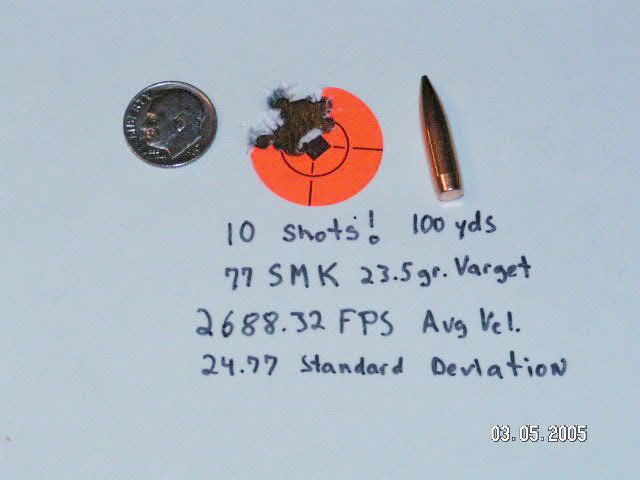
|
|
Great post. Statistically, the more shots, the more accurate representation you get. Nothing new there. I am guessing the Army still uses three-shot groups to determine battlesight zero. That is probably as much a budgetary factor as anything else. Since the Army then qualifies its soldiers on pop-up targets, they figure that three-shot groups are good enough. Also, I can qualify on an Army range, but I am not a very good shot. It is not that hard to hit a three foot high target on the range. |

|
I'm always amazed when I see the pic of that group and I absolutely agree with you on the concentricity issue. For those of you that might not be familiar with the concept of loaded round concentricity and runout here is a little information on the subject. Runout  Concentric: having a common center. Think of concentricity as a circle centered within a larger circle. The amount that one circle is off-center with the other is referred to as “runout” and is usually measured in thousandths of an inch when pertaining to ammunition. Why does all this matter. The more concentric, or the less runout that a loaded round has, the more likely it is to shoot accurately. The bullet needs to be centered in the case neck and the case neck must be centered on the case body. This all helps the cartridge align itself in the chamber of the rifle so that the bullet has a straight shot to enter the rifling. Obviously the better the job the seating die does in seating the bullet squarely in the center of the case neck the more concentric the round will be. The Forster Ultra Micrometer Bullet Seater Die does a great job of this by using a sliding sleeve that supports the case while precisely aligning the bullet for seating. The Redding Competition Bullet Seating Die works on the same principle and I use both with outstanding results. Both work equally well in my Dillon XL 650. Before you can even seat your bullets you have to have a case in which the neck is centered within the case body. Redding’s Type- S Bushing Style Dies and Competition Bushing Style Neck Sizing Dies have worked extremely well for me in achieving concentric case necks. One area in which I chose to make a compromise pertains to concentricity of case necks. In order for the dies to be able to perfectly align the case neck with the case body the case neck has to have a perfectly uniform thickness around its circumference. Most quality 223 Remington cases come from the factory with at least a couple of thousandths of an inch of variation in case neck thickness. To achieve a case neck thickness that does not vary by more than a few ten-thousandths of an inch a process known as “neck turning” can be utilized. Benchrest shooters use this technique to achieve virtually zero runout in their cases, but it is probably one of the most time consuming techniques in precision reloading. Since the chambers on most AR-15s are huge by benchrest standards I decided to forgo this step. Since I do not neck-turn my cases, I do use the expander ball in my sizing dies. This pushes the irregularities in case neck thickness to the outside of the case neck and helps achieve better seated bullet runout. Remember, with runout “Less is Better”. The carbide expander ball of the Redding dies floats on the spindle and works quite well in not pulling the case neck off center as it exits and expands the case neck. Choosing a bushing diameter that sizes the case neck down to only a couple of thousandths smaller than the expanded diameter of the case neck helps the whole process work more smoothly and probably contributes to case life by not overworking the brass. For example, when coming out of the sizing die, my case necks have a diameter of approximately .246”. I use a .244” bushing so there is only .002" of expanding being done by the expander ball. Once the bullet is seated the “seated bullet runout” must be measured using a concentricity guage. Once again there are several makes on the market. I use the NECO Concentricity Gauge and highly recommend it. When using the gauge I place the center of the ball of the GEM indicator roughly .050 to .060” ahead of the case mouth. I consistently achieve an average seated bullet runout of .001” with my reloading procedures and the 30 round sample that I tested for this portion of this text had a runout of only .0008”. Since the goal for average seated bullet runout was .0029” I am well ahead of the factory ammunition in this aspect. |

Great Post 
|
Now for the $64 question: whose dies are the most concentric? Consistency can be handled at the press for almost all variables other than concentricity. |
"You cannot conquer a free man. The worst you can do is kill him." RAH
|
In order to truely know how accurate and precise a gun shoots, you must take a MINIMUM or 30 shots under the same condition. In statistics, we call this the Central Limit Theorem. This is why gun magazines and most gun writers are absolutely worthless. They have no idea how to truely show statistics. Therefore, they are bull shitting you if they test a gun and say that the three shot group proves it's accuracy/precision. If you really want to know how to figure the accuracy and precision of your gun, check these sites for instructions. Wiki Six Sigma Accuracy v Precision |
|
I'm new to this board - a friend saw this thread and told me about it. I don't own an AR15 and my favorite bullets probably weigh more than your entire loaded cartridges, but that's irrelevant in the pursuit of accuracy, and you guys seem to be the real deal in that department. After skimming through all 9 pages pretty quickly, I'm really impressed with the level of discussion. The topic of statistical testing in shooting applications is one that has become near and dear to me for various reasons. So, I thought might throw in a few more comments of my own. While Molon's methods of quantifying accuracy is, without a doubt, the best way to go about quantifying the accuracy of a given load/rifle/setup, you might be lazy like me, and looking for something that is quicker to measure than mean radius - not to mention you may be tired of dealing with all those one-hole groups that are so hard to measure (my heart always bleeds for those with such problemshatwebsite that I wrote a while back. One thing that I believe could improve the "mean radius" technique however, is to adopt formal hypothesis testing statistics to the protocol. This is described for my 2-shot method on that webpage, but it could easily be adopted to the mean-radius metric if anyone really wanted to finess the smallest differences in accuracy between two competing loads, or two competing rifles, or two competing techniques, or whatever - all that is required is that you have two things to compare. Anyway, statistical testing of this nature is very straight forward and can be done with a minimum of math or with the use an EXCEL spreadsheet as explained on the website. FWIW, my real interest in bullets and ballistics stem from a slightly older technology. Thanks for the fine read on this thread and I hope my webpage will be of some value to you guys. Good shooting, Brent |
|
JW, 30 shots does not the "Central Limit Theorem" make. The central limit theorem is, simply put, that the mean of a population of means will be normally distributed regardless of what distribution the original means were drawn from. 30 shots provides one mean and one variance estimate. Brent |
|
Product Specification Sheet Centerfire Rifle LOAD NUMBER: XM193CALIBER: 5.56 mm CASE: Brass (Copper Alloy No. 260) BULLET: 55 Gr. FMJ Boat-Tail PRIMER: M41 Operating Range (-40 degrees to +125 degrees Fahrenheit). PRIMER SEALANT: Water Resistant Lacquer CASE MOUTH SEALANT: Yes CASE KNURL: No HEADSTAMP: Each loaded cartridge shall be headstamped with the manufacturer’s symbol and year of manufacture Revised 1-24-05 Federal Cartridge Company 900 Ehlen Drive Anoka, MN 55303 (800)322-2342, ext. 3822 or 2370ACCURACY: Three 10-round groups not to exceed 4.00” mean radius maximum average at 200 yardsINSTRUMENTAL VELOCITY: 3165 +/- 50 FPS using a 5.56 test barrel (78 feet from muzzle) MUZZLE ENERGY: 1225 Ft-Lbs. at 78’ CHAMBER PRESSURE: Piezotronic maximum average per 10 rounds – 55,000 PSI in 5.56 test barrel (case mouth location) BULLET PULL: Minimum individual 35 Lbs. PROPELLANT DETECTION: 100% mechanical and/or electrical detection of propellant levels within the cartridge VISUAL INSPECTION: 100% visual inspection of finished cartridges prior to packaging WARNING: For use in standard 5.56 mm chambers. Do not use in non-standard 5.56 chambers The above text I pasted from Federals spec sheet (a pdf file). They call for three "10 shot" groups (thirty shots?)for their accuracy criteria. |
|
I've often looked at applying biostatistic principles to target results. There are several interesting questions that I must first ask: What is the ideal? Is the expectation that all bullets would go through the same hole and any variation is what is actually measured? Which bullet is the truth? What is the population? If you shot an infinite number of rounds through a barrel and discounted the effects of heat and wear, the diameter of the target hole would represent the population of all bullets fired. What is an adequate sample? Ideally, the sample should have the same mean and distribution of the population. As noted, with very small samples, by chance alone you can have a very unrepresentative sample. As long as you discard the "bad" samples and only use the "good" ones, you have a very biased view of the population. The mean radius is an excellent tool to measure the samples. If stable over repeated sampling, it is a useful tool for estimating the "population" for that combination of barrel/rifle and cartridge combination. What are the important variables? What we all seek to answer. Control the important variables and precision follows. What is an important difference? If we accept that the ideal will never be met and that variability occurs, how much variability is acceptable? In other words, what's an important difference? Is 0.1 inches at 100 yards an important difference. You need this information in order to determine the sample size. Too small a sample and you won't statistically be able to see a difference, due to chance, even if one exists. So we first want to establish how much difference is important, then determine the sample size given known variabilities, change one test variable (different bullet), test, then compare results using statistical analysis. Some differences can be due to chance alone (Coin flip should be 50/50 heads/tails, but you can frequently toss three coins and get all head or all tails. However, probability requires that with a larger number of tests, flipped coins, the more likely you will get 50/50.) Something to consider. |
I can see a few ways to address your questions. One route to take would be to start with an unlimited benchrest-type rifle (basically a barreled action installed on an I-beam) and hand select only the most consistent components for each, painstakingly hand loaded round, then measure every possible variable in every single component and loaded round... That's going at it backwards. The more effective route would be to, using what we might consider standard loading practices, build a "good" load out of highly regarded components using care and patience, (or choosing an established commercial or military load) and THEN start measuring performance using a very good rifle on a very good rest. Once a very consistent load (combination of specific bullet, powder and charge, case brand and primer model) is identified, THEN we start changing ONE component. Not only does this give us an established starting point (let's say 1.5" mean radius at 100m), but it is fun too because you are loading and shooting... I think one of the aims this thread was started for was learning about identifying and quantifying specific loads for their accuracy. I personally would like to know the accuracy potential of M193 in MY rifle, so I can know what kind of results I can expect from the ammo. With that, I can work on the human factor and be able to tell when my mean radius is a certain size because of the round I'm shooting and when it's that size because of me. |
"You cannot conquer a free man. The worst you can do is kill him." RAH
You lost me there. What you want to do is measure variation, whether between two bullet holes or between X bullet holes and a geometric estimate of true center, it doesn't matter, the concept is the same. Which bullet is the "truth"? Don't follow.
The population is not what we are looking for - it is the difference between two treatments. I think you are limiting yourself too closely to the biostats framework, and even there you are being fairly limited in scope. If you were measuring a behavior for instance, what is the "population?" Yes, and infinite number of shots on paper would give you the true distribution - but not the population. You are reading a might too literally perhaps.
The adequate sample depends on three things - and I'm not going to write a textbook here, but they all have to do with determining the power of your tests. 1. What is the minimum difference between to treatments (or populations if you will) for which you are willing to test? Do not say zero because it is a mathematical impossibilty. Obviously, the smalller the difference that you wish to detect, the greater ths sample size must be. 2. What level of confidence to you wish to achieve? Again, 100% is not possible but anything less is. Not surprisingly, the higher the level of confidence, the greater the sample size that is needed. 3. What is the variance of the treatments you are comparing? Again, the larger the variance, the larger the sample must be to meet the criteria you have set in #1 and #2 above. From these three numbers, the required sample size is easily derived in any elementary stats book (bio or otherwise).
I don't think there is any problem defining those. They are the load components and quantities or barrels, actions, shooters, methods or any other issues you wish to compare. The emphasis being on "compare".
Well, technically, you can change multiple factors at one time, but the analysis gets a bit more complex. Generically, an Analysis of Variance is the type of testing design that is required. That's a lot more than most folks are willing to deal with however, but it is far more efficient than the "one variable at a time approach" and it has the advantage of detecting interactions among the various variables. Stats has a lot to offer to shooting, and it is an anathema to me that shooters seem to hate it so much. Brent |
|
The stereotypical "shooter" is the opposite of the "good-at-math" guy, so it's no surprise that they shun statistics. But we need some way to quantify what we're doing, so we make up measures that seem to give some intuitively "right" feedback about what's good and what isn't wiithout requiring too much effort. Hence the ES instead of MR and fewer shots per group. As far as the statistics go, my take is this: The population is all the bullets in the case, or lot, or recipe. What we want to know about the population is either: a) what is the probability that the next round I shoot will be within X" of where I aim it? or b) what area on the target can I be xx% sure that the round will hit in that area. Key question is how many shots to I shoot, and how do I measure them to compute A or B? Between two populations we want to know if one will give us a higher probability for A or a smaller area for B. In addition to how many of each to shoot and how to measure them, we need a way to compute whether A really is better than B or if it was just a fluke or if they're really the same. Trying to establish what factor in the loading will change how it shoots is a whole 'nuther ballgame, but it still depends on being able to reliably tell if the two versions are really different and which is better. As far as evaluating your shooting, you need to get a baseline for the gun off a solid bench with as much human factor eliminated as possible, then when you can shoot as well without the bench you're at the limit of your gun/ammo combination. The most common way to compare is to shoot 3- or 5-shot groups and measure ES, but as Molon has so excellently explained that has some validity issues. Mean Radius seems to be the best balance of having actual validity without being too hard to compute, though it's harder than most shooters will bother with. It looks like the T-test is the way to check for "statistically significant" differences, but it too may be more work than most shooters will bother with. The serious shooters who want to know will do the math; but not being afraid of the calculations doesn't mean they understand the statistical theory enough to know what calculations to do. |
The point I was trying to make is that we tend to assume that the center of mass of all the hits on target represents the true aiming point. Is that really a valid assumption? And if not, is there any true value in measuring from that arbitrary "center point". Mike, actually I'm calling all bullets (of the same contruction, and that's a leap of assumptions) fired through that rifle as the population. Instead of 10 or 30 or 100 rounds, there is some true measure of precision for any rifle/ammunition/environmental conditions combination. Let's ignore the environment as few can click in the change in impact due to temperature and humidity changes. And let's ignore changes due to fouling. That rifle/ammo combination should be able to place all bullets within some maximum diameter. After some time, you're just shooting through the hole. That's the true precision measure for that rifle/ammo combination. Now change some variable (powder, bullet, seating depth, etc) and you'll either shoot a larger or smaller diameter grouping. In order to know whether it's better or worse, you have to have a valid measure of true precision. If you accept this type of definition, then there is no reason to limit testing to 10 or 30 rounds, but you do get closer to the truth. Molon's work is a true step toward truth. BTW, in technical terms, accuracy means you hit the center of the target, precision means all bullets land very close to the same point. You can have only accuracy, only precision or preferably both. This is more a technical discussion rather than real-world. Bottom line: its time to discredit the writers who "shoot five and throw out the two outliers for best three shot groups." Strong work guys. C97 |
The averaged center is an estimate of the true aiming point. It is the best estimate given no other information (e.g., a known bias in some particular direction). You technically loose another degree of freedom here but we aren't dealing with technicalities at this point.
But you really need to combine it with statistical testing to appreciate it. The addition of a simplistic t-testing approach adds a whole lot of power w/o much work in today's computerized world. It would save a lot of folks a lot of ammunition and load development time, provide greater confidence in one's gear and probably win a few more matches. Brent |
We're making a lot of assumptions, but we start from the idea that if every round was exactly the same they'd all go through the same hole. Then we assume that the variations in the bullet, charge, etc. are Normal so that a sample of rounds will group up/down/left/right around a central point (analogous to the Normal mean) with most of them close to the center and some further out. A measure of how tight that cluster is (analogous to the Normal SD) would be the Radial Std. Dev. but the Mean Radius appears to be almost exactly equivalent and much easier to caclulate. Moving the aiming point of the sights to coincide with the center of the group is separate from the analysis of the group, but with a properly zeroed gun the center of the group would indeed be the aiming point.
Which leads to another problem: The "noise" in the data from things like shooter technique, fatigue, barrel heat, wind, etc. might completely mask the distribution of the bullets' variations. |
|
Guys you are loosing sight of the forest for all the trees. That bullets, no matter how identical, will never fly through the same hole every time is irrelevant. That shooters are not perfect, that bullet holes cannot be measured with infinite precision (and accuracy), etc etc. are all irrelevant too. These things all come out in the wash so to speak as they are part and parcel of anything that is dealt with in a statistical fashion. The remaining unexplained error is always with us, though we try to remove as much as possible - indeed that is the whole point. BTW, a "properly sighted gun" will be the one that is pointed at the geometric center of a group of bullet holes. That is, one for which you calibrate by approximating the center of group as you would dealing with mean radii. It is only an estimate and thus, no rifle is ever "properly" sighted if properly is implied to mean "perfectly". Brent |
Actually, I'm just pointing out that the forest is composed of trees. It's mostly just thinking out loud, but as Brent noted, there are statistical tests that help tell you if the difference that you're measuring is real (a true difference) or just coincidence (expected variation within the system). They're tools that are used to define and compare "populations". Molon is shooting "samples" of populations. The question most are asking: Is there a difference in the accuracy between M193 and Y in my rifle? Otherwise the question is "How accurate is M193 in Molon's rifle?" and I don't see that really answering the question for everyone else's rifle. Am I making sense? C97 Oh hell, bring on the BOTD! 
|
I think the whole point of this thread is to give us the info we need to answer that question for ourselves. I, for one, am glad Molon took the time to post the info. I think I will find it very useful. |
| The trouble with this whole proposition is that while a ten-shot group may very well have the dispersion noted, three-shot groups would most likely not be arranged as they were in the examples. If I were to fire a nice three-shot group like the first picture, I would proceed to adjust my sights to move it to POA. This has worked for me and most everybody else for centuries. You can't take a ten-shot group and arbitrarily pick out three-shot groups as examples. They just don't occur that way naturally. Three shots close together in one quadrant of the target is a good group. If you were to continue firing at the same POA in groups of three, assuming a rested gun, you would of course see dispersion, but it would be roughly centered on the original group. You just don't get one nice group in one quadrant and one in another without changing POA or physical changes in the gun, ammo or weather. |
The center of 3-shot groups absolutely can vary from quadrant to quadrant naturally. The targets shown below in a repost from page three are actual targets of 3-shot groups fired in succession. They show quite nicely how the center of 3-shot groups can vary from quadrant to quadrant; I even list the amount variation in minutes-of-angle. DK-Prof has also provided multiple examples of his real targets that showed the centers of 3-shot groups varying to different quadrants. Also, "Three shots close together in one quadrant of the target..." can be nothing more than an example of the Texas Sharpshooter fallacy.
|


|
Excellent post. Three shot groups are notorious for causing a shooter to chase his groups all around the black, especially at short ranges (100 yards or less). Five, or even better, 10 shot groups give a much better zero, and I personally prefer 10 shot groups for setting zero. Getting people to accept that they might need to fire thirty to fifty rounds to set a proper zero is usually not going to happen. Hopefully those reading this post will see that it makes sense and spread the word. |
Thank-you kindly. |
|
I've programmed a >free< program to measure targets and do the calculations that Molon has been discussing. The program topic and download link can be found here: ar15.com/forums/topic.html?b=3&f=118&t=314621&page=1 |
|
The Texas Sharpshooter (Second Cousin of the Internet Commando) Envious of all the attention his cousin, the Internet Commando, receives at the local tavern, as well as on the popular firearms forums on the Internet, our antagonist decides it is time for him to make his mark in the world. He decides he needs to perform some feat of marksmanship that surpasses even the accomplishments of his cousin, the Internet Commando. But what can he possibly do that the Internet Commando hasn’t already done? Our antagonist recalls the tales of the Internet Commando. He remembers his cousin boasting of shooting sub-minute of angle groups using XM193. How could he possibly top that? Then, it dawns on him. The Internet Commando was using his sights when he fired those sub-minute of angle groups with XM193. “Anyone can shoot a small group using their sights,” he thinks to himself. “It would take real skill to shoot a good group without using the sights, say . . . as in shooting from the hip!” Seeing his destiny laid out before him, our antagonist sets up his target at 25 yards and proceeds to fire on the target shooting from the hip. As our antagonist walks towards his target to examine his results he begins to grin from ear to ear. “Wait until my cousin sees this,” he actually speaks aloud. That night at the local tavern our antagonist shows his target (pictured below) to those who have been hanging on every word that his cousin, the Internet Commando has been saying. The people are absolutely astonished that our antagonist was able shoot such an amazing group firing from the hip at 25 yards. Bewildered by the incredible skill demonstrated by our antagonist, the Internet Commando tells his cousin, “You’re quite the sharpshooter Tex!”  |
|
While the fiction continues in the above fable, once again it is based on a real target. I actually fired that group from 25 yards while shooting from the hip. For those of you that haven’t already figured out how I was able to perform such a feat, here are the little details that Texas Sharpshooters fail to mention.
I actually fired 30 shots from the hip at the “target” which was a blank piece of paper measuring 36” X 24” (kind of like the broad side of a barn). I then found 3 shots that formed a cluster and “drew” the bulls-eye around the shots. Those 3 shots occurred randomly. Not from any outstanding shooting skills of mine, nor from any outstanding qualities of the rifle or ammunition I was using, but purely by chance. (The actual extreme spread of the 30-shot group was 31”.) The fallacy of the Texas Sharpshooter is based on the fact that clusters of data can occur randomly or by chance (the clustering illusion). “In making statistical observations, results will not be distributed with total uniformity but will naturally be sparser in some areas and denser in others, purely by chance.” Human beings tend to want to discern patterns in random clusters where none actually exist. We try to assign significance where there isn’t any. In the case of the Texas Sharpshooter “information that has no relationship is interpreted or manipulated until it appears to have meaning.” More specifically, “although the shots were random, the Texas Sharpshooter makes it appear as though he has performed a highly non-random act. In normal target practice, the bulls-eye defines a region of significance, and there's a low probability of hitting it by firing at random. However, when the region of significance is determined after the event has occurred, any outcome at all can be made to appear spectacular.” If you had not known that the Texas Sharpshooter had drawn the bulls-eye after the shots were fired, you would “falsely assume he's an excellent marksman by reasoning from effect (bullet holes in the bulls-eye) to cause (he fired the bullets).” The fatal flaw is “assigning significance to the outcome of a random event after it has occurred.” The danger is in “jumping to a conclusion that a random cluster is a causal pattern.” The Texas Sharpshooter “takes a random cluster, and by drawing a bulls-eye onto it makes it appear to be causally determined.” Here is a pic of the target before the bulls-eye was drawn on it. 
Here is the target in negative. 
Lastly, the target in negative with the random cluster (actually two random clusters) highlighted. 
*Quoted sentences in this post are from various unknown authors. |
One of the neat things about the show NUMB3RS is that the episodes are based on real mathematical and statistical concepts. The show even mentioned the Texas Sharpshooter fallacy in episode #309: "Waste Not." You can read more about the Texas Sharpshooter fallacy on the website describing the math and statistics used on the show NUMB3RS. |
|
Ok, so I'm getting ready (at least mentally) to start hitting the press to feed my So Molon, what's your take on that? Do I need 10 shot groups for velocity testing, or more than that? |
"You cannot conquer a free man. The worst you can do is kill him." RAH
|
During my testing of Hornady's 5.56 TAP ammunition I did a little experiment in which I compared the results (shown below) of 10-shot strings to 20-shot strings. The results were almost identical. 
Some of the literature will refer to a standard deviation of 12 fps for 10-shot strings as the gold standard for match grade ammunition. I actually take the calculation one step further and strive for a coefficient of variation of 0.5%. For comparison, the coefficient of variation for mil-spec M193 is approximately 1.2%. |
I further thought that 10 round groups for working up loads would be effective since I would (as I always have) be very precise in putting together those rounds; I've kept a 0.10grain tolerance on all my handloads (which does mean that I spend a LOT of time putting them together) for load development so that I have an idea what the load is doing, not what the load, my powder measure, my measure technique, the phase of the moon and so on are doing. Your 5 shot "scanning" method sounds like a good way to go, for finding the right range of powder charges; I'll have to try that! |
"You cannot conquer a free man. The worst you can do is kill him." RAH


NO, you're not actually supposed to be firing them. Here's why: -Ammo costs too much -Magazine springs will wear out quickly, ESPECIALLY if you leave a mag loaded for a while -Those little pins in your lower will rotate and will eventually leave dime sized holes in your lower. -M4 feedramps cause arfcom members to ramble all crazy like. ETA: ESPECIALLY on Thursdays -Last but not least, NO MATTER HOW WELL YOU SHOOT IT STILL SUCKS AND SOMEONE HERE HAS DONE ELEVENTYBILLION TIMES BETTER. If you happen to get a really, really great group, it was a fluke because 1million rounds into a 4"x4" piece of paper will get you a group like that somewhere on it and simply put, that proves that you suck at shooting. God, I love this place.  -X |
The Trouble With 3-Shot Groups (Page 5 of 12)
AR Sponsor
Join the Community
Your next conversation starts here.
Create your free account to join discussions, share your experience, save topics, and connect with the AR15.COM community.
- Join discussions
- Follow topics and replies
- Connect with fellow enthusiasts
Already a member? Sign in
Stay informed by subscribing to our Newsletter