


AR Sponsor
Posted: 4/8/2023 11:47:45 AM EDT
|
reposted with broken picture links repaired Occluded Eye Aiming and Phoria With an ACOG Many of the people that I’ve seen using the term “Bindon Aiming Concept” on the Internet, really don’t understand the meaning of the term. In point of fact, many people that claim that they are using the Bindon Aiming Concept with an ACOG scope are not actually using the Bindon Aiming Concept. They are using the ACOG scope as a dynamic occluded eye gun-sight. The “Bindon Aiming Concept” is a naturally occurring phenomenon of human binocular vision. It is not something that is built into a scope and therefore is not something that a scope does or doesn’t have. However, certain attributes of a scope (such as a large, colored, brightly lit centered reticle that stands out against the background) much more readily lend themselves to use of the Bindon Aiming Concept. Much of our "seeing" is done not with our eyes, but with our brain. When the brain (of most people) is presented with conflicting visual input from the left and right eyes, it selects the visual tract that provides the most clear/detailed image to “focus” on. Again, this is a naturally occurring phenomenon of human binocular vision. When using “both eyes open” sighting and the weapon/ACOG-sight is moving quickly, the image of the target and background presented to your dominant eye is blurred due to the magnification of the ACOG. At this point the brain selects the visual tract coming from your non-dominant eye to focus on because it is clear and sharp. The reticle itself is in focus at all times and the brain “includes” it along with the view coming from your non-dominant eye. When the weapon/sight stops moving, the magnified image presented to your dominant eye is no longer blurred and is now more detailed than the non-magnified image seen by your non-dominant eye. So, at this point, the brain selects the visual tract from your dominant eye to focus on. This is the final step of the Bindon Aiming Concept (along with a final aiming adjustment) and it is this step that many shooters omit when they claim that they are using the Bindon Aiming Concept and the complete process does not occur instantaneously. As stated above, what these shooters are actually doing is using the ACOG as a dynamic occluded eye gunsight. Phoria enters the picture (no pun intended) when using the ACOG as an occluded eye gun-sight and this is why accuracy can be degraded. …. The Effects of Phoria When Using the ACOG as an Occluded-Eye Gunsight  Phoria: the visual effect that occurs when one eye is blocked from seeing the same view of a target as the other eye; the blocked eye does not get the same sensory input as the other eye and can begin to wonder, usually to one side or the other. In an attempt to make my Trijicon TA-11 ACOG more versatile at engaging close range targets, I installed a Progressive Machine and Tool flip-down front lens cover. With the lens cover in the up position (blocking the view through the scope) the ACOG can function as a non-magnified occluded-eye gunsight; functioning more like a non-magnified red-dot sight, than a magnified scope. However, when the ACOG is functioning as an occluded-eye gunsight, the view of the target for the eye looking into the scope is blocked and the effect of phoria comes into play. 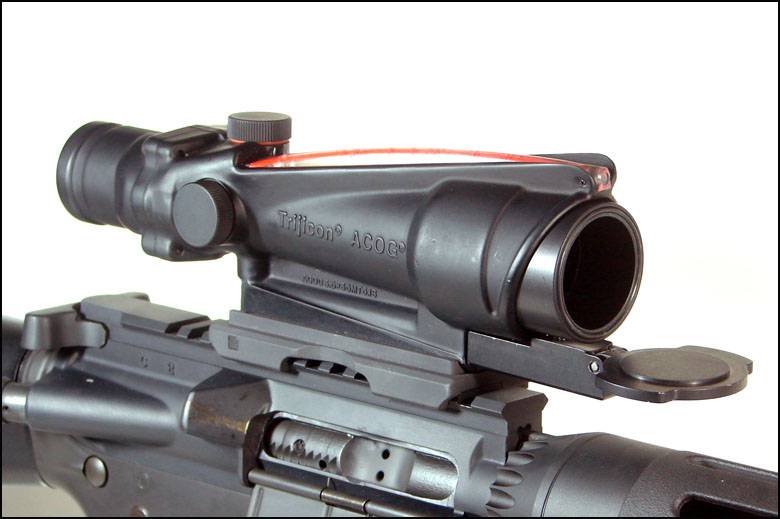 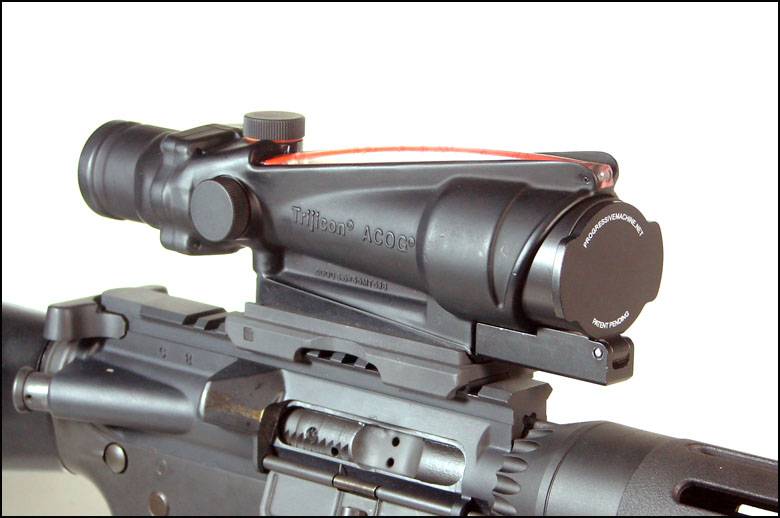 In order to determine just what the effects of phoria would be when using the ACOG TA-11 as an occluded-eye gunsight, I conducted a test comparing the accuracy and points of impact when shooting with the lens cover down (normal sighting) and the lens cover up (occluded-eye sighting.) Testing was conducted at a distance of 25 yards, the farthest distance that I would anticipate using the occluded eye-method of sighting. Shooting off of sand bags, I zeroed the TA-11 for point of aim equals point of impact at 25 yards using the normal sighting method. I then fired a 10-shot group with the normal sighting method that formed a tidy group with an extreme spread of 0.56”. 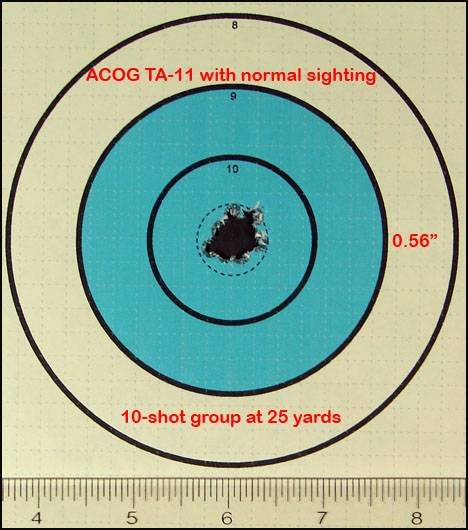 Next, I placed the lens cover in the up position, transforming the ACOG into an occluded-eye gunsight. The left eye views the target, while the right eye views the reticle in the scope. The right eye is blocked (occluded) from seeing the target due to the lens cover. The impact of the initial shots using this method had such a large horizontal deviation to the left that they were off the targets that I originally was using. I had to change to a 24” wide target and aim at the far right side of the target to capture the impact of the rounds. The aiming point for this portion of the test was the numeral “7” on the target. I fired 10 shots using the occluded-eye method of sighting. This group had an extreme spread of over 7” and the center of the group was 14” to the left of the aiming point! 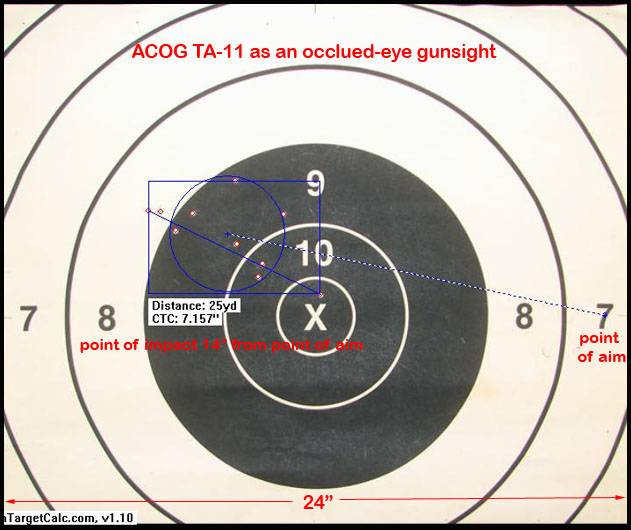 …. |
|
Using my MantisX laser trainer and my 4x ACOGs or 3x PA micro prisms I have noticed the same results. I don't have a cap installed, but my right eye was badly damaged in a paintball incident so if I shoot using my right, non-dominant eye it has the same effect. I can see the illuminated reticle, but not much beyond the end of the optic unless I close my dominant eye (then I just get a very blurry target) When I shoot non-primary hand/eye, I'm off target by several inches inside of 25yd. I can only assume that distance off target multiplies exponentially as range increases. |
|
IME, you don’t even have to fire any shots to see the effects of this as you can already see the reticle drifting when the site is occluded. I don’t run an offset sight on my competition Gun so if I’m engaging a long range target and I need to transition to a short range one, I shoot it occluded as long as it’s within 15 yards and the target doesn’t have a no shoot or hard cover. If the target does have that, I slow and shoot it with my dominant eye. |
|
Quoted: IME, you don’t even have to fire any shots to see the effects of this as you can already see the reticle drifting when the site is occluded. I don’t run an offset sight on my competition Gun so if I’m engaging a long range target and I need to transition to a short range one, I shoot it occluded as long as it’s within 15 yards and the target doesn’t have a no shoot or hard cover. If the target does have that, I slow and shoot it with my dominant eye. This has been my practice too. |
|
Excellent report, thx! I used the original Singlepoint & Armson OEG many years ago and discovered that precision aiming was nigh-impossible. I could sight them in for very fast close-in shots, but any time spent actually aiming caused the wandering eye/POI problem. |
AR Sponsor