


AR Sponsor


Member
Joined:
Dec 2023
Posts:
9290
EE: 100% (7)
 USA
USA
Posted: 3/25/2026 9:28:03 PM EDT
[Last Edit: ELittlefield][Edited]
|
There are a variety of different Forced Reset Triggers (FRTs) on the market today. They have different pros and cons, and I'll try to sum up what I know about each, both with aggregate knowledge from reading, and direct experience. I'll limit this post to small frame, locked breech, centerfire calibers such as 5.56, 300 Blackout, 458 SOCOM, and similar. Rimfire and pistol calibers can be addressed separately. FRTs can be broadly categorized into cassette type, lever type, and module type. My terminology. Most of these do not work if you have a Colt lower receiver with a web, or a pinned in block. In July 2026, a new 2 position device called the Trigger Kicker was released, which doesn't really fit into those three categories. This does work in those Colt lowers with blocks and webs. Most of these need some kind of damping buffer. When a normal buffered AR cycles and the action closes with a new round, the carrier will bounce a little off the breech, already having begun to drop the hammer on the next round. If the carrier is in mid bounce when the hammer has fallen, the hammer will hit the carrier instead of the firing pin, and you will have a dead trigger, with the hammer down, on a live round in the chamber. There will be a small mark on the primer. You have a couple options to prevent carrier bounce. The easiest and most foolproof way is to use an H3. It must contain three sliding, tungsten weights in order to deliver a dead blow. Many FRTs will also work with an H2, which has two tungsten, and one steel weight. A few will work with an H1, or even a standard carbine buffer, if your gun coincidentally has perfect timing. However, a standard H3 is best practice. It should not be a solid buffer. There are some buffers on the market called H2 or H3, which are made of solid steel, and do not provide any mitigation to carrier bounce. Some others have a steel body, and steel weights to make H2 or H3 total weight, but lack enough damping weight to function. An excellent alternative is the Tromix 2 piece buffer: It uses a larger piece of steel equal to the weight of the sliding tungsten, but since it's just steel, it's cheaper. They offer several weights. The preceding buffers are all carbine length (or A5). If you're using a rifle length buffer and buffer tube, the standard one with 5 steel weights should work just fine, no need for tungsten or 2 piece. Cassette Type. These are self contained trigger cassettes. The whole actuating system exists in one unit. They are insensitive to slight variations in the location of your trigger pin holes, and are generally the easiest to get running. Rare Breed FRT-15L3: $450. This design works well, with a reasonably crisp trigger pull, though somewhat heavy. It has a 3 position switch style safety, much like an M4 or M16: Safe, Semi, Forced Reset modes. Some people disapprove of their business practices, but that is a discussion which is not suitable for a technical forum. It shouldn't be commented on here. One particular advantage to this trigger is that they have a settled lawsuit with the ATF, which explicitly states that the ATF cannot treat it as a machine gun, which other companies do not have. I've used this trigger with 5.56 in a variety of barrel lengths, 300 Blackout suppressed, and 458 SOCOM suppressed. It is nearly foolproof, as long as you have an H3 or similar buffer. The Triggered Company (formerly Partisan) Disruptor: $220-$300. The basic design is very, very similar to the FRT-15L3. It functions much the same way, for a considerable discount. It has a lighter trigger pull, which I describe as "Glock-like." It's a somewhat light, spongy take up, with an indistinct break. They lack the settled lawsuit with the ATF that Rare Breed has, and in addition, they have had a few quality control stumbles out of the gate, including indistinct detents on their early run selectors, and a few people reporting two rounds fired per trigger pull in semi auto mode, which is not optimal. They have enthusiastic customer support, but are somewhat overwhelmed with volume at the moment. Both this trigger and the above Rare Breed use anti walk trigger pins, with screws in either side, which protrude from the lower receiver. The Triggered Company now offers some more aesthetically pleasing selectors. DatumMachineWorks.com also sells solutions to both of these aesthetic shortcomings, in the form of a modified M16 selector, and captured trigger pins: Selectors Captured milspec pins What a time in which we live, that we can now pick and choose our forced reset triggers based on their looks. It's amazing to see. Rare Breed FRT-15C3: $450. Match grade 2 stage FRT trigger. This is an extremely good trigger. It also functions with a Datum Machine Works selector and captive pins. It is a two stage trigger, both in semi auto mode and Forced Reset mode. The trigger pull in semi auto is comparable to a Larue MBT 2 stage. A light first stage with just a bit of drag/grit, and a very clean, crisp second stage break. This is by far the easiest way to get a high quality trigger pull in an FRT. You simply buy this trigger, buy an appropriate buffer, and make sure you have a full auto profile BCG. I do not know why they have chosen to price this at the same level as their original design, it is significantly better. One additional benefit: This is the only 3 position FRT of which I'm aware that will work with both high shelf lowers, AND lowers with a Colt sear block. In the event that you want to use this in a Colt blocked gun that also has 0.170 diameter trigger pins, message Gorton87 on this site (Datum Machine Works again), as he has expressed willingness to make some trigger pin bushings that will accommodate you. The Triggered Company (formerly Partisan) LAT: $350. Released in July 2026. The LAT is essentially an upgraded Disruptor, with a shorter, crisper trigger pull, and it does not bump your trigger finger when in normal semi auto mode. It shares the same three position lever selector as the Disruptor. It incorporates some of the old TacCon 3MR technology that was going around in the early part of the previous decade. "LAT" stands for Larry Alan Thorne, and is named in his honor. It's worth reading his Wikipedia article. Lever Type: Broadly speaking, these are replacement safety/selectors. The Hoffman and AS Designs require a Super Safety cut to be made on the tail of the trigger. Basically, a big piece of the right side of the tail of the shoe is removed, and the left corner is rounded slightly. Geissele triggers can be modified to work with the AS Designs, and both Geissele and Larue 2 stage triggers can be modified to work with the Hoffman. The Atrius and Cornfire nominally do not require a Super Safety cut, though I will discuss this in a moment. When using a tailless hammer (Geissele, MBT 2 stage) with a Cornfire, Atrius, or ARC-Fire lever type FRT, you must use a lever blocker. It's a simple piece of stamped steel that sits alongside and above your trigger shoe, and prevents the trip lever from falling forward under the tail of the hammer. Hoffman Super Safety: $50-$150. This is an extremely simple device, comprised merely of two pieces of milled steel or printed plastic, a modified trigger shoe as described above, and your safety detent must be rounded off. Sometimes the upper receiver needs to be modified a bit, by Dremeling the slot at the rear, in order to prevent the bolt carrier from wedging at the rear of the stroke. The result is a push button safety. To the left is safe, to the right is semi auto, and in between is Forced Reset mode. I strongly recommend that everyone who wants to get into Forced Reset buy one of these first, and get it running in order to learn the quirks. It's extremely forgiving to buffer weight, inexpensive, and easy to see what's going on in there. You can use a SS cut Geissele, or MBT 2 stage, and you do NOT need a lever blocker with these. Cornfire MARC: $200. This has essentially the same forced reset function as the Hoffman, but it has a switch style selector like an M4 or M16. It will drop in with a USGI type trigger, no modification should be needed. Interestingly, it should also work with a stock Geissele trigger. You should "Hammer back, swing lever" test the MARC after installing in the lower like this: separate the upper from the lower, put the selector in FRT mode. Then, while pressing the hammer down/back, swing the trip lever through its range of motion. It should not bind at all, it should swing freely. If it does not, you may need to modify the trigger a small amount by removing material from the top of the tail of the trigger a very small amount. Another issue that comes up when using Geissele triggers: In FRT mode, the trigger pull may be quite heavy, like pulling 8+ pounds against a hard wall before it breaks, or not breaking at all. The fix for this is also to remove a tiny amount of material from the top of the tail of the trigger shoe. Go extremely slow, removing a small amount and then function testing. I have a very high opinion of the MARC. Externally, it's difficult to tell that you have an FRT installed. The visible trigger shoe is either a USGI or a Geissele trigger bow, and the selector looks pretty much like a standard AR safety, except that it has a screw in it. A lever blocker is required for tailless hammers. Atrius Forced Reset Selector: $200-$250 (right handed or ambi). This is very, very similar to the MARC. It functions in exactly the same way, though it is not quite as good in my opinion, because its cam is slightly oversized. This makes it unable to be used with a Geissele trigger, and means that it usually fails the "Hammer back, swing lever" test described above with a USGI type trigger. Failing that test means that the lever comes under significant stress during the firing cycle, and often results in breakages in mere hundreds of rounds fired. To "tune" your USGI trigger to pass this test, you should remove some material from the top of the tail of the trigger until it is approximately 0.310" tall for a length of around 3/8". The Atrius also works very well in combination with the Rise Armament Rave 140. This is a very light, VERY crisp single stage cassette trigger. New manufacture Rave 140s drop in and pass the "Hammer back, swing lever" test. The Atrius is available in both right handed, and ambidextrous models. They also have a model called the "G-Lever," which is intended to work with certain Geissele triggers. I have found it to be essentially the same as the MARC. It may drop in, it may require slight modification to the trigger shoe. The safety switch is externally quite distinctive. If someone has seen one before, it is obvious that you have an FRT installed. Also, a lever blocker is required for tailless hammers. AS Designs ARC-Fire: $250. ($500 in the fully upgraded, ELittlefield stamp of approval, BEST overall FRT on the market configuration). This is also a switch style selector, but with a much thicker and more robust lever than the Atrius and Cornfire. It requires a Super Safety cut trigger, like the Hoffman. It CAN use a SS cut Geissele trigger, but cannot use a SS cut Larue 2 stage MBT. This selector comes with a USGI style SS cut trigger shoe: You supply the other USGI style trigger parts and hammer assembly. The selector switches themselves on the old factory ARC-Fire are somewhat skinny and smooth, they are difficult to actuate under some circumstances. AS Designs sells a set of mil spec style selectors for another 30 bucks, which I consider to be a necessary upgrade. The AS Designs ARC-Fire, with upgraded mil spec style selectors, with a SS cut Geissele trigger, with a lever blocker, is in my opinion the best FRT on the market today. It has a price tag to match. In late April 2026, AS Designs began shipping the V2 version, which has several different options for the selector throw. You can get the usual 90/180 degree, 45/180, and my personal favorite, 45/90, which makes it extremely fast and easy to throw the gun into FRT mode. The V2 is shipping with the upgraded mil spec selectors, which saves you the cost of upgrading. It was a tall order for AS Designs to improve on the original, and they absolutely delivered. A lever blocker is required for tailless hammers to work with the ARC-Fire. Module Type: This type of FRT functions by putting a little module in the back of the lower receiver, which resets and releases the trigger based on the position of the BCG during the firing cycle. Arizona Regulator 2 Position: $238. This is an ingenious little device. Once your gun is properly set up, in the space of a few seconds you can pop the upper receiver open, pluck out the module, close the receivers, and you now have a gun which has absolutely no modifications indicating that you ever had an FRT in it. You can buy a version for a USGI style trigger, for a 2 stage Larue MBT, or for certain Geissele triggers, depending on when they were manufactured. You can also buy a version which has an extra long leg, intended to be ground down by the purchaser to fit any trigger he wants. The only real drawback of this device is that it has no standard semi auto mode while installed. You have Safe, and you have Fire, which means Forced Reset Fire. Only 2 positions. To go back to standard semi auto mode, you need to open the receivers and remove the module. It's very small, smaller than the last joint of your thumb. I say that there is no sign that you ever had an FRT in the gun with the module removed, which is mostly true, but you still do need an H2 or H3 buffer with sliding tungsten weights to make it work. Arizona Regulator 3 position: $288. This functions essentially the same as the 2 position AZR, except that you also have a semi auto mode. The drawback here is that there are some proprietary parts that remain installed in your lower, that don't pop out in seconds. The 3 position AZR module is not the same as any of the 2 position ones; it has a different shaped leg. It comes with all of the trigger components you need to make it work; a modified trigger shoe, a proprietary disconnector, a hammer, a standard M16 selector, and an AZR module. It is not recommended to keep a gun with those trigger parts installed, with the module removed, because then the third position of the safety will depress the disconnector. That's not a good situation, so just keep the module installed at all times unless actively working on the gun. Externally, this FRT is indistinguishable from a military issue fire control unit. It uses a USGI style trigger shoe, and you can drop in any M4/M16 selector with no modification needed. This is an excellent choice for clone guns. The trigger pull is not the best, pretty much like any USGI type trigger, but it functions very well once installed in a gun that likes it. It is somewhat sensitive to your gun being manufactured to the correct dimensions, more so than most FRTs. I will go into this in more detail in an additional post. Kabuto Type: Broadly speaking, this is also a module type FRT. It lends itself well to 3D printing, which is not my thing, but people have successfully done it. It is somewhat similar to the Arizona Regulator in general function, but with much sloppier fit. The key distinguishing element of these, is that they can be either two position OR three position, depending on the type of selector you install with it. A standard semi auto selector will give you Safe and FRT modes. A special, custom selector will give you Safe, Semi, and FRT modes. All while retaining the ability to simply pull out the module, and your gun reverts back to a perfectly ordinary semi auto gun. It uses a longer lever to cam downward on a piece which directly engages the rear of the trigger shoe. They are made by a number of different companies, with a few different styles. Polymer Large Frame: These have a polymer sleeve which fits on both sides of your stock standard semi auto trigger and hammer. The frame allows the mechanism to be properly located. Metal Large Frame: These are similar, but entirely made of metal. My personal favorite is from Affordable 2A Prints. That specific model is probably my favorite overall FRT if your goal is to clone an M16. It's a little cheaper than the Arizona Regulator 3 position, and it doesn't disable the disconnector in FRT mode. Mini Kabuto: This is more similar to the Arizona Regulator, in that it's a much smaller, all metal module which fits in the auto sear cutout found in most upper receivers. My experience with these has not been great, it fits extremely sloppily into the auto sear cutout, and goes FRT mode when it should be in semi. Trigger Kicker: Developed by Tim Hoffman, the same man who created the original Super Safety. This may be the simplest FRT that it is physically possible to make. It's a single piece of laser cut steel, which replaces the Disconnector and Disconnector spring in a standard semi auto trigger group. Also, the Trigger Kicker works in lower receivers that have the sear block, both the pinned in kind and the formed, integral web. One of very few FRTs that work in those lowers. Hoffman recommends using "Schmid pattern" hammers, and he estimates that about 60% of the "mil spec" trigger groups on the market are the correct profile to function. This FRT offers 2 positions, Safe and FRT mode. At 43 dollars, it is the cheapest FRT on the market. Hoffman is developing a 3 position Trigger Kicker, he claims he has prototypes working properly, and is now working on how to produce them at scale. |
Member
Joined:
Dec 2023
Posts:
9291
EE: 100% (7)
USA
|
Cassette Type troubleshooting: Not much to say here for Rare Breed. Put in an H2 or H3 buffer, and they work, both the standard L3 and the 2 stage C3. Partisan Disruptor. Gorton87 here on this site really is the Man. Datum Machine Works. He offers selectors, and pin bushings to improve the aesthetics. Partisan Disruptors sometimes have light primer strikes, due to their lighter than standard hammer springs. This is distinct from carrier bounce, it will happen on the first round with certain ammunition. Militia State Armory makes extra strength hammer springs. https://militiastatearmory.com/product/frt-replacement-parts/ With regard to the Partisan Disruptor, if encountering malfunctions, (company is now called The Triggered Company) you should contact them, most easily by contacting HelpfulGuerilla here on this site, or by using their customer service links. They are rapidly expanding, so please give them a bit of grace when contacting their customer service. Remember the basic advice of "H3 buffer, Mil Spec BCG" when working on getting an FRT to work. |

Member
Joined:
Dec 2023
Posts:
9292
EE: 100% (7)
USA
|
Lever Type troubleshooting: Hoffman Super Safety You need a cut super safety trigger, this is non optional. It's fairly easy to do yourself, or you can get one professionally cut from many sources for 30 bucks or so. You need to use a rounded safety detent. Many of the Hoffman Super Safety kits come with one, or you can easily grind the tip of a detent yourself. Just make it nice and round. If you have an M16 lower receiver pocket cut, you can use a Centering Block in order to keep the lever in place in that wider space, If you nave a normally cut lower pocket, the centering block is not needed. In general, the Hoffman is the most forgiving FRT out there for your buffer weight. I have several that use only a standard carbine buffer with no tungsten weights. It's very likely that your BCG will wedge at the rear of the stroke the first time you rack the charging handle. Don't panic, just smack it a few times, get it loose, and make the cut in the upper receiver described above.  " /> " />First though, make sure you're not using a high shelf lower. Another option is to take some material from the forward face of the tip of the lever, but this is not my preferred fix. Sand/grind here:  " /> " />One other trick to use that does not require any parts fitting is to drop one or two US quarters down the buffer tube behind the buffer spring. Do not add so many quarters that your bolt face gets less than a quarter inch behind the bolt catch, viewed through the ejection port, when the BCG is fully retracted. ARC-Fire This animation shows you what's going on inside an ARC-Fire:
I don't have a lot of troubleshooting advice for these. I own six, and they just plain work. Some have had bad luck, and there may be a few out of spec models out there, so the best advice I can give is to make absolutely sure it's installed correctly, and if it still doesn't work, try to get in touch with AS Designs directly for a replacement. If using a Geissele, make sure the Super Safety cut is the correct shape, and that you're using a lever blocker. Atrius Forced Reset Selector The Atrius is a highly effective FRT, but everyone should pay close attention to this video (not mine) which explains the typical problem of Atrius trip levers breaking. The cam seems to be oversized, which can lead to levers being put under undue stress and breaking. Here is that video, my thoughts to follow: 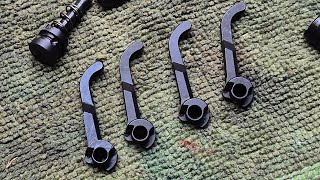 Atrius Forced Reset Selector - How I Tune My Configuration You need to use this test, the "third position, hammer pressed down, swing the trip lever" test. If it fails, if it binds, or rubs, then stop what you're doing and grind/file the top of the rear of your trigger shoe down to a vertical dimension of 0.310". Atrius has released a "G Lever" version of their FRT, which is designed for three models of Geissele triggers. Read their own literature to find out what they claim, it would be irresponsible for me to list them. Atrius G Lever You may need to file or grind a tiny amount of steel from the top of the rear of your Geissele trigger shoe to make it pass this test. It worked for me, and now that G Lever FRT is in my tractor gun. My personal favorite use for the Atrius is with a recent production Rise Armament Rave 140. This is an extremely light, extremely crisp single stage cassette trigger, which should drop right in with an Atrius. This is my preferred trigger combo for 22LR, I think the light trigger pull and short reset lend themselves well to rimfire. One quick caveat, not all Rave 140s will pass the function test. I ended up with an older model, bought second hand, which has different geometry at the base of the hammer than my two working ones. The left one here works, the right hand one does not. I do not know what date the change in geometry was made.  " /> " />Cornfire/Copperhead MARC This is essentially a product improved Atrius. It works in exactly the same way, but it does not require any modifications to a standard semi auto trigger. Externally, it is shaped much like a standard semi auto selector, though it's a bit shorter and slimmer. The MARC can be made to work with Geissele triggers, as long as you have a lever blocker. It may drop right in, or it may require a tiny amount of material to be filed or ground off the top of the trigger tail. I've tried about 5 different MARC/Geissele combinations in different lowers, and 3/5 required this tiny modification:  " /> " />The MARC now also comes with a better engagement spring than the Atrius, and than their own first run models. It's smaller in diameter, so it's less prone to binding, which I've encountered a few times with the Atrius. |
Member
Joined:
Dec 2023
Posts:
9293
EE: 100% (7)
USA
|
Arizona Regulator troubleshooting: An H2 or H3 buffer is absolutely needed. It's even more critical in these than in lever types. Go with H3 by default. These can be tricky to diagnose. It's sensitive to the dimensions of your receiver set. The size of the sear relief cut in your upper receiver is completely irrelevant to the function of your gun in normal semi auto, so there is no reason for manufacturers to hold it to the specification. H&R in particular tends to have undersized pockets in their uppers. You can't blame them, they had no reason to believe that that dimension matters at all. What I did in my H&R 9mm AZR build, is I ground on the sides of the AZR module itself to make it fit. It happened to work for me, but I do not really recommend it. You should either switch to a different brand upper, or have a gunsmith mill your pocket to the correct dimensions. Arizona Regulators occasionally have unintended rapid fire when in semi auto mode. There is no known definitive root cause. You need to ensure that your disconnector spring is installed correctly, with the wide end, the big coil pressed DOWN into the trigger shoe, not facing up. If installed incorrectly, the disconnector will not engage all the time, and you can experience hammer follow, which simulates a short burst of full auto. If your disconnector spring is installed correctly, and you are still experiencing bursts while in semi auto mode, the best advice we can come up with is to try a different lower. I wish I could be more helpful than that, but after about 8 months of research and experimentation, I haven't found better advice. Any M16 selector will work with your 3 position Arizona Regulator, which is pretty cool. In particular, I'm fond of the Griffin Armament 60/120 selector, which shortens the throw of the selector switch. If you want to improve the trigger pull, you have a few, limited options. You can try a standard trigger job on the included trigger group. You can also install a GI style trigger which has an open trough at the back, such as the Larue MBT 1 Stage. These are hard to find now as they're discontinued, but they're still around. The included trigger shoe has an angle ground beneath the tail. This may or may not need to be added to a trigger that you're considering using. My Larue did not need to be ground.  " /> " /> " /> " />Note that the Larue MBT 1 stage and the Griffin 60/120 do not play together, for some reason. I think I could get it to work with some filing on the AZR disconnector, but I haven't got round to it yet. |
Member
Joined:
Dec 2023
Posts:
9294
EE: 100% (7)
USA

|
Colt style 9mm setups Here is good Blowback 9mm reading https://blowback9.wordpress.com |
Member
Joined:
Dec 2023
Posts:
10767
EE: 100% (7)
USA

|
Bore buddy 16" 22lr upper with a trigger kicker. First of all it was a PITA so I will share, honestly I would use an arc fire or atrius for the 22 uppers. I have an arc fire and trip ordered and will post an update later. Use the plastic dry fire adapter, I broke a firing pin dry firing without it. Dry fire is needed when setting the timing. Parts: BB 16" FRT ready economy upper, BCG and red recoil spring BB Titanium firing pin Used the the included BB bolt steel weight and all the steel rod weights. PSA lower and trigger BB yellow reduced power hammer spring Schmidt hammer must have with a trigger kicker Instead of a buddy plug I just added a second buffer in front of my buffer and spring CCI mini mags, only ammo that has given me good reliability CMMG mags, note place some black take on the back of the mag for a tighter fit. Had a few rounds not feed and this eliminated it. Probably better mags would fix this as mine are between 1-15yrs old. For the trigger kicker I set the trip at 1/2" that seems to work so far.    |
|
AR22 update Arc fire on my 16" BB upper 22 works like a sewing machine. Same 16" BB upper I used with the trigger kicker Didn't use the shim and didn't have to adjust the timing on the trip. Aero lower AS designs pre cut USGI trigger V2 Arc fire FRT Schmidt hammer BB yellow reduced hammer spring. CCI mini mags and Winchester M22 ammo. CMMG mag BB Arc fire trip full steel weights Seems the Arc fire is one of the best options for a AR22 reset trigger rifle. |
AR Sponsor