


AR Sponsor

|
Originally Posted By svdude: What I’m saying is that the cavity for the spring and pin is 1.14”, and the total length of the spring and pin is 1.32”. So the spring will need to compress 0.18” and is able to compress 0.216 inches. So basically when the bolt is firmly holding a round, the spring is 0.036” from fully compressed. In short, I don’t believe the ejector spring is ever being compressed flat. I agree, I don’t think that this being a rdb pistol has anything to do with the ejection issue. Originally Posted By svdude: Originally Posted By backbencher: So the most extra depth we might be able to get would be maybe .07"? As far as understanding the extraction and ejection issues, pretend for a moment this is a straight blowback action, there are no bolt lugs, and the bolt does not rotate. What I’m saying is that the cavity for the spring and pin is 1.14”, and the total length of the spring and pin is 1.32”. So the spring will need to compress 0.18” and is able to compress 0.216 inches. So basically when the bolt is firmly holding a round, the spring is 0.036” from fully compressed. In short, I don’t believe the ejector spring is ever being compressed flat. I agree, I don’t think that this being a rdb pistol has anything to do with the ejection issue. Oh, I think it has everything to do w/ it. |

| Too many people with RDB bolts having the exact same issue after similar round counts for it not to be an ejector spring issue. The spring takes a set way too fast and when the length is compromised by the spring set, the brass fails to clear the opening and just bounces around in the receiver to jam. I am baffled how CMMG still sells the kits knowing they are not reliable. |
Joined:
Jul 2024
Posts:
10
EE: 100% (7)
 AZ, USA
|
I’m not a mechanical engineer by any means. I’m not exactly sure how much force a spring can take and how quickly. I do think that the ejection spring doesn’t take any more force than a standard ar bolt. I only assume that because when the bolt moves forward and grabs a round and pushes it into the chamber, the spring is as compressed as it will ever get since the bullet case is fully seated into the bolt. Even if there’s some head space slack, the bullet case can slam back into the bolt. But I do know that springs can compress extremely fast without issue as long as they’re not over compressed. Look at a valve spring on an engine, they can compress several hundred times per minute and do this for years with extreme heat and have no issue. I have only heard of a faulty valve spring once or twice in years and years of messing with engines. Keep in mind that everything I’m posting here is just me thinking out loud. I’m hardly stating facts since it’s mostly educated guesses and speculation on my part. I will also say that I have fired many M4’s on full auto, m240’s, m249’s, etc… all of them have springs that compress extremely fast during full auto firing. I haven’t ever heard of springs wearing out like this. Aside from a rotating delay, these Cmmg bolts are nearly the same as a ar15/m4 bolt (gas operation aside). Maybe you’re onto something with the rotating part of the equation. Maybe the rotation of the bolt next to the chamber wears on something? |
|
Originally Posted By svdude: Aside from a rotating delay, these Cmmg bolts are nearly the same as a ar15/m4 bolt (gas operation aside). I had the same problem with the MEAN Arms killing ejector springs and having failures to eject. I'm not the only one either. I know 3 other people with the MEAN uppers. 1 has less than 300 rounds through his with no issues. The other two have the same FTE's like me and we are under 1K rounds. The bolt isn't truly locked with the CMMG RDB or MEAN upper like it is on a gas operated AR15/M16. |
| Well that is crappy to hear about the Mean Arms action as well. Pretty expensive lesson to learn. Making me appreciate my PSA AR-V I built with Maxim Roller Delayed Buffer. It uses a standard 9mm blowback bolt and has no problems throwing the brass 8 ft away. Does pretty well suppressed also when you adjust the buffer tube to butt the buffer up close. |
Joined:
Jul 2024
Posts:
11
EE: 100% (7)
AZ, USA
|
Originally Posted By amphibian: Bear in mind I also have the new MEAN Arms Bearing Delay which uses the same ejector spring as an AR15/M16. I had the same problem with the MEAN Arms killing ejector springs and having failures to eject. I'm not the only one either. I know 3 other people with the MEAN uppers. 1 has less than 300 rounds through his with no issues. The other two have the same FTE's like me and we are under 1K rounds. The bolt isn't truly locked with the CMMG RDB or MEAN upper like it is on a gas operated AR15/M16. What do you mean by the bolt being "truly locked"? I went back to the range today with springs I pulled from my AR15, those are good springs but not new. I even tried different brands of ammo. I replaced the extractor spring first, still jammed. Then replaced the ejector spring, still jammed. It jammed with all types of ammo (blazer, pmc, new republic). I will say that the banshee jammed much less when I sprayed lube directly on the bolt and on the ejector pin. Maybe having a super clean and wet bolt is helpful here but I had to have an excessive amount of lube on the bolt. I tinkered with it for a bit and ended up putting about 250 rounds through the gun and had over a dozen failure to ejects. Absolute shenanigans! I do have some tubbs springs coming in tomorrow. I'll install those and see if I get lucky that they will last me a while. If I start having issues again then I'm going to attempt a return and refund from cmmg. |
|
Originally Posted By svdude: I’m not a mechanical engineer by any means. I’m not exactly sure how much force a spring can take and how quickly. I do think that the ejection spring doesn’t take any more force than a standard ar bolt. I only assume that because when the bolt moves forward and grabs a round and pushes it into the chamber, the spring is as compressed as it will ever get since the bullet case is fully seated into the bolt. Even if there’s some head space slack, the bullet case can slam back into the bolt. But I do know that springs can compress extremely fast without issue as long as they’re not over compressed. Look at a valve spring on an engine, they can compress several hundred times per minute and do this for years with extreme heat and have no issue. I have only heard of a faulty valve spring once or twice in years and years of messing with engines. Keep in mind that everything I’m posting here is just me thinking out loud. I’m hardly stating facts since it’s mostly educated guesses and speculation on my part. I will also say that I have fired many M4’s on full auto, m240’s, m249’s, etc… all of them have springs that compress extremely fast during full auto firing. I haven’t ever heard of springs wearing out like this. Aside from a rotating delay, these Cmmg bolts are nearly the same as a ar15/m4 bolt (gas operation aside). Maybe you’re onto something with the rotating part of the equation. Maybe the rotation of the bolt next to the chamber wears on something? You need to read up on the difference between blowback and locked breech systems. It's not the rotation that's causing the issue here. A 5.56 case is extracted from an AR chamber by the extractor. A 9mm case is pushing the bolt open, and many blowback firearms will operate without an extractor. A 5.56 case momentarily compresses the ejector flat with the face of the bolt on firing. A 9mm case is pushing the bolt face for much longer, as it has to push the bolt open. It's this long period of the ejector being pushed flat that is killing springs. |
Joined:
Jul 2024
Posts:
12
EE: 100% (7)
AZ, USA
|
Originally Posted By backbencher: You need to read up on the difference between blowback and locked breech systems. It's not the rotation that's causing the issue here. A 5.56 case is extracted from an AR chamber by the extractor. A 9mm case is pushing the bolt open, and many blowback firearms will operate without an extractor. A 5.56 case momentarily compresses the ejector flat with the face of the bolt on firing. A 9mm case is pushing the bolt face for much longer, as it has to push the bolt open. It's this long period of the ejector being pushed flat that is killing springs. Okay… I found a great video explaining very well how the cycle of a standard AR works:  How an AR-15 Works I understand the locked bolt now. As far as the banshee, the firing of the cartridge will push the bolt back ever so slightly while the lugs on the bolt slide along the cams of the barrel forcing the bolt to rotate. The cam path on the bcg forces the bcg forward until the bolt lugs clear the cams on the barrel. At that time the bcg moves back and at some point while it moves back, the ejector “should” kick the brass out. I am still unclear how the prolonged period of the ejector pin being pushed back kills the ejector spring. I’ve had rounds chambered in an m4 during deployments for months and the rifle has still fired every time. The ejector pin has been depressed completely for months at a time. I’ve done this with the same rifle throughout many many deployments. |
Joined:
Jul 2024
Posts:
13
EE: 100% (7)
AZ, USA
|
Breaking my posts up since I’m still limited to a 2k char post: I’m learning a lot here and discussing this has been very educational. I do wonder if the cyclic rate plays a role here. Let's assume that the cyclic rate is too fast and the bcg is moving too quick. If it moves too quick, maybe the inertia of the bcg slamming back against the buffer and also the case with it, the force is too great for the ejector to push the case out. Another assumption, the cycle is too slow and when the bcg moves rearward, the ejector pushes the case out but the case hasn’t cleared the chamber fully. In this event the case hits the chamber but the extractor still has a hold on the case but the case is no longer being pushed by the ejector. Just some thoughts to kick around. |
|
Originally Posted By svdude: Okay… I found a great video explaining very well how the cycle of a standard AR works:  https://www.youtube.com/watch?v=omv85cLfmxU https://www.youtube.com/watch?v=omv85cLfmxUI understand the locked bolt now. As far as the banshee, the firing of the cartridge will push the bolt back ever so slightly while the lugs on the bolt slide along the cams of the barrel forcing the bolt to rotate. The cam path on the bcg forces the bcg forward until the bolt lugs clear the cams on the barrel. At that time the bcg moves back and at some point while it moves back, the ejector “should” kick the brass out. I am still unclear how the prolonged period of the ejector pin being pushed back kills the ejector spring. I’ve had rounds chambered in an m4 during deployments for months and the rifle has still fired every time. The ejector pin has been depressed completely for months at a time. I’ve done this with the same rifle throughout many many deployments. Originally Posted By svdude: Originally Posted By backbencher: You need to read up on the difference between blowback and locked breech systems. It's not the rotation that's causing the issue here. A 5.56 case is extracted from an AR chamber by the extractor. A 9mm case is pushing the bolt open, and many blowback firearms will operate without an extractor. A 5.56 case momentarily compresses the ejector flat with the face of the bolt on firing. A 9mm case is pushing the bolt face for much longer, as it has to push the bolt open. It's this long period of the ejector being pushed flat that is killing springs. Okay… I found a great video explaining very well how the cycle of a standard AR works: https://www.youtube.com/watch?v=omv85cLfmxUI understand the locked bolt now. As far as the banshee, the firing of the cartridge will push the bolt back ever so slightly while the lugs on the bolt slide along the cams of the barrel forcing the bolt to rotate. The cam path on the bcg forces the bcg forward until the bolt lugs clear the cams on the barrel. At that time the bcg moves back and at some point while it moves back, the ejector “should” kick the brass out. I am still unclear how the prolonged period of the ejector pin being pushed back kills the ejector spring. I’ve had rounds chambered in an m4 during deployments for months and the rifle has still fired every time. The ejector pin has been depressed completely for months at a time. I’ve done this with the same rifle throughout many many deployments. Pretty sure the CMMG carrier isn't being forced forward by anything other than the recoil spring. When fired, the CMMG carrier is moving rearward faster than the bolt is initially. When the round is in the chamber, I expect the ejector is pushed just forward of the surface of the bolt ever so slightly. When the round is fired, a brass hammer (or steel if you're cheap) forces the ejector flush w/ the bolt face. A 5.56mm brass hammer has tremendous force very briefly. The 9mm brass hammer has less force, but a much longer dwell time against the ejector as it is the brass case itself forcing the bolt to rotate and the bolt carrier to accelerate. I think the longer dwell time is what's killing the springs. |
Joined:
Jul 2024
Posts:
14
EE: 100% (7)
AZ, USA
|
I think I recall reading a post by amphibian somewhere that the 9mm banshee on full auto fires around 660rpm, and semi it shoots around 630rpm. For easy math, let's assume that it will fire on average 650rpm. That means that there's 10.8 rounds fired per second or one full cycle after a trigger pull is close to a tenth of a second. My iphone15pro max can do a high (ish) video speed of 30fps. Which in one cycle of the pistol, my camera will capture the cycle in 3 frames. Not nearly enough to see what's happening. I'll try to find a decent high speed camera to see exactly what's happening with the case as the pistol fires. Having this footage will help with either one of my theories above. Using a chronograph to determine the bullet velocity may help as well. I find it interesting that 1 out of 5 or 1 out of 10 rounds will fail to extract. This means there's an 80-90% success rate. If a spring is broken or worn, I don't believe there would be that high of a success rate. Granted, for a gun this is absolutely terrible but for many other things 80-90% success rate is pretty good. My guess is that the 10-20% of rounds that fail to eject are either a tad bit hotter or colder than the others which effects the cycle rate. Again, just theories at this point and I'm thinking out loud here. |
Joined:
Jul 2024
Posts:
15
EE: 100% (7)
AZ, USA
|
Originally Posted By backbencher: Pretty sure the CMMG carrier isn't being forced forward by anything other than the recoil spring. When fired, the CMMG carrier is moving rearward faster than the bolt is initially. When the round is in the chamber, I expect the ejector is pushed just forward of the surface of the bolt ever so slightly. When the round is fired, a brass hammer (or steel if you're cheap) forces the ejector flush w/ the bolt face. A 5.56mm brass hammer has tremendous force very briefly. The 9mm brass hammer has less force, but a much longer dwell time against the ejector as it is the brass case itself forcing the bolt to rotate and the bolt carrier to accelerate. I think the longer dwell time is what's killing the springs. If I'm visualizing the mechanics properly, when the banshee is fired, the bolt will move back ever so slightly (due to headspace) until the lugs on the bolt contact the cams on the barrel. The cams will force the bolt to rotate clockwise viewed from the rear of the gun to the front. During this clockwise rotation, the cam path on the bcg will force the bcg to move forward a bit (1/4 inch or less). Aside from the buffer spring, I believe this is the only force that moves the bcg forward after firing. It's only a bit but this is what gives the gun its delay. I understand what you're saying about the dwell time and all but the spring shouldn't be allowed to over compress based on how I measured everything in my posts above. The ejector retaining pin stops the ejector when it's flush with the recess in the bolt. This will stop the spring from being over compressed. Unless I'm not understanding what you're saying? |
|
Originally Posted By svdude: If I'm visualizing the mechanics properly, when the banshee is fired, the bolt will move back ever so slightly (due to headspace) until the lugs on the bolt contact the cams on the barrel. The cams will force the bolt to rotate clockwise viewed from the rear of the gun to the front. During this clockwise rotation, the cam path on the bcg will force the bcg to move forward a bit (1/4 inch or less). Aside from the buffer spring, I believe this is the only force that moves the bcg forward after firing. It's only a bit but this is what gives the gun its delay. I understand what you're saying about the dwell time and all but the spring shouldn't be allowed to over compress based on how I measured everything in my posts above. The ejector retaining pin stops the ejector when it's flush with the recess in the bolt. This will stop the spring from being over compressed. Unless I'm not understanding what you're saying? Originally Posted By svdude: Originally Posted By backbencher: Pretty sure the CMMG carrier isn't being forced forward by anything other than the recoil spring. When fired, the CMMG carrier is moving rearward faster than the bolt is initially. When the round is in the chamber, I expect the ejector is pushed just forward of the surface of the bolt ever so slightly. When the round is fired, a brass hammer (or steel if you're cheap) forces the ejector flush w/ the bolt face. A 5.56mm brass hammer has tremendous force very briefly. The 9mm brass hammer has less force, but a much longer dwell time against the ejector as it is the brass case itself forcing the bolt to rotate and the bolt carrier to accelerate. I think the longer dwell time is what's killing the springs. If I'm visualizing the mechanics properly, when the banshee is fired, the bolt will move back ever so slightly (due to headspace) until the lugs on the bolt contact the cams on the barrel. The cams will force the bolt to rotate clockwise viewed from the rear of the gun to the front. During this clockwise rotation, the cam path on the bcg will force the bcg to move forward a bit (1/4 inch or less). Aside from the buffer spring, I believe this is the only force that moves the bcg forward after firing. It's only a bit but this is what gives the gun its delay. I understand what you're saying about the dwell time and all but the spring shouldn't be allowed to over compress based on how I measured everything in my posts above. The ejector retaining pin stops the ejector when it's flush with the recess in the bolt. This will stop the spring from being over compressed. Unless I'm not understanding what you're saying? I think you are very confused about how delayed blowback guns work. Blowback guns simply use mass to keep the bolt moving slowly enough for extraction of the brass case after gas pressure has dropped sufficiently. Delayed blowback guns use an acceleration mechanism of some sort to accelerate a mass rearward faster than the bolt itself, allowing less mass to be used than in a straight blowback design. This is the "delay" - the bolt is moving more slowly than its companion mass. Ask yourself what happens to the speed of the bolt if the bolt carrier moves forward while the bolt is moving rearward? |
Joined:
Jul 2024
Posts:
16
EE: 100% (7)
AZ, USA
|
Originally Posted By svdude: Thank you for the clarification. You are correct, when the round fires the bolt does rotate clockwise but that rotation makes the carrier move rearward just a bit till the bolt lugs clear the cams in the barrel. Delayed blowback is one of the most confusing mechanical firearm operations to me, and it took me a long time to mostly understand. When CMMG's rotary delayed system 1st came out I completely misunderstood it until someone broke it down for me. If you already are familiar w/ lever-delay, the CMMG system makes more sense. Roller delay is another level of confusion, particularly given Maxim and HK use opposite directions for their rollers.  It doesn't help when people regularly confuse roller locked systems like the MG42 with roller delayed systems like the HK series. Then others try to claim that cocking the hammer or striker is a delay mechanism, when it's part of EVERY semi-auto or full auto mechanism except in DAO guns & fixed firing pin open bolt designs. What points to CMMG's ejector spring issue being essentially unsolvable is their introduction of a fixed ejector on their next line of rotary delayed blowbacks - a solution our good amphibian had already trialed on his submachine gun. Another data point is that every straight blowback AR9 uses an ejector outside the bolt, including the Olympics that had an ejector mounted in the upper. Given the AR9 ejection port is immediately behind the barrel extension, to get any faster ejection from the system you'd need to mill the upper receiver's ejection port forward, and then mill out some of the receiver extension. It's possible to do, but it's still not going to reduce the significantly longer dwell time of the case pressing the ejector completely flat against the bolt face. |
Joined:
Jul 2024
Posts:
17
EE: 100% (7)
AZ, USA
| I have a hard time agreeing that the problem is unsolvable. Some people report that their 9mm banshee's run thousands of rounds problem free. Even those of us who have the issue can run several rounds before a jam. So something is working right at least 80% of the time. Why is it working right, and why is it not working right? What are the variables when it works right and wrong? I think discovering these will help understand the problem and lead to a solution. |
| Well even CMMG hasn't figured it out as they offer even stronger ejector springs in the form of mk10 springs and now a new bolt which most could not see the difference between the old and new bolt other than some different markings, a different spring that goes between it and the carrier and maybe different angle on the lugs. Even the new bolt was having issues. |
|
Originally Posted By svdude: I have a hard time agreeing that the problem is unsolvable. Some people report that their 9mm banshee's run thousands of rounds problem free. Even those of us who have the issue can run several rounds before a jam. So something is working right at least 80% of the time. Why is it working right, and why is it not working right? What are the variables when it works right and wrong? I think discovering these will help understand the problem and lead to a solution. Given CMMG's 2nd design of a radially delayed blowback firearm uses a fixed ejection, I think the solution is staring you in the face. We know: 1) Radially delayed blowback is a novel operating system in the AR; 2) CMMG's RDB system w/ the bolt mounted ejector degrades ejector springs quickly in the 9x19mm chambering; it is not clear if this is an issue in other calibers, or if there are just far fewer other calibers in the wild, thus fewer complaints; 3) The nature of blowback systems means there is a longer dwell time of the case base pushing on the ejector than in a traditional locked breech system; 4) CMMG's 2nd RDB system moved to a fixed ejector system; 5) All previous straight blowback AR-9s use an ejector outside the bolt rather than the original AR-15 integral to the bolt design. I don't think you can solve the problem even by drilling the ejector blind hole deeper - I don't think .07" or even .1" is going to solve the problem. You'd have to redesign the bolt to allow a much deeper hole for a longer spring, and thus modify the carrier... and once you've done all that, why not just modify the bolt & carrier to accept a fixed ejector? That's exactly what CMMG did. |
|
Originally Posted By backbencher: 2) CMMG's RDB system w/ the bolt mounted ejector degrades ejector springs quickly in the 9x19mm chambering; it is not clear if this is an issue in other calibers, or if there are just far fewer other calibers in the wild, thus fewer complaints; As I documented here: https://c3junkie.com/?page_id=280 My previous configuration using a .40SW bolt instead of 9mm bolt yielded a softer recoil impulse. So soft that the spring loaded ejector won't work since the bolt isn't moving fast enough to reliably kick the brass out. I had to go to fixed ejector doing that. Fixed ejector allows for a larger operating window. It will kick the brass out no matter how fast the bolt is moving. It totally eliminates that point of wear or failure. |
Joined:
Jul 2024
Posts:
18
EE: 100% (7)
AZ, USA
|
What about drilling the bolt an additional half inch and putting half of another ejector spring in there? I’m not sure if there’s enough material to do that though. This will allow for more spring compression without either spring compressing as much. If there’s no simple fix then the bolt, bcg, and barrel are trash anyways. I don’t want a setup where the spring needs to be replaced every 300-1000 rounds. |
|
Thank you to all of you who are actively trying to work out this issue. I hope somebody can devise a fix that doesn't involve heavily modifying the system for use with a fixed ejector due to the additional time and money that particular fix entails. |
Who wants to be my friend?
|
Originally Posted By svdude: What about drilling the bolt an additional half inch and putting half of another ejector spring in there? I’m not sure if there’s enough material to do that though. This will allow for more spring compression without either spring compressing as much. If there’s no simple fix then the bolt, bcg, and barrel are trash anyways. I don’t want a setup where the spring needs to be replaced every 300-1000 rounds. Scroll up. You have .14" of steel btwn the bottom of the ejector spring hole & the back of the bolt. In 9x19mm & .40 S&W, there's decent evidence a bolt mounted ejector is not going to work w/o replacing springs after every shooting session. Fixed ejector is the answer, and amphibian can show you how to modify everything but the bcg to use the CMMG fixed ejector system. The problem doesn't seem to be evident in .45 ACP or 5.7x28mm, possibly b/c of the lower bolt thrust - or perhaps b/c there's not enough of those systems in the wild for the problem to manifest. |
Joined:
Jul 2024
Posts:
19
EE: 100% (7)
AZ, USA
|
I believe a spring loaded ejector still can work. I’m waiting on some things to science this out. Some questions I would like answered and I’m hoping that I can use a chronograph and high speed camera will help answer: 1) When the cases are being ejected, where in the cycle are they being ejected? This will help determine if the case is staying flush against the bolt while the bolt is cycling back. 2) What is the velocity of the rounds when the cases are ejected properly and when the gun jams. I don’t think this will provide a ton of good feedback, I’m more curious why the gun seems to cycle and eject rounds properly 80-90% of the time. 3) What is the springs tension (when the ejection pin is fully depressed) when new, and after every 100 rounds until the gun starts to have ejection issues. I think this will help determine how the spring is wearing. Continued below due to 2000 char limit for me (new guy account) |
Joined:
Jul 2024
Posts:
20
EE: 100% (7)
AZ, USA
|
In theory, if the round is loaded into the chamber and the bolt is forward, the ejector pin should be pushed back as far as it can go and the spring should not ever compress more than it is at this point. Unless amphibian is right about the headspace issue which will allow the boot to violently move back a few thousandths of an inch and slam into the cams of the barrel. This action may be enough to shock load the spring. Shock loading will in fact deteriorate a spring’s performance. Since amphibian was able to make a new barrel with no slack in headspace and have the gun perform well for several thousand rounds, it may be possible that the excessive headspace is shock loading the spring. My current hypothesis is maybe I can use a worn ejector spring and cut a few coils off of it. Then heat treat the coils to soften them up just a little bit so that the spring is soft enough to absorb the shock load. These few cut and heat treated coils will be used in conjunction with the main spring to make a dual rate spring. The idea is that the smaller spring will soft enough to absorb the shock load but just long enough that when the ejector pin is fully depressed, the short spring will be compressed flat allowing the longer spring to do its job properly. I understand what you’re saying about the dwell time but as long as a spring isn’t over compressed (and again, I don’t believe it’s being over compressed based on my measurements above), it should be able to be compressed for extremely long periods of time without significant wear. |
|
Originally Posted By svdude: In theory, if the round is loaded into the chamber and the bolt is forward, the ejector pin should be pushed back as far as it can go and the spring should not ever compress more than it is at this point. Unless amphibian is right about the headspace issue which will allow the boot to violently move back a few thousandths of an inch and slam into the cams of the barrel. This action may be enough to shock load the spring. Shock loading will in fact deteriorate a spring’s performance. Since amphibian was able to make a new barrel with no slack in headspace and have the gun perform well for several thousand rounds, it may be possible that the excessive headspace is shock loading the spring. My current hypothesis is maybe I can use a worn ejector spring and cut a few coils off of it. Then heat treat the coils to soften them up just a little bit so that the spring is soft enough to absorb the shock load. These few cut and heat treated coils will be used in conjunction with the main spring to make a dual rate spring. The idea is that the smaller spring will soft enough to absorb the shock load but just long enough that when the ejector pin is fully depressed, the short spring will be compressed flat allowing the longer spring to do its job properly. I understand what you’re saying about the dwell time but as long as a spring isn’t over compressed (and again, I don’t believe it’s being over compressed based on my measurements above), it should be able to be compressed for extremely long periods of time without significant wear. If head space is excessive, then the casehead slamming into the bolt face may give the ejector so much momentum that it slams backward below the bolt face surface and overcompresses the spring. Perhaps an aluminum or magnesium ejector is in order? |
Joined:
Jul 2024
Posts:
21
EE: 100% (7)
AZ, USA
|
Originally Posted By svdude: Since amphibian was able to make a new barrel with no slack in headspace and have the gun perform well for several thousand rounds, it may be possible that the excessive headspace is shock loading the spring. That was a .40SW CMMG RDB bolt that was headspaced for 9mm which had the slop removed. Again, the .40SW has less aggressive angles for more delay. It would NOT work with the spring loaded ejector since the recoil impulse was so soft. I had to use my custom fixed ejector with that combination. Which I ran till the bolt cracked at around 25K rounds. It did work great before then. I think the CMMG RDB and the MEAN RDB require a little 'jolting' for reliable ejection with the spring loaded ejector. Again, fixed ejector increases the operating window. My hybrid fixed ejector Dissent is super soft and 100% reliable ejection. The elongated Dissent bolt pictured below resolves all this keeping the cam pin hole away from the slot required for the fixed ejector.  |
Joined:
Jul 2024
Posts:
22
EE: 100% (7)
AZ, USA
|
My tension gauge finally came in the mail today so I was able to measure the spring tension of the old springs. I was surprised by the numbers, I thought they would be lower than what they were. So, the old ejector spring (measure with the ejector spring and pin installed, and pushing down on the pin till it’s flush with the bolt face) came in at around 10lb of force. The extractor spring (measured while installed and measured the force till the arch of the extractor appeared flush with the perimeter of the bolt) came in at around 6.3 lbs. coincidentally, the new springs from Cmmg came in today as well. So I installed those (ejector and extractor springs) and measure them the same as above. The ejector spring measured at around 12 lbs and the extractor measured at around 7 lbs. I’m gonna run them and see what happens. Also, they sent a new extractor but I don’t think that has anything to do with what’s going on. I installed it anyways. I will measure both springs every 100 rounds and see what the gun does. I’m still considering messing with a dual rate spring setup… I just don’t know how much time I wanna put into this thing. |
Joined:
Jan 2023
Posts:
134
EE: 100% (18)
PA, USA
|
Some users report over a thousand and some several thousand rounds before failure, or no failure at all of the spring. If the ejector roll pin limits forward and rearward movement of the ejector, could it be a matter of tolerance range on the ejector roll pin notch? If the notch is farther forward or rearward it would effect how much the spring compresses and how far the ejector itself can retract into the bolt. If the ejector as limited by the notch on its rearward travel it might not be compressing the spring as hard or as long if the ejector itself bottoms out on the roll pin and keeps a slightly higher profile on the bolt face. Maybe by nature of the system, as proven by the mean arms system having the same failure point, the ejector springs is worn out quickly and the extreme ends of the tolerance range on the pin notch allow some ejectors to not over stress the spring and run for many thousands of rounds? Just spitballing ideas here. |

Joined:
Dec 2022
Posts:
1
EE: 0% (0)
NM, USA
|
For anyone having Banshee ejection issues, I’ve had success using an A5 length buffer in a carbine length extension. It perfectly short strokes so that the buffer bottoms out and the brass has a ton of room to leave the ejection port with a very consistent 4-5 o'clock pattern (I’m using the 6.83 oz VLTOR A5H4 buffer with my suppressor) The last round bolt hold open still works because it can grab the bottom lip of the BCG instead of the bolt face. I'm also using a braided HK 416 ejector spring. |
|
Originally Posted By JMattJ: For anyone having Banshee ejection issues, I've had success using an A5 length buffer in a carbine length extension. It perfectly short strokes so that the buffer bottoms out and the brass has a ton of room to leave the ejection port with a very consistent 4-5 o'clock pattern (I'm using the 6.83 oz VLTOR A5H4 buffer with my suppressor) The last round bolt hold open still works because it can grab the bottom lip of the BCG instead of the bolt face. I'm also using a braided HK 416 ejector spring.
 So if you take a CMMG RDB Banshee BCG at 17.6 and add in say an RB5007 at 5.9oz you are now at 23.5oz (which BTW is my old CMMG RDB Banshee) setup. As documented on blowback9's website: https://blowback9.wordpress.com/2023/05/28/9mm-ar-gentle-recoil-buffer-system-final/ he is saying you need to be at least 22oz or more for a straight blowback operation. Yes, my old CMMG RDB Banshee setup was very smooth and topped the list in this guy's review below but I didn't like having so much reciprocating mass.  Ultimate 9mm PCC Comparison PART 2 | CMMG Dissent (CMMG Dissent vs Banshee vs Sig MPX vs MP5) If you look at Blowback9's high speed videos as well as my high speed video's of my old CMMG RDB Banshee setup, you can see how much the gun shifts forward due to all the reciprocating mass. Again, look at the MP5 BCG reciprocating mass which is the gold standard in terms of smoothness for a closed bolt SMG below. Very hard to come close to 9.3oz of reciprocating mass....so little reciprocating mass sitting in a relatively heavy gun makes the MP5 super smooth. However, the MP5 does shoot a tad too fast to consistently pull single rounds off in full auto. So while my current configuration at 16.6oz is 7.3oz heavier than the MP5, I have the cyclic rate I want while retaining a super smooth recoil impulse as demonstrated in my high speed videos above. 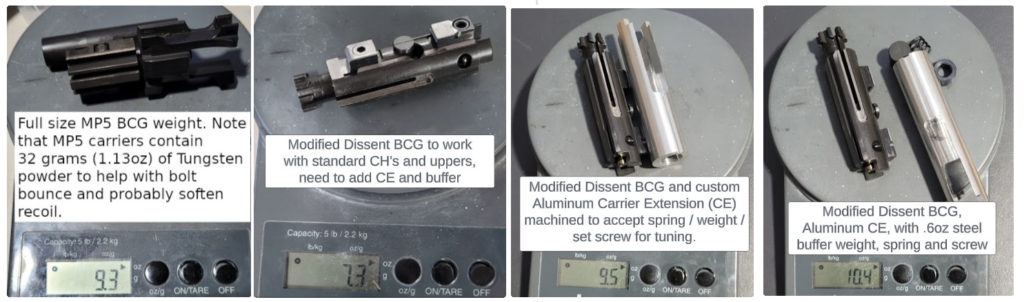 I know my criteria of wanting a tune-able and smooth full auto 9mm M16 is probably very small in the gun community but I am grateful that various manufacturers made the components that gave me the foundation to achieve my goals. My son is 13 and started shooting with me in SMG matches but only in semi auto for now. My configuration being lightweight and smooth has worked out well for him and I want the same manual of arms for a 556 AR15 / M16 so that he will be familiar with that when he is ready. I also had him try my MP5K PDW and he likes my hybrid setup over that. I also want the most reliable setup for him to use so he is not frustrated with malfunctions or learn how to clear them...for now. |


|
Originally Posted By JMattJ: For anyone having Banshee ejection issues, I’ve had success using an A5 length buffer in a carbine length extension. It perfectly short strokes so that the buffer bottoms out and the brass has a ton of room to leave the ejection port with a very consistent 4-5 o'clock pattern (I’m using the 6.83 oz VLTOR A5H4 buffer with my suppressor) The last round bolt hold open still works because it can grab the bottom lip of the BCG instead of the bolt face. I'm also using a braided HK 416 ejector spring. How many rounds do you have through this setup? Have you thought about trying our the K-spec a5h4 buffer, its a little heavier, but it should be smoother. |

|
Originally Posted By Mad-Machinist: Not trying to be a smart ass.....but with an unlocked action headspace isn't really possible to check. Do not decieve yourself, at no time is an RDB action ever locked. When I make RDB barrels I make then like a make DI barrels, with a locking bolt. It seems to work as I have done quite a few with out complaint. My CMMG 9mm Dissent RDB locks. I can take the upper off the lower, bush the BCG forward and insert a metal rod down the barrel applying pressure against the bolt face and it does not move. I'd call this locked. Once I pull the carrier back about 1/4 or so, then the bolt has rotated enough that the rod down the barrel can push it back. Not trying to be a smart ass.... but my testing shows CMMG isn't the one trying to deceive me. Per CMMG as well: A prime example of our Aim To Be Different mantra is our patented Radial Delayed Blowback system. The Radial Delayed Blowback system paved the way for larger caliber PCCs in an AR platform. Radial Delayed Blowback allows reliable operation without a heavy bolt, buffer or spring. The mechanical delay allows pressure to fall in the chamber before it unlocks.The system means less recoil, increased accuracy, and better velocity when using a suppressor. We started with .45 ACP and additionally, we offer 10mm, .40 S&W, 5.7x28mm and 9mm in our BANSHEE line. Attached File |
If you are putting a lot of effort into arguing with me, you are probably really just wasting your time, sorry.
|
Originally Posted By zentradi: My CMMG 9mm Dissent RDB locks. I can take the upper off the lower, bush the BCG forward and insert a metal rod down the barrel applying pressure against the bolt face and it does not move. I'd call this locked. Once I pull the carrier back about 1/4 or so, then the bolt has rotated enough that the rod down the barrel can push it back. Not trying to be a smart ass.... but my testing shows CMMG isn't the one trying to deceive me. Per CMMG as well: https://cmmg.com/radial-delayed-blowback A prime example of our Aim To Be Different mantra is our patented Radial Delayed Blowback system. The Radial Delayed Blowback system paved the way for larger caliber PCCs in an AR platform. Radial Delayed Blowback allows reliable operation without a heavy bolt, buffer or spring. The mechanical delay allows pressure to fall in the chamber before it unlocks.The system means less recoil, increased accuracy, and better velocity when using a suppressor. We started with .45 ACP and additionally, we offer 10mm, .40 S&W, 5.7x28mm and 9mm in our BANSHEE line. https://www.ar15.com/media/mediaFiles/14200/CMMG_RDB_png-3313236.JPG Originally Posted By zentradi: Originally Posted By Mad-Machinist: Not trying to be a smart ass.....but with an unlocked action headspace isn't really possible to check. Do not decieve yourself, at no time is an RDB action ever locked. When I make RDB barrels I make then like a make DI barrels, with a locking bolt. It seems to work as I have done quite a few with out complaint. My CMMG 9mm Dissent RDB locks. I can take the upper off the lower, bush the BCG forward and insert a metal rod down the barrel applying pressure against the bolt face and it does not move. I'd call this locked. Once I pull the carrier back about 1/4 or so, then the bolt has rotated enough that the rod down the barrel can push it back. Not trying to be a smart ass.... but my testing shows CMMG isn't the one trying to deceive me. Per CMMG as well: https://cmmg.com/radial-delayed-blowback A prime example of our Aim To Be Different mantra is our patented Radial Delayed Blowback system. The Radial Delayed Blowback system paved the way for larger caliber PCCs in an AR platform. Radial Delayed Blowback allows reliable operation without a heavy bolt, buffer or spring. The mechanical delay allows pressure to fall in the chamber before it unlocks.The system means less recoil, increased accuracy, and better velocity when using a suppressor. We started with .45 ACP and additionally, we offer 10mm, .40 S&W, 5.7x28mm and 9mm in our BANSHEE line. https://www.ar15.com/media/mediaFiles/14200/CMMG_RDB_png-3313236.JPG CMMG's marketing department isn't made up of engineers. The nature of blowback systems is that they are NOT locked. You are not pushing the bolt face w/ the force of a 9x19mm case. Get you a hammer and pound that rod, your bolt will rotate. |
I sell firearms produced by the finest child labor in the world, be it Filipino, Muslim, Mormon, Arizonan, or Texan.
|
Originally Posted By backbencher: CMMG's marketing department isn't made up of engineers. The nature of blowback systems is that they are NOT locked. You are not pushing the bolt face w/ the force of a 9x19mm case. Get you a hammer and pound that rod, your bolt will rotate. Duh, because hitting it with the hammer will create recoil and move the BCG back. Same as firing a round. The bolt must rotate to clear the lugs. It is a smooth system, a very smooth system when the bolt rotates, but there is engagement between the corresponding bolt and barrel lugs when the BCG is all the way forward in my CMMG Dissent 9mm. The bolt is locked from rearward movement when it's all the way forward, until (I estimate) about 1/4" of BCG movement occurs. That is probably why the Dissent 9mm gets away with the action being so easy to pull back (very little force needed to pull the BCG back, , yet operates smoothly and has almost no observable recoil. |
If you are putting a lot of effort into arguing with me, you are probably really just wasting your time, sorry.
|
So yah, you guys are full of crap. I just put a brass rod in the barrel, put it muzzle down with the BCG forward, and put weights on the stock and it didn't move at all. I took the same weights and put them on the charging handle and it pulled it right down, so if it wasn't locked from rearward movement, the same weight against the bolt face would have cycled it even with the BCG forward. |
If you are putting a lot of effort into arguing with me, you are probably really just wasting your time, sorry.
|
Originally Posted By zentradi: Duh, because hitting it with the hammer will create recoil and move the BCG back. Same as firing a round. The bolt must rotate to clear the lugs. It is a smooth system, a very smooth system when the bolt rotates, but there is engagement between the corresponding bolt and barrel lugs when the BCG is all the way forward in my CMMG Dissent 9mm. The bolt is locked from rearward movement when it's all the way forward, until (I estimate) about 1/4" of BCG movement occurs. That is probably why the Dissent 9mm gets away with the action being so easy to pull back (very little force needed to pull the BCG back, , yet operates smoothly and has almost no observable recoil. Originally Posted By zentradi: Originally Posted By backbencher: CMMG's marketing department isn't made up of engineers. The nature of blowback systems is that they are NOT locked. You are not pushing the bolt face w/ the force of a 9x19mm case. Get you a hammer and pound that rod, your bolt will rotate. Duh, because hitting it with the hammer will create recoil and move the BCG back. Same as firing a round. The bolt must rotate to clear the lugs. It is a smooth system, a very smooth system when the bolt rotates, but there is engagement between the corresponding bolt and barrel lugs when the BCG is all the way forward in my CMMG Dissent 9mm. The bolt is locked from rearward movement when it's all the way forward, until (I estimate) about 1/4" of BCG movement occurs. That is probably why the Dissent 9mm gets away with the action being so easy to pull back (very little force needed to pull the BCG back, , yet operates smoothly and has almost no observable recoil.  Ask yourself - what moves the bolt carrier? How can the bolt carrier move if the bolt is locked? I didn't understand radial delayed blowback when CMMG introduced it either until it was explained to me. The bolt in the CMMG radial delayed blowback system is NEVER locked. As soon as ignition occurs, the bolt begins to move rearward and rotate. You are mixing up the AR-15 gas operated bolt carrier and rotating bolt and this system. |
I sell firearms produced by the finest child labor in the world, be it Filipino, Muslim, Mormon, Arizonan, or Texan.
|
Originally Posted By zentradi: So yah, you guys are full of crap. I just put a brass rod in the barrel, put it muzzle down with the BCG forward, and put weights on the stock and it didn't move at all. I took the same weights and put them on the charging handle and it pulled it right down, so if it wasn't locked from rearward movement, the same weight against the bolt face would have cycled it even with the BCG forward. Mechanical advantage - how does it work? Taken a hammer to the rod in the barrel yet? What moves the bolt carrier? |
I sell firearms produced by the finest child labor in the world, be it Filipino, Muslim, Mormon, Arizonan, or Texan.
|
Originally Posted By backbencher: Mechanical advantage - how does it work? Taken a hammer to the rod in the barrel yet? What moves the bolt carrier? Not sorry I'm not going to hit my rifle with a hammer for you. Maybe I just hit things harder than you do. As far as the action, it's called timing, a very smooth action, the action works as designed. Absolutely, the bolt is locked from rearward movement when the carrier is forward. |
If you are putting a lot of effort into arguing with me, you are probably really just wasting your time, sorry.
|
Originally Posted By zentradi: Not sorry I'm not going to hit my rifle with a hammer for you. Maybe I just hit things harder than you do. As far as the action, it's called timing, a very smooth action, the action works as designed. Absolutely, the bolt is locked from rearward movement when the carrier is forward. Originally Posted By zentradi: Originally Posted By backbencher: Mechanical advantage - how does it work? Taken a hammer to the rod in the barrel yet? What moves the bolt carrier? Not sorry I'm not going to hit my rifle with a hammer for you. Maybe I just hit things harder than you do. As far as the action, it's called timing, a very smooth action, the action works as designed. Absolutely, the bolt is locked from rearward movement when the carrier is forward. What moves the carrier? That's the entire key to this action, and why is isn't - and can't be locked. What makes the carrier move? |
I sell firearms produced by the finest child labor in the world, be it Filipino, Muslim, Mormon, Arizonan, or Texan.
|
Originally Posted By backbencher: What moves the carrier? That's the entire key to this action, and why is isn't - and can't be locked. What makes the carrier move? The recoil moves the carrier back, rotating the bolt to unlock it and allow rearward movement. About an (estimated) 1/4 inch of movement of the carrier rearward occurs before the bolt is free from the barrel lugs for rearward movement. As I have said, the bolt is locked from rearward movement until the carrier has begun moving to the rear. Hitting it with a hammer will either create recoil the same as firing, if I allow for rearward movement of the weapon. If the weapon is completely fixed from movement, the force of the impact will press the bolt lugs against the barrel lugs, and that force will be transferred to the plastic brace and then to the floor. If the Dissent is floating, such as if it were being shouldered or in the hand, the force will allow the inertia of the mobile part, the bolt carrier, to travel to the rear at which time as designed the bolt will rotate and be free of the barrel lugs and move to the rear with the carrier. The bolt may not stay as locked as long as other designs such as the Stribog A3, although lacking a high-speed camera to test this, I can accurately state I find the roller-locked Stribog better at suppression (use of a silencer), in comparison to the Dissent, although the Dissent is significantly better suppressed than any blowback I have shot. This combination of the inertia-driven carrier and the timing of the radial delayed blowback allows for both a smooth cycling action and a very light recoil spring. The bolt is locked from rearward movement when the carrier is forward. Therefore I find CMMG's description accurate and Macon's post as deceiving. I again retested and verified you are full of crap, by placing weights on a rod pressed against the bolt face with the carrier forward and no movement occurred, however then the same weight is applied to the charging handle it easily pulls the bolt carrier group to the rear. Until rearward movement of the carrier occurs, the bolt in my Dissent is locked from rearward movement. |
If you are putting a lot of effort into arguing with me, you are probably really just wasting your time, sorry.
|
Originally Posted By zentradi: The recoil moves the carrier back, rotating the bolt to unlock it and allow rearward movement. About an (estimated) 1/4 inch of movement of the carrier rearward occurs before the bolt is free from the barrel lugs for rearward movement. As I have said, the bolt is locked from rearward movement until the carrier has begun moving to the rear. Hitting it with a hammer will either create recoil the same as firing, if I allow for rearward movement of the weapon. If the weapon is completely fixed from movement, the force of the impact will press the bolt lugs against the barrel lugs, and that force will be transferred to the plastic brace and then to the floor. If the Dissent is floating, such as if it were being shouldered or in the hand, the force will allow the inertia of the mobile part, the bolt carrier, to travel to the rear at which time as designed the bolt will rotate and be free of the barrel lugs and move to the rear with the carrier. The bolt may not stay as locked as long as other designs such as the Stribog A3, although lacking a high-speed camera to test this, I can accurately state I find the roller-locked Stribog better at suppression (use of a silencer), in comparison to the Dissent, although the Dissent is significantly better suppressed than any blowback I have shot. This combination of the inertia-driven carrier and the timing of the radial delayed blowback allows for both a smooth cycling action and a very light recoil spring. The bolt is locked from rearward movement when the carrier is forward. Therefore I find CMMG's description accurate and Macon's post as deceiving. I again retested and verified you are full of crap, by placing weights on a rod pressed against the bolt face with the carrier forward and no movement occurred, however then the same weight is applied to the charging handle it easily pulls the bolt carrier group to the rear. Until rearward movement of the carrier occurs, the bolt in my Dissent is locked from rearward movement. Originally Posted By zentradi: Originally Posted By backbencher: What moves the carrier? That's the entire key to this action, and why is isn't - and can't be locked. What makes the carrier move? The recoil moves the carrier back, rotating the bolt to unlock it and allow rearward movement. About an (estimated) 1/4 inch of movement of the carrier rearward occurs before the bolt is free from the barrel lugs for rearward movement. As I have said, the bolt is locked from rearward movement until the carrier has begun moving to the rear. Hitting it with a hammer will either create recoil the same as firing, if I allow for rearward movement of the weapon. If the weapon is completely fixed from movement, the force of the impact will press the bolt lugs against the barrel lugs, and that force will be transferred to the plastic brace and then to the floor. If the Dissent is floating, such as if it were being shouldered or in the hand, the force will allow the inertia of the mobile part, the bolt carrier, to travel to the rear at which time as designed the bolt will rotate and be free of the barrel lugs and move to the rear with the carrier. The bolt may not stay as locked as long as other designs such as the Stribog A3, although lacking a high-speed camera to test this, I can accurately state I find the roller-locked Stribog better at suppression (use of a silencer), in comparison to the Dissent, although the Dissent is significantly better suppressed than any blowback I have shot. This combination of the inertia-driven carrier and the timing of the radial delayed blowback allows for both a smooth cycling action and a very light recoil spring. The bolt is locked from rearward movement when the carrier is forward. Therefore I find CMMG's description accurate and Macon's post as deceiving. I again retested and verified you are full of crap, by placing weights on a rod pressed against the bolt face with the carrier forward and no movement occurred, however then the same weight is applied to the charging handle it easily pulls the bolt carrier group to the rear. Until rearward movement of the carrier occurs, the bolt in my Dissent is locked from rearward movement. Dude, it's not an inertial lock - at all. The bolt begins moving rearward and rotating as soon as the base of the case begins pressing on it. That starts the rearward motion of the carrier. The faster movement of the carrier to the rear than the bolt itself is what creates the delay, and allows the recoiling mass to be lower than if it was straight blowback. You can verify this yourself by taking your gun to the range, and sandbagging it on a bench til it doesn't move at all. If it was an inertial lock like a Benelli shotgun, the gun wouldn't be able to cycle. It will cycle, b/c it's not an inertial lock. The delay is from the mechanical advantage of the cam pin. Which is why you're not getting the bolt to unlock w/ the same force you applied to the carrier. When you pull the charging handle, it operates directly on the carrier, giving you a mechanical advantage in twisting the bolt. When the case, or your rod, presses directly on the bolt, it is moving the bolt hundredths of an inch as the bolt begins to rotate, and the cam pin forces the carrier to move significantly faster than the bolt itself can move to the rear. Pull your bolt carrier out, and you can see if you hold the bolt in one place, and rotate the bolt, the carrier is forced to the rear. SAAMI limits for pressure on the case head are 35,000 PSI, so just pushing a rod against the bolt face by hand is probably not going to get it to move when it's in battery. You're gonna need a hammer or a hydraulic jack. Using the external dimensions of the 9mm case head, instead of the proper internal one, and 3.14 for Pi, max pressure 9x19mm uses up to 4200 pounds of force to operate that bolt. Look at svdude's posts above, as he gradually figures it out. I can't seem to link to his exact post where the lightbulb goes on.  Radial Delayed Blowback - A Closer Look Here is CMMG's animation - and they correctly show the bolt carrier moving to the rear at the same time the bolt begins to rotate. Try watching it at .25 speed starting at about 40 seconds. The bolt's rotation, forces the cam pin to rotate in the carrier, which forces the bolt to the rear as the cam pin moves in the cam path. Because of the mechanical advantage built into the cam path, the bolt carrier moves faster to the rear than the bolt can. This mechanical advantage, which accelerates the bolt carrier, provides the delay in the blowback action. |
I sell firearms produced by the finest child labor in the world, be it Filipino, Muslim, Mormon, Arizonan, or Texan.
|
If I can stack weights on something and it remains mobile, it's locked... until it isn't and then it moves. Not sure if you are just bent on getting the last wrong word in, encouraging Macon's seemingly effort at deception or what, but CMMG's description remains accurate. I do agree as well with the smoothness and niceness of the CMMG Dissent's 9mm action, and for that they definitely did well when so many companies are living in the past with simple blowback. Talk about living in the outdated. https://cmmg.com/radial-delayed-blowback "The mechanical delay allows pressure to fall in the chamber before it unlocks" Keep arguing, but I hope you understand you are only trying to convince yourself. They actually made it, so I think they know what they are talking about on this one. Good luck with yourself. |
If you are putting a lot of effort into arguing with me, you are probably really just wasting your time, sorry.
|
It’s not locked. It just takes more force than your rod to overcome the radial DELAY. This is done with mechanical (dis)advantage through the cam pin. As the bolt is pushed rearward the angled lugs make it rotate. This has to push the carrier back at a faster speed through the cam pin. That is the delay. Pulling the charging handle moves the carrier to the rear, eliminating the mechanical disadvantage of the fired cartridge (or rod) pushing the bolt. If it was locked like a regular AR-15, then the lugs wouldn’t need to be cut at an angle. Also the angle wouldn’t need to be different for the different amount of force with different calibers. |
Joined:
Feb 2024
Posts:
5
EE: 0% (0)
AZ, USA
| LOL. If y'all watch the video in post #45 carefully you will see how the bolt and carrier interact. "Recoil" is not exactly the driving force here, it's the case thrust which pushes the bolt back. Recoil begins the instant the bullet starts to move out of the case, the case doesn't begin to push back on the bolt until the chamber pressure has subsided enough to overcome the grip of the case on the chamber walls and allow it to begin to move back towards the bolt. As the bolt starts to move back the angled surfaces of the lugs contact the barrel extension and starts to rotate the bolt. This rotation is transferred to the BCG pin which then cams the carrier back. If the bolt was "locked" to the extension then the case thrust would not be able to move it backwards. Instead the case thrust does indeed push the bolt back, the delay is the rotation required for the lugs to clear the extension as the carrier moves back. In a DI AR-15 it is the gas which causes the carrier to move back first, then the camming action of the pin on the bolt rotates the latter, unlocking the bolt from the extension - the opposite of what happens in the CMMG action where the bolt drives the carrier. It's really pretty simple and elegant if you pay attention. |
Joined:
Aug 2022
Posts:
603
EE: 100% (171)
USA
|
Originally Posted By zentradi: If I can stack weights on something and it remains mobile, it's locked... until it isn't and then it moves. Not sure if you are just bent on getting the last wrong word in, encouraging Macon's seemingly effort at deception or what, but CMMG's description remains accurate. I do agree as well with the smoothness and niceness of the CMMG Dissent's 9mm action, and for that they definitely did well when so many companies are living in the past with simple blowback. Talk about living in the outdated. https://cmmg.com/radial-delayed-blowback "The mechanical delay allows pressure to fall in the chamber before it unlocks" Keep arguing, but I hope you understand you are only trying to convince yourself. They actually made it, so I think they know what they are talking about on this one. Good luck with yourself. No offense but you seem to not understand the difference between a delayed blowback and a locked breach. You can smack a locked ar-15 bolt as hard as you want, it ain't opening until the carrier is pushed back. There is no such mechanism on the CMMG. The system is mechanically delayed not locked. No matter what a marketing guy writes on a website. I can find you a ton of websites that say the AR-15 is direct impingement, but it's clearly an internal piston. |
|
CMMG remains correct. The bolt is locked from rearward movement until it begins to rotate at which time the ramped area of the back of the bolt is in contact with the barrel lugs and the bolt glides smoothly over the barrel lugs. This is why I can stack weights against it, and the carrier must move first, to allow the rotation of the bolt. This is why the CMMG dissent sounds better suppressed than straight blowback guns. It is a very well-thought-out and timed action that allows for a smooth movement. The CMMG action is very well done. Unless you have the muscle fortitude of a weak pansy, there is hardly any recoil. A roller lock action such as an A3 Stribog does suppress better though, so I would love to see what CMMG could do to make a more inertia-driven action to further delay the movement of the bolt, because shooting unsuppressed guns is lame. I might custom make a bolt that has an increased flat area distance before ramp contact area, similar to the .40 bolt, to try and delay the unlocking further. The bolt does eventually move, it's not like a bolt or lever action that needs to be manually moved. Saying it doesn't lock because it moves means you don't get the whole semi-automatic repeating weapon idea. Attached File |
If you are putting a lot of effort into arguing with me, you are probably really just wasting your time, sorry.
AR Sponsor