


AR Sponsor
Posted: 5/26/2025 6:05:02 PM EDT
|
My project: I'm (finally) building a (legally) rifle lower using a variation of the GRS buffer setup (as designed by Blowback9). A few events aligned with purchasing parts for other builds during Memorial Day sales such that it was convenient for me to get the parts for a GRS setup. I'm going to experiment with the tungsten weights, and I am building this out as a rifle lower. I have 2 9mm 16" uppers, but only 1 rifle lower. I run both suppressed. My current 9mm rifle lower has a Maxim carbine buffer length RDB. I thought it would be nice to have a side-by-side comparison with a GRS buffered lower. GRS Background, synopsis of pertinent parts (for the uninitiated): The Original GRS setup which Blowback 9 describes as "the best" of his GRS configurations, with "recoil impulse [that] feels similar to a CMMG Banshee", is the performance I want to emulate. This setup uses a JRC 8.5" tube, flatwire spring, Kynshot RB5015HD All PCC 9mm Heavy Damped Hydraulic Recoil Buffer for High Pressure or Suppressed (6 oz.), and 2x Kynshot Spacer Weights 0.75", 2.5oz. (=1.5", 5 oz). Total buffer weight 11 oz. The GRS tungsten weight experimental setup "best solution" is listed as 7" carbine buffer tube, flatwire spring, Kynshot RB5000HP Multi-Caliber High Performance Hydraulic Recoil Buffer For High Pressure Or Suppressed, and 2x tungsten spacer weights 3/8", 3.25 oz. (= 3/4", ~6.5- oz.). Total buffer weight ~11 oz. While the total weight is approximately the same, the tungsten setup moves about 1.5 oz out of the deadblow (buffer body) section of the buffer, and moves it forward of the buffer head. Same weight, but the original GRS should have a superior deadblow effect (or have an interesting reason to not). My Intended Setup: I ended up with a spare KAK A5 tube, so I decided to split the difference between the GRS original 8.5" and the experimental tungsten setups 7" lengthwise, but emulate the buffer & weights of the heavy/suppressed setup, as I'm shooting suppressed heavy loads from a longer barrel -- which seems like a situation calling for the a heavy GRS setup. As this is a rifle lower, the build is a little bit heavier overall, hopefully helping resist any red dot bounce from heavy buffer... not that it really matters at the rate I typically shoot. Using a 7.75" tube, I am going to try out Dirty Bird and Battle Steel flatwire springs, with the less well-fit going in another build. I like the force profiles on these, with slightly higher than mil-spec closed bolt forces, but fully-open bolt force at or below mil-spec. I am hoping this force profile reduces the initial opening acceleration as much as possible without also creating excessive bolt speed during chambering. (If by chance neither spring works satisfactorily due to end ID issues, I'll get a Tubb or Spinta.) For the buffer & weights, I'm going to use the longer RB5015HD Kynshot buffer (6 oz), and 2 tungsten spacers (3/4", 6.5oz.). That should be the right length (will verify pre testing), and with total buffer weight 12.5 oz., I believe appropriate for a suppressor and longer barrel. I looked at the work Blowback9 did on the tungsten spacers, and I plan to remove less mass from the spacers by having smaller grooves. To complement that, I'll add some additional small holes at the bottoms of the position holes on the buffer tube and in an arrangement at the rear of the buffer, similar to the hole pattern in the Griffin Maritime buffer tube. I want to avoid the piston effect Blowback9 mentions in Tungsten GRS article, but I figured I'd use a 2-pronged approach to keep the mass as high as possible. The piston effect is created when a mass that covers a significant majority of the cross-section of a tube moves through the tube. To reduce the effect, the cross-section of the mass needs to be reduced (flats on 3 sides of buffer faces, or grooves in this case), the tube needs to get wider (not an option), or the tube needs to stop being enclosed (skeletonized or regular openings). Adding holes makes the tube less enclosed, and smaller grooves along the tungsten means less mass removed. The piston effect is also reduced by reducing the mass's speed, which is what adding mass does (through reducing acceleration). I'm hoping the higher mass/slower speed also aids in mitigating the piston effect. The KAK A5 length tube should be ideal for this, as it's a 9 position tube and the center of each flat-bottomed position indent on the buffer tube has an smaller indent at its center, perfectly angled to center a drill bit. I'm thinking that'll make for easy and adequate regular openings, especially combined with 3 additional ones on the rear, to ensure there's not a piston effect. I'll post pics when I got something photo-worthy. And now, I wait for shipment and arrival. |
|
Quoted: Just to be clear...looks like for your 'total reciprocating weight' you are not including the weight of the bolt. Looks like you are just talking about what you are stuffing in the buffer tube. Yes. I failed to add the word "buffer" into 2/3 places I used the phrase. Meant to type out "total reciprocating buffer weight" for all 3 places. Will clarify. "total buffer weight" is simpler and clearer. I don't know why my brain got stupid about the terms. Next time we talk, I'll ask. ETA: first post edited/clarified |
| Already tried everything you're doing, using a Tubb spring. Even tried using the 5000HP buffer, two Tungsten weights and a 3/4 inch spacer under the spring. Not completely under the spring, only 1/16" with the rest inside the spring. Drilled all the holes on the buffer tube. too. It works! |
|
Quoted: Already tried everything you're doing, using a Tubb spring. Even tried using the 5000HP buffer, two Tungsten weights and a 3/4 inch spacer under the spring. Not completely under the spring, only 1/16" with the rest inside the spring. Drilled all the holes on the buffer tube. too. It works! Good to know I'm barking up the right hole. Did you use adhesive between the weights? How long of a barrel did you use with it? Suppressed or un? And as to a buttstock -- did you feel the need to get one that allowed more air to flow through the position holes? Or was any stock fine? (I'm not worried too much about this, but I'd hate to undo the effect of what I just did, and I just realized this evening I don't any in the parts bin.) ------------------------------- Gotta give a shout-out to the pinewood derby supplies company that Blowback9 mentions and links to in his article on the tungsten weights (link in first post). I'm not going to name drop them here, as they are not a firearms company and make products many kids use. Anyhow, my tungsten weights shipped today. I wasn't expecting any particular delay in shipping, but the short order prep time was nice. Botach also shipped today, so my kynshot buffer is on the way, too. I suppose I should give them props for the quick turnaround, too. I got the KAK 9 position buffer tube in the drill press today. The rear 4 position holes I drilled out to 5/32". The next 4 I drilled out to 3/32". The front position hole I didn't drill out. I widened the center rear hole to 3/32", but have not added any additional holes. |
|
Quoted: Is this a free-recoil system where the buffer comes to a stop on its own before smacking the back of the tube? If so, I don't think I've seen any straight blowback 9mm configuration achieve that. Also look at @blowback9 overmass project. Going all the way to 37.5oz and a 2.5" barrel, he found it would still cycle and the GRS isn't that heavy so I would suspect it is still going to bottom out on the buffer tube. https://blowback9.wordpress.com/2022/09/30/the-overmass-project-worlds-heaviest-9mm-blowback-action/ I have a CMMG RDB build that I'm pretty sure isn't bottoming out but I need to get someone to go with me to the range to help me with taking the video to prove it. I am going the opposite direction and want to reduce the reciprocating mass. In the configuration below, my modified Dissent BCG + my aluminum hollow carrier extension is 9.4 oz + RB5007 is 5.9 oz so a total of 15.3oz of total reciprocating mass. Suppressor is one that I re-cored and an integral. I only have 6 ports in the barrel as it is 5" long. I ported just enough to make typical 115 and 124 Gr subsonic.  |
|
Quoted: Good to know I'm barking up the right hole. Did you use adhesive between the weights? How long of a barrel did you use with it? Suppressed or un? And as to a buttstock -- did you feel the need to get one that allowed more air to flow through the position holes? Or was any stock fine? (I'm not worried too much about this, but I'd hate to undo the effect of what I just did, and I just realized this evening I don't any in the parts bin.) No adhesive as such, just a light coat of oil. Barrels have bee anywhere from 2-1/2' to 16", un-suppressed. Several different buttstocks and braces, with nothing done to affect air flow. Drilled all holes in the tube to the diameter of the dimple, just because it was easy. Three narrow grooves around diameter of Tungsten spacers. |
|
Thanks, hdcharlie! Spring Selection When I looked at Blowback9's Flat Wire Spring Comparison article a couple trends stood out. Blowback9 has listed the ID of the spring at the ends and in the middle. This is a great detail. A lot of people don't realize how tricky bending the end of a spring closed (to make a flat end) can be. As the metal twists to align horizontally, it relieves stress and the spring wants to expand outward. So when you close a spring, you have to apply inward force as it is bent shut. Not enough, the ID at the ends is wider than in the middle. Bend it inward too much, and your ID at the ends will be narrower than the middle. While typically uniformity is the goal, a tighter end can be intentional, but I don't consider it a feature here. (I've made lots of springs, though it's been a while.) The ID is important in binding. Looking at Blowback 9's chart Once the middle of the spring has an ID <= .764", it binds or is tight. Every spring rated "loose" across the board has |middle_ID - end_ID| <= .002" (This, to me, is indicative of a refined spring-end closing process and likely a quality manufacturing process.) So, why would I choose Battle Steel or Dirty Bird when they're not ideal? Well, I had access to them without an additional shipping cost, and I think I can improve them. Their middle ID is right between AR Stoner and Tubb springs, yet they bind. Their end IDs are both <=.750, significantly smaller than their .773"/.774" middle IDs, but it is only at the very end that the diameter decreases. Some light bending of the last half-coil or so allows the spring to destress and open up. I believe I can eliminate any binding issues by doing this. With a couple gentle bends, the Dirty Bird spring opened from from .743" (my initial measurement) to ~.755". I'm sure I can get the ID > .765" without too much work or any damage to the springs. If I'm successful, then that might expand the options for springs. If not, I'll just grab one of the other springs and pay shipping. |
|
An (short) update, with more (& pics) coming soon: Will follow up with a longer update once I get some pictures, get parts on a scale, and get to the range. All my parts arrived. Botach's seemingly zippy shipping was an illusion -- 3 days after the shipping notice (generated by simply printing a shipping label), they let me know they were cancelling part of my order because they had run out of stock, and would finally ship the rest. Fortunately, it wasn't the kynshot. My tungsten rounds arrived first, by a few days. The tungsten rounds measured at 1.000" and 0.999" in diameter and needed a slight reduction in size, but not quite the reduction Blowback9's needed. With about 15 minutes of shop time, starting with the side of grinding wheel, they fit the tube and were acceptably smooth. I did not put any flats, slots or grooves around the sides -- if I have problems with that, I'll address it in the future; for now, max mass. The kynshot fits fine with the Dirty Bird spring after opening the end of the spring up slightly. I mostly shoot 135gr and 148gr subs, and I test fired a few 148gr. suppressed rounds -- Wow! Smooth. All my AR-9s, before starting this GRS lower, ran on buffer systems requiring the removal of the weight in the bolt. So when I tested the upper on this, it was with a bolt that I hadn't re-installed a weight in. After sorting out some uppers and lowers, I now have a weight reinstalled in one of my bolts, and I expect will only improve smoothness once I do some more proper testing at the range. |
Murphy and his law had a strong say in how my range trip went. I took this newly built lower, a Maxim RDB (carbine tube length) lower, and two 16" uppers, one setup for each lower. Plan was to compare them side by side. Alas, 'twas not to be in any meaningful sense.  I am not a happy camper right now, largely because I, of course, can blame myself for a good chunk of it. I am not a happy camper right now, largely because I, of course, can blame myself for a good chunk of it.The GRS performed fine. Everything else not so much. The charge was lead by too many untested new parts in a new lower, and followed by one 16" barrel I thought I had modified the feed cone on, but apparently neglected when I did so to every other 9mm AR barrel I own. The cycling was very smooth, but the second upper I was running didn't have the tail weight installed in the bolt, so it wasn't as good as it could be. The bolts weren't interchangeable between the uppers due to one being an FM forward charger.  - Feed cone not reprofiled => feeding issues! (At least I had a second upper w/modified feed cone!) - Cheap Rguns lower w/rough mag well walls + Sylvan Arms mag well adapter => very tight magwell was a problem for every magpul glock mag, and others! - Rough magwell walls + Sylvan arms mag well adapter => magazines tilted forward and back if not held in place, intermittent feeding issues! - New trigger (apparently) in need of adjustment => an unexpected "follow up" shot! x2 - Feed cone not reprofiled => feeding issues! (At least I had a second upper w/modified feed cone!) - Cheap Rguns lower w/rough mag well walls + Sylvan Arms mag well adapter => very tight magwell was a problem for every magpul glock mag, and others! - Rough magwell walls + Sylvan arms mag well adapter => magazines tilted forward and back if not held in place, intermittent feeding issues! - New trigger (apparently) in need of adjustment => an unexpected "follow up" shot! x2Clearly I would be in a better position if I shelled out the money to build another dedicated 9mm lower, lol. Or get some endomags. Either way, can't really do a decent side by side test unless both lowers are fully functional. I used parts I had sitting around (lower, mag well adapter) to build the non-buffer system parts of the lower. I have a stripped Aero Ambi lower sitting around I could throw this all in to see if it cleans up some of the tight mag well issues, but I'd prefer to get another dedicated lower and not waste the ambi mag release on a 9mm lower w/magwell adapter. I had never used the Sylvan arms mag adapter before this, and I may not again after. Maybe it just needs a more agreeable lower, but I don't think that'll clean up the magazine tilting forward and back. It had been in a parts container for several years, and so there it shall return, cursed to stay for all eternity. (Or something less dramatic.) I'll get some pics and weights later when I'm done being pissed off about a less than stellar range trip. The trigger issue I'm 99% certain is related to the trigger itself, a new Griffin 2 stage. The trigger is relatively new to the market, and the misbehavior of mine fits a reported issue, most likely solved by trigger adjustment. Like an idiot, I didn't have the adjustment allen wrench there. But, through sheer luck, one of Griffin's customer service rep/warranty repair guys was working a second job at the range, something he does only a couple days a month. I had an informative chat with him after paying for the metal target hanger that I put a hole through with the second inadvertent "follow up" shot, and feel confident in what I should adjust to tune the trigger. Anyway, after the cascading series of setbacks during the course of putting about a hundred rounds downrange, I called it a day. I came home, started a fire, played with the dogs, and did some yard work until the rain set in; then I came in and typed this. I'll leave you with a quote from an old Crosby, Stills, and Nash song that started going through my head as I was cleaning up at the range: So we cheated and we lied and we tested And we never failed to fail It was the easiest thing to do -- Stephen Stills, "Southern Cross" |
|
Quoted: Murphy and his law had a strong say in how my range trip went. I took this newly built lower, a Maxim RDB (carbine tube length) lower, and two 16" uppers, one setup for each lower. Plan was to compare them side by side. Alas, 'twas not to be in any meaningful sense. I am not a happy camper right now, largely because I, of course, can blame myself for a good chunk of it.The GRS performed fine. Everything else not so much. The charge was lead by too many untested new parts in a new lower, and followed by one 16" barrel I thought I had modified the feed cone on, but apparently neglected when I did so to every other 9mm AR barrel I own. The cycling was very smooth, but the second upper I was running didn't have the tail weight installed in the bolt, so it wasn't as good as it could be. The bolts weren't interchangeable between the uppers due to one being an FM forward charger. - Feed cone not reprofiled => feeding issues! (At least I had a second upper w/modified feed cone!) - Cheap Rguns lower w/rough mag well walls + Sylvan Arms mag well adapter => very tight magwell was a problem for every magpul glock mag, and others! - Cheap mag well adapter => magazines tilted forward and back if not held in place, intermittent feeding issues! - New trigger (apparently) in need of adjustment => an unexpected "follow up" shot! x2Clearly I would be in a better position if I shelled out the money to build another dedicated 9mm lower, lol. Or get some endomags. Either way, can't really do a decent side by side test unless both lowers are fully functional. I used parts I had sitting around (lower, mag well adapter) to build the non-buffer system parts of the lower. I have a stripped Aero Ambi lower sitting around I could throw this all in to see if it cleans up some of the tight mag well issues, but I'd prefer to get another dedicated lower and not waste the ambi mag release on a 9mm lower w/magwell adapter. I had never used the Sylvan arms mag adapter before this, and I may not again after. Maybe it just needs a more agreeable lower, but I don't think that'll clean up the magazine tilting forward and back. It had been in a parts container for several years, and so there it shall return, cursed to stay for all eternity. (Or something less dramatic.) I'll get some pics and weights later when I'm done being pissed off about a less than stellar range trip. The trigger issue I'm 99% certain is related to the trigger itself, a new Griffin 2 stage. The trigger is relatively new to the market, and the misbehavior of mine fits a reported issue, most likely solved by trigger adjustment. Like an idiot, I didn't have the adjustment allen wrench there. But, through sheer luck, one of Griffin's customer service rep/warranty repair guys was working a second job at the range, something he does only a couple days a month. I had an informative chat with him after paying for the metal target hanger that I put a hole through with the second inadvertent "follow up" shot, and feel confident in what I should adjust to tune the trigger. Anyway, after the cascading series of setbacks during the course of putting about a hundred rounds downrange, I called it a day. I came home, started a fire, played with the dogs, and did some yard work until the rain set in; then I came in and typed this. I'll leave you with a quote from an old Crosby, Stills, and Nash song that started going through my head as I was cleaning up at the range: So we cheated and we lied and we tested And we never failed to fail It was the easiest thing to do -- Stephen Stills, "Southern Cross" As you indicated that the walls of the lower were not properly made, I strongly suspect that the cause of the magwell adapter to not fit properly was directly related to the magwell itself, not the adapter. I've had a Sylvan Arms Glock mag pattern magwell adapter for about six years and it fits properly in a Colt M16 lower and a couple other brand AR-15 lowers where I've used it. Also, while not Aero brand, in the past few years I've had to file out the inner magwells of a couple AR lowers to get even mil spec mags to fit. In addition, while not directly related, I suspect that a lot of poorly functional .22LR AR attempts are due to upper receivers being out of spec. I speculate that there is simply a certain level of poor quality manufacture and inspection occurring. MHO, YMMV, etc. |
|
Quoted: As you indicated that the walls of the lower were not properly made, I strongly suspect that the cause of the magwell adapter to not fit properly was directly related to the magwell itself, not the adapter. I've had a Sylvan Arms Glock mag pattern magwell adapter for about six years and it fits properly in a Colt M16 lower and a couple other brand AR-15 lowers where I've used it. Also, while not Aero brand, in the past few years I've had to file out the inner magwells of a couple AR lowers to get even mil spec mags to fit. In addition, while not directly related, I suspect that a lot of poorly functional .22LR AR attempts are due to upper receivers being out of spec. I speculate that there is simply a certain level of poor quality manufacture and inspection occurring. MHO, YMMV, etc. I appreciate the info on the Sylvan. With that info, I'd say it probably is the lower - this Rguns lower was like $35 on sale, so if I have to file out the mag well a bit, so be it. You can see and feel the striations from the machining inside the magwell. I got it when I was at the store already (getting the on-sale Aero ambi-lowers), so I gave it a try. The Aero I mentioned is one I have sitting around from that Memorial Day weekend shopping trip. ETA: The Sylvan magwell was making contact with both uppers -- the retention screw at the right rear of the adapter's top face -- and was making contact with the FM upper at the front of the raised bar on the front right side of the magwell adapter. The pressure from this couldn't have helped with the magazine and magwell issues. A nice confluence of events. ETA 2: After addressing both of those points of contact and pressure, inserting magazines got MUCH easier. I'm pretty sure pressure from the uppers was deforming the mag adapter enough to pinch the magazines. This may have altered feeding. I owe the corrected setup another chance, but a new lower is on my to-do list now, regardless. |
|
I went through it looking for a FWS for my RB5007....and found a few things that need some updating. The best flatwire spring he recommended is the AR Stoner (part #972072) and it's been discontinued. Good luck with the Spinta flatwire spring being in-stock. It's been sold out for months. I have a few of the newer Wilson flatwire springs.... I will verify it won't slide over the RB5007 buffer body. So that leaves the either of the Tubbs FW springs as the best option for the Kynshot RB series hydraulic buffers. Or the Bexar FWS if the spring rate works for you. They claim 12lbs bolt back, 7.5lbs bolt forward, so a little different from what is on blowback's chart. . |
|
Quoted: I went through it looking for a FWS for my RB5007....and found a few things that need some updating. The best flatwire spring he recommended is the AR Stoner (part #972072) and it's been discontinued. Good luck with the Spinta flatwire spring being in-stock. It's been sold out for months. I have a few of the newer Wilson flatwire springs.... I will verify it won't slide over the RB5007 buffer body. So that leaves the either of the Tubbs FW springs as the best option for the Kynshot RB series hydraulic buffers. Or the Bexar FWS if the spring rate works for you. They claim 12lbs bolt forward, 7.5lbs bolt back, so a little different from what is on blowback's chart. I think it is a nice compromise between the Tubb 556 and Tubb LW spring. The power is between the two. The Tubb LW spring is too weak for 5.56 use but gives me a slower full auto cyclic rate. The Neverwear is pretty close but still works with 556 uppers. 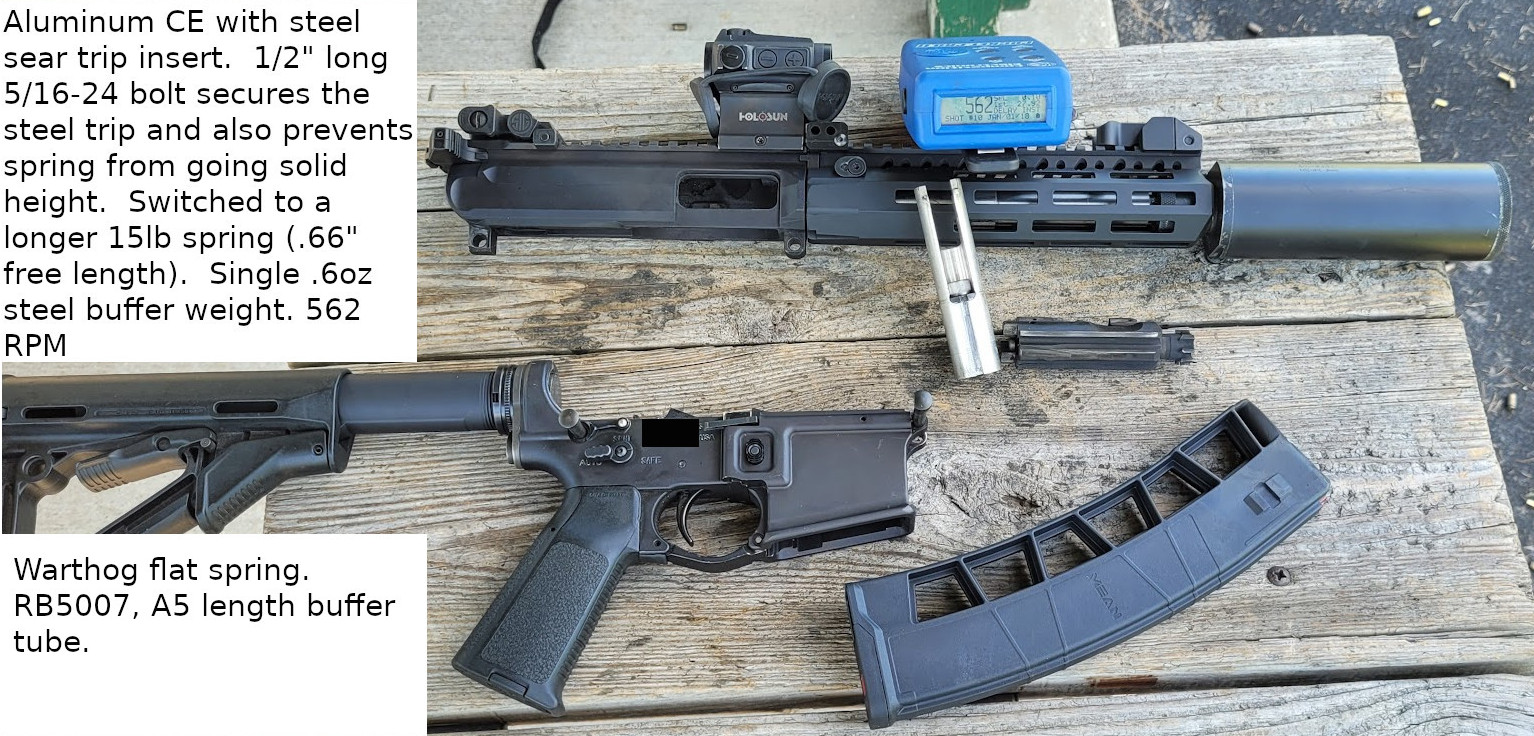 I was getting them from Apex when they had them in stock: https://www.apexgunparts.com/ar15-m16-flat-buffer-spring-new-us-made.html Or you can get them direct from here: https://www.neverwearsprings.com/index.php/product/ar15-warthog-flat-wire-buffer-spring-1-spring-26-00-ea/ |
|
Quoted: I appreciate the info on the Sylvan. With that info, I'd say it probably is the lower - this Rguns lower was like $35 on sale, so if I have to file out the mag well a bit, so be it. You can see and feel the striations from the machining inside the magwell. I got it when I was at the store already (getting the on-sale Aero ambi-lowers), so I gave it a try. The Aero I mentioned is one I have sitting around from that Memorial Day weekend shopping trip. ETA: The Sylvan magwell was making contact with both uppers -- the retention screw at the right rear of the adapter's top face -- and was making contact with the FM upper at the front of the raised bar on the front right side of the magwell adapter. The pressure from this couldn't have helped with the magazine and magwell issues. A nice confluence of events. ETA 2: After addressing both of those points of contact and pressure, inserting magazines got MUCH easier. I'm pretty sure pressure from the uppers was deforming the mag adapter enough to pinch the magazines. This may have altered feeding. I owe the corrected setup another chance, but a new lower is on my to-do list now, regardless. Quoted: Quoted: As you indicated that the walls of the lower were not properly made, I strongly suspect that the cause of the magwell adapter to not fit properly was directly related to the magwell itself, not the adapter. I've had a Sylvan Arms Glock mag pattern magwell adapter for about six years and it fits properly in a Colt M16 lower and a couple other brand AR-15 lowers where I've used it. Also, while not Aero brand, in the past few years I've had to file out the inner magwells of a couple AR lowers to get even mil spec mags to fit. In addition, while not directly related, I suspect that a lot of poorly functional .22LR AR attempts are due to upper receivers being out of spec. I speculate that there is simply a certain level of poor quality manufacture and inspection occurring. MHO, YMMV, etc. I appreciate the info on the Sylvan. With that info, I'd say it probably is the lower - this Rguns lower was like $35 on sale, so if I have to file out the mag well a bit, so be it. You can see and feel the striations from the machining inside the magwell. I got it when I was at the store already (getting the on-sale Aero ambi-lowers), so I gave it a try. The Aero I mentioned is one I have sitting around from that Memorial Day weekend shopping trip. ETA: The Sylvan magwell was making contact with both uppers -- the retention screw at the right rear of the adapter's top face -- and was making contact with the FM upper at the front of the raised bar on the front right side of the magwell adapter. The pressure from this couldn't have helped with the magazine and magwell issues. A nice confluence of events. ETA 2: After addressing both of those points of contact and pressure, inserting magazines got MUCH easier. I'm pretty sure pressure from the uppers was deforming the mag adapter enough to pinch the magazines. This may have altered feeding. I owe the corrected setup another chance, but a new lower is on my to-do list now, regardless. FWIW, I don't use the retention screw with the Sylvan adapter. My first purchased AR 9mm magwell adapter is a VM Hytech that I bought in 2008, and it does not have a retention feature. So I got used to stretching an o-ring over the standard AR mag release button to prevent the button from being pushed inward, and continue to do so with the Sylvan and Stern Defense magwell adapters as well. MHO, YMMV, etc. |
|
So, I've been keeping busy, and it's delayed me getting to an update. First some details on the GRS setup I have and guns I have it on, then the range trip and my reactions. Real short version: I love the GRS. Buffer Weight Setup  RB5015HD + 2 Tungsten round weights Weight: 12.5 oz. As I had put multiple holes in the buffer tube to allow pressure to rapidly equalize, I opted not to put flats or grooves in the sides of the tungsten weights. To reduce their diameter to fit in the tube, I slowly turned them while grinding them on the side of my shop grinding wheel at a 45° angle to the bore. I also gave a light grinding to give them a slight chamfer. I then did a quick sanding at 400 grit before moving up to 1k thru 3k grit. (Green arrow indicates where the weight in one of the two the bolt tails made contact. The weight I used extended about .05" behind the bolt, and I ground it down to fit, but apparently not enough. More later.)  I wanted the side surfaces smooth, but was hoping to get some oil retention in the grooves and a reduced overall surface area to keep friction low. The biggest two concerns with finish, shape, and diameter are: binding and piston effect; and the second was addressed. Binding could be caused by grime buildup in a tight fit, spacer tilt + sharp edges, or the weights simply being too large and jamming. Wear on the buffer tube interior is also a concern if I haven't sufficiently smoothed the edges of the tungsten weights. After grinding/smoothing, the ODs of the tungsten weights vary from .992"-.995". I rough ground them only enough to get them to fully compress in a dry tube with no binding or resistance, then I smoothed the sides and rounded the edges. My goal was maximum weight retention. I can always take more off. With how short these weights are, I wanted to keep the OD as high as possible to avoid the weights tilting in the tube, which could lead to binding; this effort works in conjunction with rounding sharp edges.  Bolts The two bolts I used were an FM bolt and a Trybe chrome nitride finish bolt. FM Productions Bolt  Returned to the same configuration it came in. Lower lug height: 0.166" Face diameter: 0.394" Face Pocket Depth: 0.131" Weight: 14.4 oz. Reciprocating Mass (buffer + weights + bolt): 26.9 oz. Trybe Bolt  The weight dropped slightly (15.4 oz. -> 15.3 oz.) after grinding the rear of the insert weight, as it was extended slightly beyond the bolt tail. This insert weight did not originally come with this bolt, but I wanted to push up the mass. This bolt appears to me to be a bolt from Outerwild Manufacturing, based on information from Blowback9's article Which 9mm Bolt Should I Get?. Lower lug height: 0.131" Face diameter: 0.396" Face Pocket Depth: 0.131" Weight: 15.3 oz. Reciprocating Mass (buffer + weights + bolt): 27.8 oz. You can see my initial grinding job on the bolt weight, which, after a range trip showed evidence of impacts, indicating it was still a little too long. Note the green arrow, and the flattened spot which corresponds to the face of the tungsten weight (above).  The Gun Builds Lower Receiver 80% Juggernaut tactical ambi lower, mil-spec safety, Hiperfire X2S trigger, KAK A5 length buffer tube. I previously used it w/a carbine-length Maxim RDB. It has tested and reliable feed geometry. After my fiasco with using a previously-unused-by-me magwell adapter with a cheap lower, I decided to drop the side by side comparison for now and put another FM 9mm Lower on my "to buy list". More on the fiasco below. I've been working on improving this lower's LRBHO functionality, so any notes about LRBHO on targets are because I am tracking how it behaves with different magazines. Weight: 3lb 0.4 oz (48.4 oz)  FM Upper Receiver Complete FM 16" front charging upper, w/modified & polished feed cone, 2.5x Primary Arms scope, troy 45° buis (diamond rear, HK front), Griffin taper-mount flash hider Primary Arms 2.5x scope Weight w/o bolt: 3 lbs 12.4 oz (60.4 oz) Weight w/bolt: 4 lbs 11.8 oz (75.8 oz) Assembled weight (lower + upper + suppressor + bipod): 9 lbs 8.1 oz. Reciprocating Mass (buffer + weights + bolt): 27.8 oz. Homebrew Upper Forged upper w/o forward assist, Trybe 9mm bolt w/alternate weight, Wilson Combat 16" fluted 9mm bbl w/polished feed cone, Vortex/Opmod Strikefire II red/greed dot, Griffin taper-mount flash hider Weight w/o bolt: 4 lbs 3.1 oz (67.1 oz) Weight w/bolt: 5 lbs 1.5 oz (81.5 oz) Assembled weight (lower + upper + suppressor + bipod): 9 lbs 2.3 oz. Reciprocating Mass (buffer + weights + bolt): 26.9 oz. The chainmail grips are lightweight aluminum, quiet, grippy, and have some flex. I also find them comfortable for my hands. I always like finding new uses for that 2300 year old technology. Suppressor Griffin Rev 9 w/internal spacer and minimalist blast can taper mount adapter Weight: 10.6 oz. Bi-pod Some cheap picatinny-QD bi-pod. Weight: 11.8 oz. A Day at the Range I put about 220 rounds down range between the two uppers last trip. I used a bi-pod and shot from the bench as I was zeroing both uppers. By the end of the trip, my eyes were getting a bit tired. I still need to refine the zero on the FM upper, but they're pretty good. I mostly shot 147 gr hps, but also mixed in some 135 gr, 124 gr, and 115 gr in a mixture of round nose, round nose flat point, and hp. The FM upper's optic needed large adjustments because I had trued the very uneven receiver face and hadn't re-zeroed since. The red dot was a new optic to this upper and needed zeroing. These are my most consistent shot groupings of the day. They were only at 15 yards, as I was zeroing the optic which needed a large adjustments, and I didn't want to shoot off-paper; my first target before adjustment was grouped about 6" low and 2.5" left of bull (also at 15 yards). 15 shot groups with the FM upper. Clearly the upper is accurate. I usually have at least one or two get a little bit away from me. So, I felt good about this. Most of my shooting was at 25 yards. It really helped that the recoil was so smooth.  The GRS recoil was gentle as all get-out. The cycling felt very smooth with both uppers. I noticed the smoothest recoil experience with the handful of 115s I shot, but with the subs it was very quiet and still exceptionally smooth. I feel like it's less gassy and much smoother than my 10" barreled AR-9 pistol with a CQB length Maxim RDB system (which I shoot a fair bit) shooting 135s through the same suppressor (but in a shorter configuration). I haven't shot my carbine length Maxim RDB enough to confidently compare to this without shooting them side by side. I felt like even with the 147s it was fairly easy to keep the dot on target, but I want to try more 115s for a better comparison. I'd like a better idea of how smooth the recoil is with different weight bullets. I know using a bipod really reduces this, too, so I'll get a better feel for the recoil and the dot bounce after I've finished refining the FM's zero and shoot offhand with these setups. While I won't convert my AR-9 pistol to using the GRS, it's not because the GRS isn't awesome -- it is. That particular gun is designed to be compact, easily broken down to fit in a carry case. The Maxim CQB wins if the consideration is effectiveness per inch of buffer tube, IMO. It offers a significant portion of the GRS's performance in much more compact package, and an increased charging force also necessary. Right now the GRS is making its case for any setup that can use a carbine length or longer buffer tube. My Earlier Range Visit & Fiasco This was my second range trip with the GRS, and my first fully primarily successful one. My first trip was derailed largely by a new lower build using a Sylvan Arms mag well adapter -- at least I'm pretty sure of the brand; I got it as a "just in case" on sale, and sat in a parts bin for a couple years. I'll start with the conclusion: this mag well adapter in this lower is not a functional option with the uppers I intend to use with this lower. To be very clear, I am not saying all Sylvan Arms adapters are no-gos. The lower's magwell was fairly rough, but walls shouldn't have had much, if any, contact with the the magazines, if everything was aligned as intended. Unfortunately, even after addressing the issues of the adapter's contact with the uppers, it still aligned magazines too low to feed 135gr - 147gr subs for my uppers, both which feed fine from my 80% Juggernaut Tactical 9mm lower or my FM lower. Yes, there's a possibility that if my feed cones were even more generous that it could be a functional setup. The cause here could lie in tolerance stacking, a bad adapter (possibly I bought a knock-off?), poor lower machining & geometry, or more than one. The Rguns lower magwell:  In places those ridges are pronounced and sharp enough to cause extra friction, but not all of them. More than anything I see these as a clear indication of the level of care put into manufacturing this dirt-cheap lower. (I gave Rguns lower a try because it was on sale, and I like to give regional and local businesses a shot -- support local economies and such.) The grooves on the other side were slightly deeper.  The adapter: The red circle indicated where contact was made with the FM upper at the front of the magwell. The red arrow indicates where you can see the aluminum left on the retention screw. I filed down the front of the right "wing" of the adapter so it wouldn't contact the FM upper.  And here's the two uppers, with red circles indicating where the magwell screw and frame contacted the upper receiver. First the forged upper:  And here's the FM upper: (The feed cone in this picture is from before I pulled the barrel from the upper and opened up the feed cone more evenly. I did some quick reprofiling of the lower part of the cone to see if I could get adequate improvement before resorting to pulling the barrel and doing a proper job of it.):  If any sentences stop mid way through, my apologies. I started putting this post together 2 days ago and have come back to work on it when I've had time. I jumped around in editing and writing. ETA: Modified Dirtybird Buffer Spring My modified dirtybird FW spring works perfectly so far for me. After loosening the last few turns of the spring at one end by bending 1/4-1/2 turn of the spring at a time with a couple pairs of pliers and allowing the spring to open as the metal relaxed, and then using a dremel to clean off where I gouged the spring with the pliers (yeah, I wasn't very careful) on the ID of the spring, I ended up with a spring that works great. No binding. The middle of the spring slides smoothly over the body of the kynshot just fine. Now the end of the spring does too. It takes the right touch to bend a spring like this, so I'm not recommending this approach to just anyone. I've hand bent the ends of 10s of thousands of springs, and I can say it takes a certain touch to get it right. |
|
Thanks! And thanks to amphibian and IdahoPCCinc. Updated info on available options is always helpful. Oh, bonus points to for figuring out why I have experience bending ends of 10's of thousands of spring ends. I just realized there's enough clues in the above post to figure that out. |
|
Quoted: [...] I've had a Sylvan Arms Glock mag pattern magwell adapter for about six years and it fits properly in a Colt M16 lower and a couple other brand AR-15 lowers where I've used it. What barrel(s) have worked well with your magwell adapter? Are there any it especially does or doesn't work well with? I swapped my adapter from the Rguns lower to one of my Aero lower, and there was no real change in feeding performance despite it being a clearly superiorly manufactured lower. So I started trying out all my barrels, even ones sitting in boxes, to see if any would feed from it. None of my barrels (KAW Valley, Wilson Combat, Foxtrot Mike, ELD Performance) were initially cooperative. Each one of thee barred uppers has been tested and feeds up to 147 gr HPs from my other 9mm lowers (FM, Juggernaut Tactical 80%). I have a pair of ELD Perfomance (Davidson Defense) barrels I picked up a couple years ago on sale, and they're the widest feed cones I have at about ~0.785" (measured after polish, so measurement may be a bit wide), but with a very narrow radius at the transition to the chamber. I ground and polished a generous radius between feed ramp/chamber transition, and I finally have a barrel which will feed 115s thru 147 HPs reliably from the mag adapter. I'm hoping I didn't radius too deep, but I think it should be good. Either way, there's a range trip to see how the brass looks after firing. I'll get some pictures of the polished (but otherwise unmodified cone) and the newly radiused feed cone after I test it and see what the brass looks like after firing, to make sure I didn't remove too much support. I'm starting to suspect that my particular mag adapter may be the problem. Not sure if it's a lemon, a knock-off, or if at some point manufacturing specs were changed, but whatever the case it took a lot to get it to feed reliably compared to my dedicated Glock mag lowers. Either way, there'll be more to come. I may end up with a side-by-side comparison of the Maxim CQB RDB, Maxim Carbine RDB, and (modified) GRS. |
AR Sponsor