


AR Sponsor


6.8SPC or 6.5G? Which one should I buy? (Page 5 of 14)


|
NOT TECH RELATED STAY ON TOPIC ~ Cold
|
"Texas - the only state that ever kicked another country's ass."
"I'll never forget September 11, 2001, those who have fought and died, or those who continue to fight to avenge the deaths of over 3000 innocent Americans"
"I'll never forget September 11, 2001, those who have fought and died, or those who continue to fight to avenge the deaths of over 3000 innocent Americans"

|
NOT TECH RELATED STAY ON TOPIC ~ Cold
Well said and I agree. I don't agree that the 6.5G requires a longer barrel as accuracy between short barreled Grendels is no worse than a longer barrel, the ony trade off is velocity (which is to be expected) and it looses very little velocity when going to a shorter barrel ... +/- 100fps going from a 16" to 24" barrel. I would guess that the 6.8 also sees a reduction in velocity in the short barrels. The difference is the 6.8 isn't intended to shoot long range so the benefits of velocity gained by a longer barrel is a moot point. |
Μολὼν λαβέ

AR Variants Mod and Juris Doctor (in training)!
Joined:
Oct 2003
Posts:
11437
EE: 100% (480)
 USA
USA
|
People being banned or not banned from boards has NOTHING to do with technical aspects of "which one should I buy""
Got it? I sent warnings out to those who have already been informally warned by myself or Z for failure to stay on topic in here. Next is a rec for lock out of tech, were not interested in internet drama from other sites, this forum is for technical discussion of each round, only. |
When there's lead in the air... there's hope in the heart.
<font size=3>www.68Forums.com</font id=s3>
Oh, how the ghost of you clings...
<font size=3>www.68Forums.com</font id=s3>
Oh, how the ghost of you clings...
|
Originally Posted By Dogue:
Well said and I agree. I don't agree that the 6.5G requires a longer barrel as accuracy between short barreled Grendels is no worse than a longer barrel, the ony trade off is velocity (which is to be expected) and it looses very little velocity when going to a shorter barrel ... +/- 100fps going from a 16" to 24" barrel. I would guess that the 6.8 also sees a reduction in velocity in the short barrels. The difference is the 6.8 isn't intended to shoot long range so the benefits of velocity gained by a longer barrel is a moot point. What is the fps/TB performance of 6.5G out of 14.5, 12, 10 inch barrels? Does anyone make short barreled 6.5G's? |
|
Originally Posted By Dogue:
NOT TECH RELATED STAY ON TOPIC ~ Cold Well said and I agree. I don't agree that the 6.5G requires a longer barrel as accuracy between short barreled Grendels is no worse than a longer barrel, the ony trade off is velocity (which is to be expected) and it looses very little velocity when going to a shorter barrel ... +/- 100fps going from a 16" to 24" barrel. I would guess that the 6.8 also sees a reduction in velocity in the short barrels. The difference is the 6.8 isn't intended to shoot long range so the benefits of velocity gained by a longer barrel is a moot point. Dropping 100-150 FPS off a bullet that starts out at only 2500 FPS then renders that cartridge almost identical in ballistics to the 7.62 X 39. When you consider the cost of ammo for the X 39 is about $.70 per round less, why not just shoot the X 39? At least with 6.8, you can still shoot an 85 grain bullet at 2900 FPS , even from a barrel as short as 12". So, I think you reversed the point: With the 6.8 you get exceptional velocity from a very short barrel and therefore you don't have to compromise performance significantly, even when going down 4" in barrel. It still has almost identical terminal performance from a 12 as it does a 16" barrel. I don't believe that you can say that for the Grendel, because of the expansion threshold of many bullets. IMHO, 100 to 200 FPS is very significant. To get the most out of the Grendel, I believe that you need at least 18" of barrel, and I don't see any Grendel SBR's being made (perhaps there are some) because that castrates its performance. Will it work well at close range?... of course! Is that it's niche, no. Perhaps the guy who needs his AR to reach 400 yards with a certain retained velocity, should buy the Grendel, but be prepared to carry a longer rifle. Simple. When you tout a cartridge as a "long range performer...." then that and SBR are generally mutually exclusive. |
"Texas - the only state that ever kicked another country's ass."
"I'll never forget September 11, 2001, those who have fought and died, or those who continue to fight to avenge the deaths of over 3000 innocent Americans"
"I'll never forget September 11, 2001, those who have fought and died, or those who continue to fight to avenge the deaths of over 3000 innocent Americans"
|
Yes, there are plenty of SBR Grendels being built.
Yes, they do very well at extended ranges. The factory 100 grain Lapua load stays supesonic from a 10.5" until nearly 900 yards according to Sierras "Infinity" ballistics program. Yes, they will flat do in a whitetail, or a hog, or anything else that gets in the way of the bullet. And no, it hardly makes it identical to the 7.62x39, because the bullets are so much more aerodynamic than the 7.62 slugs! A properly used 10.5" Grendel is very accurate, (a friend easily shoots squirrels off his deer feeder at 80+ yards with his), and allows the use of bullets which are much more ballistically friendly than most of the 6.8 bullets. hi-tech, you've done a ton or work on the 6.8, and I applaud your enthusiasm for what is a good cartridge, but the Grendel will do pretty much everything the 6.8 will do. You CAN hand load the 6.8 to slightly higher velocities, but time and again, that 100 fps or so advantage just doesn't make much difference in the ranges that the vast majority of encounters takes place. At extended ranges, where the bullets of the 6.8 cause significant falloff, the Grendel keeps going because of those better BC's. These two cartridges are so close that there is very little to choose between them out to 400 yards. Only if you go to extended ranges does the Grendel begin to distance itself. Up close, they are effectively inseperable. Look at the energy delivered by a lighter, faster bullet vs. a slower, heavier bullet inside 400 yards. Can anyone REALLY tell the difference? Bill |
|
I saw this table the other day:
5.56 M855 62gr @ 2860fps 0.283 BC 14.5" Barrel Range –– yards 0 100 200 300 400 500 600 700 800 900 1000 Velocity ––- fps 2860 2539 2240 1964 1709 1482 1289 1141 1038 965 908 Energy ––- ft-lb 1126 887 691 531 402 302 229 179 148 128 114 Drift ––- inches 0.0 0.5 2.2 5.4 10.2 17.0 26.2 38.0 52.0 68.0 85.6 Time - seconds 0.0 0.1 0.2 0.4 0.5 0.7 1.0 1.2 1.5 1.8 2.1 6.5 Grendel 120gr @ 2480fps 0.428 BC 14.5" Barrel Range –– yards 0 100 200 300 400 500 600 700 800 900 1000 Velocity ––- fps 2480 2283 2095 1918 1749 1591 1449 1321 1212 1124 1056 Energy ––- ft-lb 1639 1388 1170 980 815 675 559 465 392 337 297 Drift - inches 0.0 0.4 1.7 4.1 7.6 12.4 18.7 26.6 36.1 47.2 59.9 Time - seconds 0.0 0.1 0.3 0.4 0.6 0.8 1.0 1.2 1.4 1.7 1.9 6.8 SPC 115gr @ 2480fps 0.292 BC 14.5" Barrel Range –– yards 0 100 200 300 400 500 600 700 800 900 1000 Velocity ––- fps 2480 2194 1929 1684 1467 1283 1140 1040 969 913 866 Energy ––- ft-lb 1570 1229 950 724 550 420 332 276 240 213 192 Drift - inches 0.0 0.6 2.7 6.4 12.1 20.1 30.6 43.3 57.9 74.1 91.8 Time - seconds 0.0 0.1 0.3 0.4 0.6 0.9 1.1 1.4 1.7 2.0 2.3 IF it is accurate (anyone want to confirm or deny this?) it helped me to understand two things. 1) The 6.5G does well out of m4 barrel length - even having an edge on 6.8 (in energy terms) except at <50 yards 2) The 6.8 does not "drop like a stone" at 400+ range. While not as good as 6.5G, it is still better than 5.56. This seems to confirm what you guys are saying that the similarities are more striking than the differences |

|
Originally Posted By bwaites:
All of the above was the same data I found and conclusion to which I arrived all on my own, that is why I built a 6.5 Grendel and will not likely ever build a 6.8 SPC. A second or third 6.5 G? Well, yessir, that's in the not so distant future!
Yes, there are plenty of SBR Grendels being built. Yes, they do very well at extended ranges. The factory 100 grain Lapua load stays supesonic from a 10.5" until nearly 900 yards according to Sierras "Infinity" ballistics program. Yes, they will flat do in a whitetail, or a hog, or anything else that gets in the way of the bullet. And no, it hardly makes it identical to the 7.62x39, because the bullets are so much more aerodynamic than the 7.62 slugs! A properly used 10.5" Grendel is very accurate, (a friend easily shoots squirrels off his deer feeder at 80+ yards with his), and allows the use of bullets which are much more ballistically friendly than most of the 6.8 bullets. hi-tech, you've done a ton or work on the 6.8, and I applaud your enthusiasm for what is a good cartridge, but the Grendel will do pretty much everything the 6.8 will do. You CAN hand load the 6.8 to slightly higher velocities, but time and again, that 100 fps or so advantage just doesn't make much difference in the ranges that the vast majority of encounters takes place. At extended ranges, where the bullets of the 6.8 cause significant falloff, the Grendel keeps going because of those better BC's. These two cartridges are so close that there is very little to choose between them out to 400 yards. Only if you go to extended ranges does the Grendel begin to distance itself. Up close, they are effectively inseperable. Look at the energy delivered by a lighter, faster bullet vs. a slower, heavier bullet inside 400 yards. Can anyone REALLY tell the difference? Bill |
|
Originally Posted By Grendelizor:
Crenca, what's the source for your table? John | 6.5 Grendel: The Tier One AR Cartridge. | www.65grendel.com It was being passed around on several forums. I can't attest to it's accuracy - though others have said it is reasonable. I question the fps on the 6.8, as I think a current "combat" load would have a little extra on it (2550 or maybe a tad more). What do you think of it? |
|
Originally Posted By bwaites:
Yes, there are plenty of SBR Grendels being built. Yes, they do very well at extended ranges. The factory 100 grain Lapua load stays supesonic from a 10.5" until nearly 900 yards according to Sierras "Infinity" ballistics program. Yes, they will flat do in a whitetail, or a hog, or anything else that gets in the way of the bullet. And no, it hardly makes it identical to the 7.62x39, because the bullets are so much more aerodynamic than the 7.62 slugs! A properly used 10.5" Grendel is very accurate, (a friend easily shoots squirrels off his deer feeder at 80+ yards with his), and allows the use of bullets which are much more ballistically friendly than most of the 6.8 bullets. hi-tech, you've done a ton or work on the 6.8, and I applaud your enthusiasm for what is a good cartridge, but the Grendel will do pretty much everything the 6.8 will do. You CAN hand load the 6.8 to slightly higher velocities, but time and again, that 100 fps or so advantage just doesn't make much difference in the ranges that the vast majority of encounters takes place. At extended ranges, where the bullets of the 6.8 cause significant falloff, the Grendel keeps going because of those better BC's. These two cartridges are so close that there is very little to choose between them out to 400 yards. Only if you go to extended ranges does the Grendel begin to distance itself. Up close, they are effectively inseperable. Look at the energy delivered by a lighter, faster bullet vs. a slower, heavier bullet inside 400 yards. Can anyone REALLY tell the difference? Bill These are the kinds of posts I really enjoy reading on this tech forum. Bill, I completely agree with everything you say here, and thank you for correcting me on the Grendel SBR's. That has to be a pretty cool rifle. I have spent so much time on the 6.8 SBR's ( including researching subsonic loads, and trying to get them to cycle) that I just didn't do so, looking into Grendel shorties  For sure, if I wasn' t so tied up in the 6.8, I would have a 6.5G and try some of those 100 grain Lapua's. For sure, if I wasn' t so tied up in the 6.8, I would have a 6.5G and try some of those 100 grain Lapua's.
The only other small technical item I will add is that, when I get another 100-150 FPS MV handloading, I do see a flatter trajectory, and with the ranges at which I shoot, it allows me to hold "dead-on" using the 85 TSX and 110 TTSX, all the way out to 250 yards. I never thought the 6.8 would be able to do that. |
"Texas - the only state that ever kicked another country's ass."
"I'll never forget September 11, 2001, those who have fought and died, or those who continue to fight to avenge the deaths of over 3000 innocent Americans"
"I'll never forget September 11, 2001, those who have fought and died, or those who continue to fight to avenge the deaths of over 3000 innocent Americans"
|
Originally Posted By crenca:What do you think of it?
I think the 6.5 Grendel velocity is too high for a 14.5", 2475 fps is about right for a 6.5mm 123gr from a 16" bbl. As for the 6.8 velocity, I suppose it depends on who you talk to on any given day. Which ammo mfr? Which chamber? Which load? Some loads look good on paper but don't hold up long term in the real world (meaning serious military use). I generally don't accept SSA figures (haven't they withdrawn their combat loads?), but use Hornady instead. I certainly don't use handload figures! The 6.8 camp says I'm unfairly hamstringing their cartridge's performance specs to make the 6.5 Grendel look better by comparison. (So be it, but I think the military agrees with me. Also, consider that Cris Murray, designer of 6.8 SPC, has posted that his ideal 7x46 combat cartridge should not exceed 50,000 psi. True?). Anyway, we're at an impasse; it'll get sorted out eventually. . . . John | 6.5 Grendel: The Tier One AR Cartridge. | www.65grendel.com |
|
1) SSA quotes the 85 grain TSX at 3050 FPS in a 16" 6.8 SPC.
2) my handloads, using THEIR powder produced 3050 FPS in all my rifles. SPC II and DMR. I even have a SAMMI chambered 1 in 10 and it shot 3001 FPS with no pressure signs. With Reloder 7, I got the 85 to 3089 FPS with no pressure signs whatsoever. Pressure trace suggested that most barrels produced no more than 58,000 PSI, with this load. For reference, M193 and M855 produces 58,000 PSI....standard issue among US troops now. 3) My hand loaded 115 grain SMK's chrono'ed 2620 FPS in a 16" barrel, and that was not a max load, but at least 1.5 grains short thereof. 14.5 and 16" are insignificantly different in the 6.8. For three years, we have proven that when simply using the SPCII chamber, Hornady figures are so low, that most of those rifles short-stroked until they changed the powder to suit the lower pressure chamber. 4) There are only 2 viable 6.8 SPC chambers. The SAAMI chamber is not considered to be the one that Cris Murray designed and will be completely obsolete once a new chamber is recognized by SAAMI. The two chambers in use now are the SPC II, now ubiquitous, and the DMR, which is simply a match chamber, and works beautifully in stainless, longer barreled 6.8's especially 12 twist, 3 groove (ARP) and 12 twist 4 groove poly (Noveske). This chamber like any other match chamber, requires a little more attention to reloading and ammo choice, just like with any precision match .223 or .308. Nothing exotic, fellas. I would stand by my statement that the 6.8, other things generally being equal, produce greater velocity in short barrels than does the Grendel. for long ranges (> 300 yards) the Grendel carries more energy. For shorter ranges (paraphrasing Doc GKR) " no other caliber or round was superior to the 6.8 / .277 OTM in ballistic gelatin testing." |
"Texas - the only state that ever kicked another country's ass."
"I'll never forget September 11, 2001, those who have fought and died, or those who continue to fight to avenge the deaths of over 3000 innocent Americans"
"I'll never forget September 11, 2001, those who have fought and died, or those who continue to fight to avenge the deaths of over 3000 innocent Americans"
|
Originally Posted By hi-tech-rancher:
I would stand by my statement that the 6.8, other things generally being equal, produce greater velocity in short barrels than does the Grendel. for long ranges (> 300 yards) the Grendel carries more energy. For shorter ranges (paraphrasing Doc GKR) " no other caliber or round was superior to the 6.8 / .277 OTM in ballistic gelatin testing." The first sentence is undoubtedly true, as is the second. It should be qualified by pointing out that that the Grendel is shooting heavier bullets, however. As for DocGKR's statement, well, that is NOT a velocity issue, those tests were done with lower velocity rounds than you are talking, but a projectile design issue, and everyone tends to gloss that over. Pick the right projectlle, and there would be little, if any difference between the two. Simply look at the results in hunting situations, shooting similarly designed bullets, the Barnes types in each rifle, and deer and pigs are easily and comparably taken with either. I defy anyone to PROVE that .3mm diameter makes a difference in terminal peformance at the same range, using the same type of bullet! There is more variation from simple yaw attributes than from diameter! Bill |

|
Originally Posted By bwaites: Originally Posted By hi-tech-rancher: I would stand by my statement that the 6.8, other things generally being equal, produce greater velocity in short barrels than does the Grendel. for long ranges (> 300 yards) the Grendel carries more energy. For shorter ranges (paraphrasing Doc GKR) " no other caliber or round was superior to the 6.8 / .277 OTM in ballistic gelatin testing." The first sentence is undoubtedly true, as is the second. It should be qualified by pointing out that that the Grendel is shooting heavier bullets, however. As for DocGKR's statement, well, that is NOT a velocity issue, those tests were done with lower velocity rounds than you are talking, but a projectile design issue, and everyone tends to gloss that over. Pick the right projectlle, and there would be little, if any difference between the two. That's not quite true. You can't gloss over the case design and the bullet length and consider it a minimal issue. First of all, bullets of approximately the same weight will always be longer in 6.5 than 6.8, and that affects sectional density. That, in turn, has a significant effect on terminal performance. The same thing goes to case design. I'm not an expert on how shorter/fatter cases compare with longer/narrower cases, but it has to affect burn rate, and in turn should have an effect on velocity, which in turn is tightly coupled with barrel length. |
Daddy loves you. Now go away.

|
Originally Posted By bwaites:
I defy anyone to PROVE that .3mm diameter makes a difference in terminal peformance at the same range, using the same type of bullet! There is more variation from simple yaw attributes than from diameter! Bill A little off topic, but how exactly do you convert Caliber to millimeter? I was taught that the inch to millimeter factor is25.4mm/inch so based on that: 5.56mm = .218" yet uses .224" bullets 6.5mm = .254" yet is .264 in bullets 6.8mm = .268" and yet is .277 in bullets. .277" is a little over 7mm, so is there a different factor for converting caliber to millimeter or inches, or is it something different like the minor diameter of the bore? To get back to topic somewhat, I'm torn between these two calibers as well for my next build. On the one hand, I'd like to build a compact hunter in 6.8, but there are no real hunting opportunities withing a couple hundred miles of here that I'm aware of. I'd also like to build something that would allow me to develop skills at the 1000 yard end, but the longest ranges within an hour or two driving are only 600 yards. I suppose I could just drive out to the desert and find some 1000yd-ish opportunities, but its nice to have those range facilities sometimes. I'm trying to keep up with both the 6.8 and 6.5 forums as well as WEVO and the variants forum here and while there does seem to be a fair chunk of data supporting both options (repetitive though it may be) its a bit discouraging to have to sort through all the bickering and sniping. Almost enough to drop the idea altogether, but I'm a stubborn bastard so I'll say I'm leaning toward the 6.5 this afternoon, especially after seeing those numbers in relatively short barrels. |
“I come in peace, I didn’t bring artillery. But I am pleading with you with tears in my eyes: If you f--- with me, I’ll kill you all.”
MARINE MAJOR GENERAL JAMES MATTIS, TO IRAQI TRIBAL LEADERS
MARINE MAJOR GENERAL JAMES MATTIS, TO IRAQI TRIBAL LEADERS
|
Originally Posted By Zhukov:
Originally Posted By bwaites:
Originally Posted By hi-tech-rancher:
I would stand by my statement that the 6.8, other things generally being equal, produce greater velocity in short barrels than does the Grendel. for long ranges (> 300 yards) the Grendel carries more energy. For shorter ranges (paraphrasing Doc GKR) " no other caliber or round was superior to the 6.8 / .277 OTM in ballistic gelatin testing." The first sentence is undoubtedly true, as is the second. It should be qualified by pointing out that that the Grendel is shooting heavier bullets, however. As for DocGKR's statement, well, that is NOT a velocity issue, those tests were done with lower velocity rounds than you are talking, but a projectile design issue, and everyone tends to gloss that over. Pick the right projectlle, and there would be little, if any difference between the two. That's not quite true. You can't gloss over the case design and the bullet length and consider it a minimal issue. First of all, bullets of approximately the same weight will always be longer in 6.5 than 6.8, and that affects sectional density. That, in turn, has a significant effect on terminal performance. The same thing goes to case design. I'm not an expert on how shorter/fatter cases compare with longer/narrower cases, but it has to affect burn rate, and in turn should have an effect on velocity, which in turn is tightly coupled with barrel length. You're not reading the statement I made correctly. Yes 6.5 bullets will be slightly longer, and have higher sectional density, and that will affect penetration somewhat, so we aren't talking case designs, but terminal ballistics. Take 2 bullets of the same construction, and very similar diameters, put them at reasonably similar velocities, and the TERMINAL ballistics (which have nothing to do with case design) will be grossly similar. In fact, they will be so similar that if you took a 110 .277 TSX and 120 .264 TSX and shot them into ballistic gel, with all other variables consistent, you would have a very difficult time telling the wound cavities apart, and an even tougher time telling the bullets themselves apart without weighing them. In the 6.8 vs 6.5 scenario, the slightly lighter bullet, 6.8, will have slightly higher velocity, and the slightly heavier bullet, the 6.5, will be slower, but all in all, the results will be so close as to be almost indistinguishable at normal hunting ranges. In fact, I'll bet that you could bias the results more by simply shooting one of them at a 5 degree angle into the gel than you would see with the difference in results from the diameter. In both cases whatever you shot would be very dead! Bill |
|
Originally Posted By knight_dive: A little off topic, but how exactly do you convert Caliber to millimeter? I was taught that the inch to millimeter factor is25.4mm/inch so based on that: 5.56mm = .218" yet uses .224" bullets 6.5mm = .254" yet is .264 in bullets 6.8mm = .268" and yet is .277 in bullets. .277" is a little over 7mm, so is there a different factor for converting caliber to millimeter or inches, or is it something different like the minor diameter of the bore? Lands versus grooves. The bullet is measured to fill out to the grooves, the rifle bore is specified by the lands. |
Daddy loves you. Now go away.
|
Originally Posted By bwaites: You're not reading the statement I made correctly. Take 2 bullets of the same construction, and very similar diameters, put them at reasonably similar velocities, and the TERMINAL ballistics (which have nothing to do with case design) will be grossly similar. In fact, they will be so similar that if you took a 110 .277 TSX and 120 .264 TSX and shot them into ballistic gel, with all other variables consistent, you would have a very difficult time telling the wound cavities apart, and an even tougher time telling the bullets themselves apart without weighing them. Fair enough, but that's two different weight bullets, and we're not dealing with hypotheticals where we can ignore case design. In the end, the whole package matters. Both are a great improvement on 5.56, that's for sure. Where they go from here depends on the end user and what the .mil decides to do... |
Daddy loves you. Now go away.
|
Originally Posted By Zhukov:
Originally Posted By bwaites:
You're not reading the statement I made correctly. Take 2 bullets of the same construction, and very similar diameters, put them at reasonably similar velocities, and the TERMINAL ballistics (which have nothing to do with case design) will be grossly similar. In fact, they will be so similar that if you took a 110 .277 TSX and 120 .264 TSX and shot them into ballistic gel, with all other variables consistent, you would have a very difficult time telling the wound cavities apart, and an even tougher time telling the bullets themselves apart without weighing them. Fair enough, but that's two different weight bullets, and we're not dealing with hypotheticals where we can ignore case design. In the end, the whole package matters. Both are a great improvement on 5.56, that's for sure. Where they go from here depends on the end user and what the .mil decides to do... .mil has decided, and there will not be a new general issue weapon or caliber in the next decade that is a brass cased, traditional cartridge. SF and a few other elite forces may access either cartridge from time to time, (and have) but as for a new general issue cartridge in the next 10 years? Not happening. IF .mil makes a change in the next 10 years, it will be to something radically different that isn't yet public knowledge. If they can't make a decision on a specialty item like snipers rifle cartridges, where the outlay expense is much lower, and the obvious benefit much greater than current weapons, (and they haven't, they still are playing with .308, 300 WinMag, and the .338 Lapua at least!), they certainly won't come up with a new general issue weapon inside of 10 years. Bill |
|
Originally Posted By Zhukov:
Originally Posted By knight_dive:
A little off topic, but how exactly do you convert Caliber to millimeter? I was taught that the inch to millimeter factor is25.4mm/inch so based on that: 5.56mm = .218" yet uses .224" bullets 6.5mm = .254" yet is .264 in bullets 6.8mm = .268" and yet is .277 in bullets. .277" is a little over 7mm, so is there a different factor for converting caliber to millimeter or inches, or is it something different like the minor diameter of the bore? Lands versus grooves. The bullet is measured to fill out to the grooves, the rifle bore is specified by the lands. Thanks! |
“I come in peace, I didn’t bring artillery. But I am pleading with you with tears in my eyes: If you f--- with me, I’ll kill you all.”
MARINE MAJOR GENERAL JAMES MATTIS, TO IRAQI TRIBAL LEADERS
MARINE MAJOR GENERAL JAMES MATTIS, TO IRAQI TRIBAL LEADERS

|
I've been doing some reading on these two cartridges as I'm interested in branching out from the traditional 5.56 and 7.62 AR platforms. I will be doing almost all of my shooting at 300 yards or less so extreme long ranger performance is a small issue to me. I also have other rifles that would be better suited to that application than either a 6.8 or 6.5. I would like to build 2 rifles, one an 11.5" SBR and one an 18" precision gun. Both cartridges will do, ballistically, what I would ask of them in either weapon. The advantage I see to the 6.8 is the high velocity potential in short barrels and the main advantage to me for the 6.5 is the ability to make brass from 7.62x39. Other small things advantages to me for the 6.8 are that the it can share bullets with my .270 and several interesting wildcats are surfacing using the 6.8 bolt and magazines. I also like that more companies are involved with making parts for the 6.8.
I haven't made a final decision yet but I'm leaning toward the 6.8 right now. I did have a couple questions about the newer chamber designs. The SPC II chamber is to the SAAMI chamber what the 5.56 chamber is to the .223 from what I've read but I've also read alot about using a slower twist in conjunction with this chamber. In 5.56 the trend has been toward a faster (1:7) twist, not to a slower twist like in the 6.8. Does the twist really affect the pressure enough to make a difference? It would seem that keeping the versatility of a faster twist for longer bullets would be better unless there was some tangible benefit to using the slower twist. If it does affect pressure significantly, wouldn't that same be true for 5.56, making a 1:9 better for hot loads than a 1:7? |
|
Originally Posted By alorton:
I've been doing some reading on these two cartridges as I'm interested in branching out from the traditional 5.56 and 7.62 AR platforms. I will be doing almost all of my shooting at 300 yards or less so extreme long ranger performance is a small issue to me. I also have other rifles that would be better suited to that application than either a 6.8 or 6.5. I would like to build 2 rifles, one an 11.5" SBR and one an 18" precision gun. Both cartridges will do, ballistically, what I would ask of them in either weapon. The advantage I see to the 6.8 is the high velocity potential in short barrels and the main advantage to me for the 6.5 is the ability to make brass from 7.62x39. Other small things advantages to me for the 6.8 are that the it can share bullets with my .270 and several interesting wildcats are surfacing using the 6.8 bolt and magazines. I also like that more companies are involved with making parts for the 6.8. I haven't made a final decision yet but I'm leaning toward the 6.8 right now. I did have a couple questions about the newer chamber designs. The SPC II chamber is to the SAAMI chamber what the 5.56 chamber is to the .223 from what I've read but I've also read alot about using a slower twist in conjunction with this chamber. In 5.56 the trend has been toward a faster (1:7) twist, not to a slower twist like in the 6.8. Does the twist really affect the pressure enough to make a difference? It would seem that keeping the versatility of a faster twist for longer bullets would be better unless there was some tangible benefit to using the slower twist. If it does affect pressure significantly, wouldn't that same be true for 5.56, making a 1:9 better for hot loads than a 1:7? I would say that your research has already paid off because you seem to have characterized the slight differences in these two cartridges accurately. I find it very cool that you can make Grendel brass from X 39 (Thanks Dave Fortier!) There is a relative versatility with the 6.8 in that the 11.5 " SBR will perform so well as to make it an excellent compliment to an 18" precision gun. This is what I use. Primarily a 12" SBR for pigs (mostly on foot, with NOD's & suppressed, ergo the short, light gun), and the 20" 12 twist, 3 groove for maximum velocity and trajectory.... "stand" hunting, deer etc. Chambers & twists: It is unwise to compare the presumed need for extreme twist rates in the 5.56, to that which is best for the 6.8. The 6.8 SPC uses lightest weight for caliber bullets. I.e, 80, 85, 90, 100, 110 and 115 grain bullets. The 130 grain bullets are not a viable round, given the design of this cartridge, and the length of that weight of bullet. Many magazines will not accept OAL's > 2.26" and you can't get even the 110 TTSX in a 43mm case without going to 2.30". Why would one ever use the fastest twist for varmint-weight-for-caliber bullets? Would you use a 1:7 with 40 grain VMAx's in the 5.56? No, one would not, unless he had the mistaken idea that somehow 1:7 must be good for everything. I have loaded many 130 grain .277 bullets, and I was not satisfied with the velocity or the terminal performance. So, it males very little sense to use a twist that can handle 130 grain bullets, when those are not even loaded routinely. There is NOT ONE 130 grain 6.8 SPC factory load on the market today. So, why do we need 1 in 10" twist? We do not, unless you are shooting a 10" SBR, or subsonics. I have a SAAMI 1 in 10 barrel, and I use it exclusively to create excess pressure so that I can get subs to cycle. It never sees supersonic rounds. When you use the combination of SPCII or DMR chambers, and a proper land: groove ratio, the pressure is lower than with more land area. Many 10 twist barrels use 6 grooves, possess more land area, and create more bearing surface contact with the bullet, increasing pressure. I have never seen a 10 twist 3 groove barrel, but I would guess it would be a good SBR barrel, especially if you used 115 grain bullets. LWRC uses 10 twist and polygonal rifling, and I have now seen their barrels handle pressure....they do it very well. When you use the SPCII chamber with an improper land: groove ratio, or excess chrome, even 1 in 11" twist might handle less pressure than a 1 in 10 with Poly or stainless barrel and good bore ratio. So, it is not simply about how many times the bullet spins on its way out. However, many benhcrest shooters agree that unnecessarily fast twists waste energy, and give lower velocities. They result in more throat erosion, because bullets may actually tend to "skip" over the first few lands before they catch. They may destroy light, thin jacketed bullets. I WOULD NOT purposely buy a very fast twist barrel, just so that I might be able to shoot heavy bullets which don't fit the case well, or are not loaded by any manufacturer. The 6.8 SPC does not require heavy bullets for its performance. The 85 grain TSX is among the most lethal killers I have ever used in the field, in my 30+ years of hunting. When you use a SPC II or DMR chamber with 12 twist and 3 grooves with the proper ratio, you can get groups like this ( below) , and velocities that some people still think (mistakenly) are unattainable. AR Performance and Noveske make 11.25 and 12 twist barrels, with 5r and 4 groove rifling, which easily handle the pressure of the 6.8 X 43 mm. LWRC's are promising, as well. I wold love to see someone else re-release a 12 twist 3 groove. If you want someone else's opinion in the industry, not just mine, ask Noveske why they chose the SPCII chamber, 4 grooves and 1 in 12" twist. Probably because therein lies the new standard. 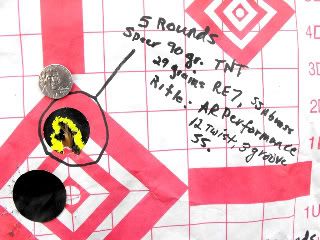
|
"Texas - the only state that ever kicked another country's ass."
"I'll never forget September 11, 2001, those who have fought and died, or those who continue to fight to avenge the deaths of over 3000 innocent Americans"
"I'll never forget September 11, 2001, those who have fought and died, or those who continue to fight to avenge the deaths of over 3000 innocent Americans"
|
I hadn't considered the case overall length. That is an excellent point. If I can't reasonably load heavy bullets there is no reason to have the faster twist. I'm not one of the guys that won't own a 5.56 AR if it isn't 1:7, it just seems to be the current trend.
The down side, however, is that I won't likely be sharing bullets with my .270, since it is typically loaded with 130gr bullets. There is nothing saying I can't use a 90 or 100 grain bullet in a 270, but it performs very well with the 130's. I gather the 6.8 and the 6.5 perform well against deer sized game but my interest is more for critters with 2 legs. I can't hunt with either cartridge in my state but I'm a Police Officer and I've been reading about the 6.8 in particular being a very viable alternative for Police use. Does anyone here know if there has been any overpenetration testing with intermediate barriers like drywall? One of the big arguments for the 5.56 rifles is that they have been proven to penetrate intermediate barriers less than handgun rounds. If that isn't true with the 6.8 I find it unlikely that it would be adopted as a standard patrol rifle, but for snipers is seems like a very useful alternative to the .308, which has definite overpenetration problems. Is there any data for the 6.8 or the 6.5 in this area? I haven't found a department that has adopted either cartridge. Thank you for the quick and informative reply. That is the purpose of threads like this. It has been very useful in helping me make an informed decision. |
|
Originally Posted By alorton:
I hadn't considered the case overall length. That is an excellent point. If I can't reasonably load heavy bullets there is no reason to have the faster twist. I'm not one of the guys that won't own a 5.56 AR if it isn't 1:7, it just seems to be the current trend. The down side, however, is that I won't likely be sharing bullets with my .270, since it is typically loaded with 130gr bullets. There is nothing saying I can't use a 90 or 100 grain bullet in a 270, but it performs very well with the 130's. I gather the 6.8 and the 6.5 perform well against deer sized game but my interest is more for critters with 2 legs. I can't hunt with either cartridge in my state but I'm a Police Officer and I've been reading about the 6.8 in particular being a very viable alternative for Police use. Does anyone here know if there has been any overpenetration testing with intermediate barriers like drywall? One of the big arguments for the 5.56 rifles is that they have been proven to penetrate intermediate barriers less than handgun rounds. If that isn't true with the 6.8 I find it unlikely that it would be adopted as a standard patrol rifle, but for snipers is seems like a very useful alternative to the .308, which has definite overpenetration problems. Is there any data for the 6.8 or the 6.5 in this area? I haven't found a department that has adopted either cartridge. Thank you for the quick and informative reply. That is the purpose of threads like this. It has been very useful in helping me make an informed decision. Both the 6.8 and the 6.5 are likely to penetrate walls. The 5.56 does too, and anyone who states otherwise is setting the test up to give the results they want. High velocity, pointed rifle rounds are much more likely to do so than lower velocity pistol rounds, unless they are specifically designed to fragment on impact. You might want to check out this site: http://www.theboxotruth.com/ It's not very scientific, but it is real world. Here is the thread where they shoot interior wall sheetrock and pine boards: http://www.theboxotruth.com/docs/bot1_2.htm Bill |
|
Originally Posted By alorton:
I hadn't considered the case overall length. That is an excellent point. If I can't reasonably load heavy bullets there is no reason to have the faster twist. I'm not one of the guys that won't own a 5.56 AR if it isn't 1:7, it just seems to be the current trend. The down side, however, is that I won't likely be sharing bullets with my .270, since it is typically loaded with 130gr bullets. There is nothing saying I can't use a 90 or 100 grain bullet in a 270, but it performs very well with the 130's. I gather the 6.8 and the 6.5 perform well against deer sized game but my interest is more for critters with 2 legs. I can't hunt with either cartridge in my state but I'm a Police Officer and I've been reading about the 6.8 in particular being a very viable alternative for Police use. Does anyone here know if there has been any overpenetration testing with intermediate barriers like drywall? One of the big arguments for the 5.56 rifles is that they have been proven to penetrate intermediate barriers less than handgun rounds. If that isn't true with the 6.8 I find it unlikely that it would be adopted as a standard patrol rifle, but for snipers is seems like a very useful alternative to the .308, which has definite overpenetration problems. Is there any data for the 6.8 or the 6.5 in this area? I haven't found a department that has adopted either cartridge. Thank you for the quick and informative reply. That is the purpose of threads like this. It has been very useful in helping me make an informed decision. Keep in mind that the 110 grain Barnes TTSX is the same length as many 130 grain bullets. It is one of the most lethal bullets I have ever used, and there is no reason you could not load that in your .270. If you buy a 6.8, just be sure to get PRI mags, (Barrett will allow these OAL'a, too) so that you can load to 2.30." This allows loading the 110 TTSX. Also note that there WILL be a 100 grain TTSX in the future, as will there be a 100 grain Hornady GMX (I am quite certain they would not let Barnes take this niche all to themselves). I agree with Bill. These 6.8 and 6.5 rounds are powerful enough to penetrate dry wall. We might all do ourselves well to face that fact, rather than look for something going 2700 +/- FPS that won't cross such barriers. The best you can do now, is to load the 90 grain Speer TNT, which has an extremely thin jacket, its exceptionally accurate, and makes for good, fast loads in the 6.8, when using reloder 7. It will fragment the most completely of all the currently avail. .277 bullets. ETA: Just as a very brief aside....12 gauge 2 & 3/4 steel #6 waterfowl loads through a skeet choke will do grotesque damage to a BG at 10 feet, but given the hideous ballistic properties of steel, any contract with any barrier renders them far less harmful. That is probably the optimal HD round for those of you (who perhaps have children) considering using your 6.8. |
"Texas - the only state that ever kicked another country's ass."
"I'll never forget September 11, 2001, those who have fought and died, or those who continue to fight to avenge the deaths of over 3000 innocent Americans"
"I'll never forget September 11, 2001, those who have fought and died, or those who continue to fight to avenge the deaths of over 3000 innocent Americans"
|
<Off-topic comments removed - Z> |
"Texas - the only state that ever kicked another country's ass."
"I'll never forget September 11, 2001, those who have fought and died, or those who continue to fight to avenge the deaths of over 3000 innocent Americans"
"I'll never forget September 11, 2001, those who have fought and died, or those who continue to fight to avenge the deaths of over 3000 innocent Americans"

|
Ok, I've enjoyed the discussion on penetration but lets get this thread back to the 6.8, I've hijacked this thread bad enough already.
So, my question still stands: has any testing been done on the 6.8 that would mirror that done by the FBI with .223 (ie penetration and wound ballistics after passing through glass, drywall, heavy clothing etc.)? Before my agency would even consider the round it would have to have solid scientific testing backing it. I'm interested in the round regardless of whether I get to use it at work, but if it would make a good tool at work I don't want to discount it. |
|
Originally Posted By alorton:
So, my question still stands: has any testing been done on the 6.8 that would mirror that done by the FBI with .223 (ie penetration and wound ballistics after passing through glass, drywall, heavy clothing etc.)? Before my agency would even consider the round it would have to have solid scientific testing backing it. Yes, Dr. Gary Roberts has done extensive testing of 6.8 (as well as 5.56, 308, and many other commonly used service rounds). He is a leading authority in ballistics field: http://www.m4carbine.net/showthread.php?t=19884 http://www.m4carbine.net/showthread.php?t=19881 http://www.m4carbine.net/showthread.php?t=19878 This is a good place to start: http://www.dtic.mil/ndia/2008Intl/Roberts.pdf |

| I just finished reading the 10 pages in this thread and I think I am very close to making a decission on my next build. I apologize if I missed it, but I don't remember any discussions on barrel life comparisons between 6.5 Grendel and 6.8 SPC. Who has the edge in this area? |
Compromise is always wrong if it means sacrifing a principle.
|
Originally Posted By txcas:
I just finished reading the 10 pages in this thread and I think I am very close to making a decission on my next build. I apologize if I missed it, but I don't remember any discussions on barrel life comparisons between 6.5 Grendel and 6.8 SPC. Who has the edge in this area? I don't think there has ever been a study done to compare the barrel life of the two calibers, or even a study of the life of individual barrels. Throw in the fact that there is no 'standard' (as in material, finish, and rifling method then you're out of luck. However, in a precision rifle course I took a couple years ago the instructor alluded to barrel life being most closely related to amount of powder being burned. If you look at things that way then the 6.x classes should be closely comparable to 5.56 possilby with slightly shorter lives. |
'98 Jeep XJ Owner
6.8 > 6.5
6.8 > 6.5
|
Originally Posted By Forest:
Originally Posted By txcas:
I just finished reading the 10 pages in this thread and I think I am very close to making a decission on my next build. I apologize if I missed it, but I don't remember any discussions on barrel life comparisons between 6.5 Grendel and 6.8 SPC. Who has the edge in this area? I don't think there has ever been a study done to compare the barrel life of the two calibers, or even a study of the life of individual barrels. Throw in the fact that there is no 'standard' (as in material, finish, and rifling method then you're out of luck. However, in a precision rifle course I took a couple years ago the instructor alluded to barrel life being most closely related to amount of powder being burned. If you look at things that way then the 6.x classes should be closely comparable to 5.56 possilby with slightly shorter lives. I don't know anyone that has tested either caliber, but of course, barrel material and construction determines longevity to the greatest extent across all calibers. I will say this: Chrome Lining has proved problematic for the 6.8. Bore ratio and dimensions have to be pretty close to spec (i.e +/- .001") in order to prevent pressure problems with higher pressure loads. Moreover, if barrel X is made by MFR Y, and the chrome plating is sloppy or the riflings are too large, you will have higher pressure, more heat and less life. Plating that same barrel with chrome might make things worse, if there are spots along that barrel which are not perfectly concentric. Many MFR's are getting around this by using nitrocarburizing, which seems to be a very good alternative. So, pick a good quality of barrel with the right rifling profile ( 3 or 4 grooves or 5r profile are best in 6.8) and you will be set. I expect my barrels to last many years. |
"Texas - the only state that ever kicked another country's ass."
"I'll never forget September 11, 2001, those who have fought and died, or those who continue to fight to avenge the deaths of over 3000 innocent Americans"
"I'll never forget September 11, 2001, those who have fought and died, or those who continue to fight to avenge the deaths of over 3000 innocent Americans"
|
Originally Posted By txcas:I don't remember any discussions on barrel life comparisons between 6.5 Grendel and 6.8 SPC. Who has the edge in this area?
All things being equal, cartridges that run less pressure and less velocity give longer-lasting barrels. This goes for any cartridge. John | 6.5 Grendel: The Tier One AR Cartridge. | www.65grendel.com |
AR Variants Mod and Juris Doctor (in training)!
Joined:
Oct 2003
Posts:
11465
EE: 100% (480)
USA
|
Originally Posted By Cold:
Originally Posted By Grendelizor:
Originally Posted By txcas:I don't remember any discussions on barrel life comparisons between 6.5 Grendel and 6.8 SPC. Who has the edge in this area?
All things being equal, cartridges that run less pressure and less velocity give longer-lasting barrels. This goes for any cartridge. Got to agree with the G-Man here. Yes, I would also agree that, all else being equal, less pressure and lower velocity will allow for a longer lasting barrel. However, I consider barrels to be "consumables," and the ease of interchange of a barrel in the AR-15 is part of what makes this the most popular rifle in America, these days. So, that is not really something to which I give much thought in the throes of a purchase. I generally look at accuracy potential, and efficiency of the cartridge in shorter barrels. You guys' needs might vary, but those are my first criteria. Moreover, there is a wide disparity in the number of rounds that AR owners shoot. Some guys run 10-12 magazines of ammo through their guns in a single weekend competition, and some just ( are lucky and ) get to shoot alot. But, I would guess that the great majority fire less than 500 rounds per year through their AR-15's. With that kind of frequency, any of the popular calibers, should last for 10, maybe even 20 years. BTW, Bill, I generally shoot about 600-1000 rounds per year in 2 of the 4 AR's I own. One of the four, less fired, is a 5.56 and sits, oh so lonely in the safe, since I got infected with 6.8 fever. The other, is my stainless 20 inch, 12 twist, 3 groove. A beautiful, yet slightly more fragile specimen with "match chamber," which is reserved for trophy deer and the occasional longer distance hog, shot during the day. The high volume "meat guns," are Chromed (a Cardinal 12.5" SBR) and NC'ed ( my ARP XT 16" 5r) . I beat the crap out of them, and they just run and run and run. But, things change so much in every 10 year period of my life that , if a barrel lasts that long, I feel its likely that something else will be catching my fancy by then anyway.
|
"Texas - the only state that ever kicked another country's ass."
"I'll never forget September 11, 2001, those who have fought and died, or those who continue to fight to avenge the deaths of over 3000 innocent Americans"
"I'll never forget September 11, 2001, those who have fought and died, or those who continue to fight to avenge the deaths of over 3000 innocent Americans"
|
Originally Posted By hi-tech-rancher:
Moreover, there is a wide disparity in the number of rounds that AR owners shoot. Some guys run 10-12 magazines of ammo through their guns in a single weekend competition, and some just ( are lucky and ) get to shoot alot. But, I would guess that the great majority fire less than 500 rounds per year through their AR-15's. With that kind of frequency, any of the popular calibers, should last for 10, maybe even 20 years. BTW, Bill, I generally shoot about 600-1000 rounds per year in 2 of the 4 AR's I own. One of the four, less fired, is a 5.56 and sits, oh so lonely in the safe, since I got infected with 6.8 fever. The other, is my stainless 20 inch, 12 twist, 3 groove. A beautiful, yet slightly more fragile specimen with "match chamber," which is reserved for trophy deer and the occasional longer distance hog, shot during the day. The high volume "meat guns," are Chromed (a Cardinal 12.5" SBR) and NC'ed ( my ARP XT 16" 5r) . I beat the crap out of them, and they just run and run and run. But, things change so much in every 10 year period of my life that , if a barrel lasts that long, I feel its likely that something else will be catching my fancy by then anyway. That's sort of what I was getting at, some guys think they are going nuts if they shoot a hundred rounds a year, others of us pound out 30 or 40 times that, or more. For the 100 round a year guys, ANY caliber and ANY barrel will likely last years! I would expect any of the barrels to have a serviceable life of more than 3000 rounds, and probably less than 10,000. I have 4,000 rounds down my Grendel, and still can shoot .25 inch groups, when I do my part with the right ammo. VERY few barrels ever get shot out unless the owner is a competitive shooter. Since most owners aren't, I doubt many people ever actually wear the barrel out. I always laugh at how we get attached to rifles, and decide to baby that "special" one. But if we don't shoot them often, what's the fun in owning them? They aren't pieces of art, they are shooters, or, as one of my Special Forces friends like to say, they are "blasters". He says ALL AR's are blasters, built to shoot, not to show! In his view, black is black, and there is no beauty in any AR, just a very useable tool, and by and large, I agree with him, I guess! Bill |
|
The technical aspects of cartridge case design were touched on, but not thoroughly explored.
But first - if someone is looking at either cartridge as a substitute for the 5.56, you won't be going wrong if you understand at present both are still wildcats in a secondary market. Both cartridges are actually more alike than different - WHICH IS THE BASIS OF MOST OF THE DISAGREEMENT. It's human nature to have questions of similarity argued more vehemently. If they were more dissimilar, most of us curious about the rounds would say, well, duh, of course, that's the difference. It's a lot harder with 6.8 vs. 6.5. Take the obvious emotionalism out of the discussion, as the moderators here have done, and it's a matter of applying the cartridges BEST attributes to how it will be used. The cartridge case design and work done by the originator of the 6.5 was done at time the 6PPC and others had established a presence in target shooting. A fat case to hold more power, a 30 degree shoulder to maximize it and help the vortex of burning gas push the base of the bullet, and the longest possible bullet length to maximize ballistic coefficient are obvious to the long distance competitive shooter. It was suggested the top ten cartridges in use at long distance varied in caliber. In case design they are often more alike. This is the signal mark of the long distance cartridge these days, especially in restricted length magazines. No doubt it's good engineering as the originator of the 6.5 is supposed to still hold the 600m record. It is not a common configuration for military ammunition. Most combat rounds have a more shallow shoulder, and the neck/case diameter ratio is much closer to 1 than a PPC cartridge. The visual difference is obvious side by side. The AMU wasn't ignorant of PPC design when Murray came to them for their expert advice. Nonetheless, a PPC case was not chosen for the 6.8. First, it's apparent in the application that the 6.8 would not need to be maximized for long range.Enhancing the maximum effective range was more the goal. Secondly, since a long, high BC bullet wouldn't be needed, a shorter one allowing a longer, more narrow case could give nearly equivalent powder capacity. That case design could then work with the given barrel length of 16". Military cartridges all seem to hold a similar profile of shallow neck angle and higher neck/case ratio. That might be due to the slow pace of cartridge adoption, but the physical challenge of chambering a round repeatedly at high speeds in automatic weapons cannot be ignored. It's been said both cartridges function well in full auto fire. One attribute of the AR is that Stoner designed the locking lugs in a barrel extension (duh). That means the cartridge nose does not feed into the chamber almost immediately, but has to negotiate the length of the barrel extension to enter the chamber. It's a significant feature of the AR - no large structural receiver, and front locking lugs. Whether this helps or hurts feeding the round is an issue rarely discussed. The size of the case could affect it, also, as a bigger case must sit deeper in the mag well, rise further to feed, and will enter the barrel extension at a steeper angle. What isn't discussed is whether the nose of the cartridge hits the shoulder in the chamber during feeding, or whether the unique barrel extension gives enough length to straighten the entry path and prevent it. It would seem a fact that a 30 degree angle would promote misfeeds, but remains unknown to most of us. In the larger view, the cause of most misfeeds in the field are improperly shaped magazine feed lips, given a sufficient powder charge is used. My particular choice to build a 6.8 was based on this kind of observation. I wanted an enhanced military cartridge, not a copy-wildcat of PPC heritage. Knowing I was giving up the superior long distance accuracy wasn't hard, as my application was more in line with the military's use. 87% of hits by soldiers occur under 300 yards according to one study, which confirms what the German General Staff already knew going into WWII. My experience hunting, reading about others hunting experiences, and what game I would hunt with an AR lead me to decide to use a cartridge designed from the beginning for optimum performance at that range, not longer. I didn't feel it necessary to include the low percentage, what if? scenarios that rarely occur. I wanted a cartridge that would shoot the 87%, not the 13%. Alexander Arms only offers one 16" carbine, the rest are 19.5" and longer. That is testimony enough for me that the major marketer of the design doesn't see it as optimum for carbine use, but certainly enough so for rifles. After all, 6.5 is a 600m record holder on paper. What I've seen recently is a move by some to position it as a carbine or even SBR round, but chronographed reviews of that use are lacking. If the tactical carbine crowd doesn't get distracted by the .30 AR or the next new round announced at SHOT maybe we'll see those results. |
6.8SPC or 6.5G? Which one should I buy? (Page 5 of 14)
AR Sponsor