


AR Sponsor

[ARCHIVED THREAD] - Observations On The Effect Of Parallax Error When Shooting With an Aimpoint Comp M5 and Trijicon MRO (Page 1 of 2)
Posted: 2/14/2021 7:30:23 PM EDT
|
Observations On The Effect Of Parallax Error When Shooting With an Aimpoint Comp M5, a Trjicon MRO and an Aimpoint T2 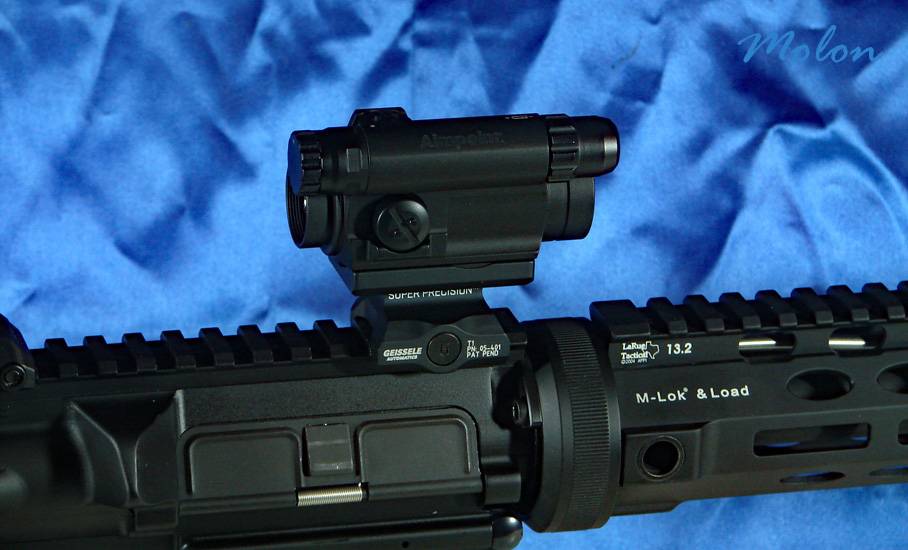 Some manufacturers of red-dot sights have made claims that their red-dot sights are “parallax free“. Most of us are already aware that this is simply not true at all distances. Inherent parallax error with a red-dot sight is typically greatest at CQB distances (MOA wise) and decreases as the distance to the target increases. In this ballistic exercise we’ll be looking at the amount of parallax error occurring during objective, controlled, live-fire testing at the distances of 7 yards, 15 yards, 25 yards and 50 yards when shooting with an Aimpoint Comp M5 and a Trijicon MRO mounted on a precision AR-15. The Aimpoint Comp M5 has a 2 MOA red dot, as does the Trijicon MRO. All shooting for this exercise was conducted from my bench-rest set-up using one of my precision AR-15s. This AR-15 has a 20” Lothar Walther barrel with a 223 Wylde chamber and a 1:8” twist and it routinely produces 0.75 MOA 10-shot groups at 100 yards (with a high magnification scope). The ammunition used for this exercise was one of my match-grade hand-loads topped with the Sierra 52 grain MatchKing. Wind conditions on the range were monitored using a Wind Probe. The set-up was very similar to that pictured below. 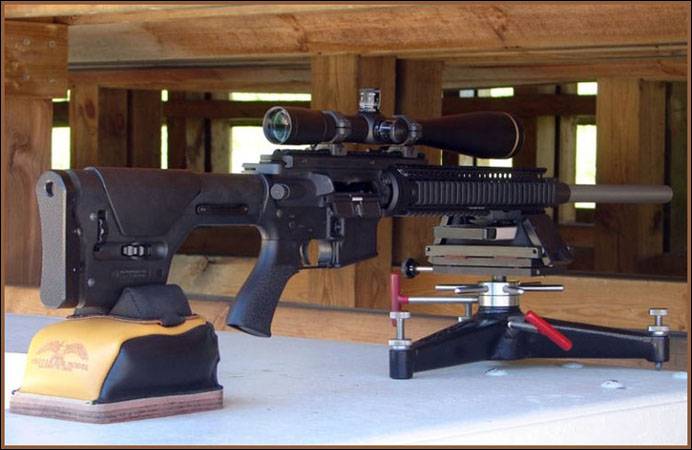 The barrel . . . 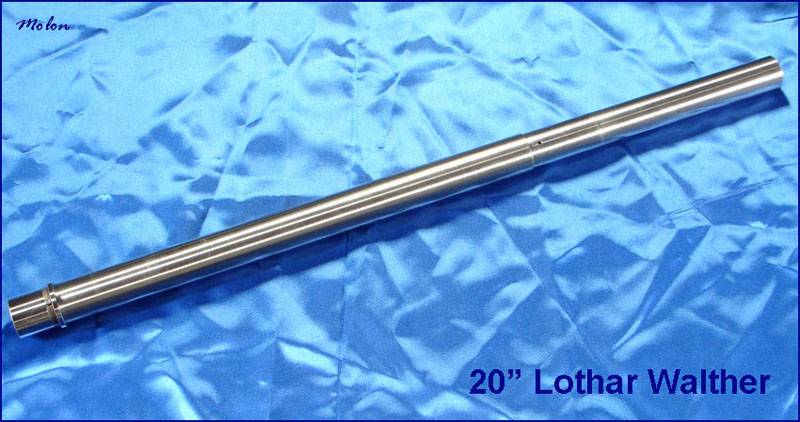 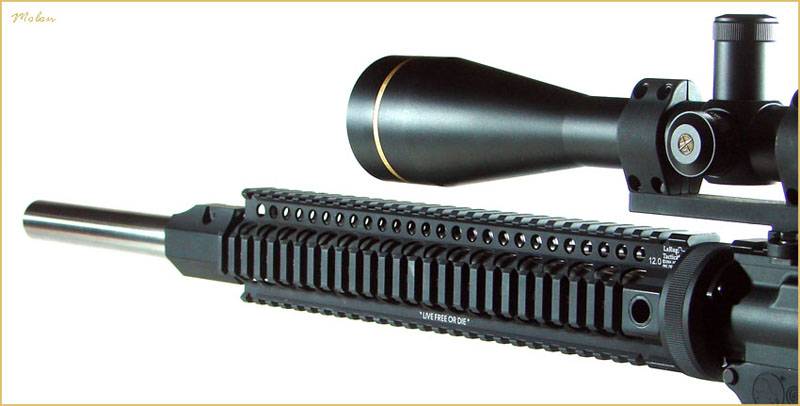 10-shot group at 100 yards . . . 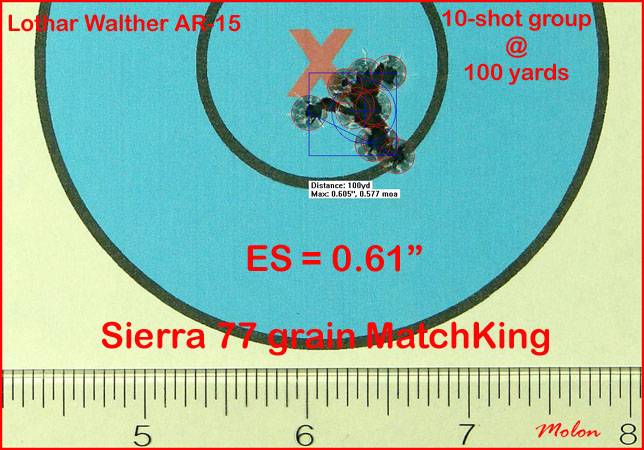 The Wind Probe . . . 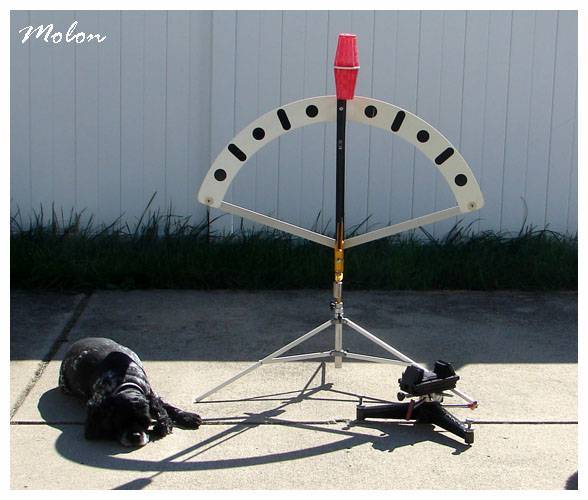 The Details The methodology for this ballistic exercise was as follows . . . Shooting from the bench-rest set-up with the Aimpoint Comp M5 atop the precision AR-15 at the initial distance of 7 yards, an 8-shot control group was fired with the red-dot centered in the sight window. Next, 8-shot parallax test-groups were fired in the following manner: 2 shots fired with the red-dot positioned in the extreme 12 o’clock position of the sight window. 2 shots fired with the red-dot positioned in the extreme 3 o’clock position of the sight window. 2 shots fired with the red-dot positioned in the extreme 6 o’clock position of the sight window. 2 shots fired with the red-dot positioned in the extreme 9 o’clock position of the sight window. Additional 8-shot parallax test-groups were then fired sequentially at 15 yards, 25 yards and 50 yards in the manner described above. This simple methodology is illustrated in the two pics shown below. The solid black dot on the target was the point-of-aim. The 8-shot control group at 7 yards . . . 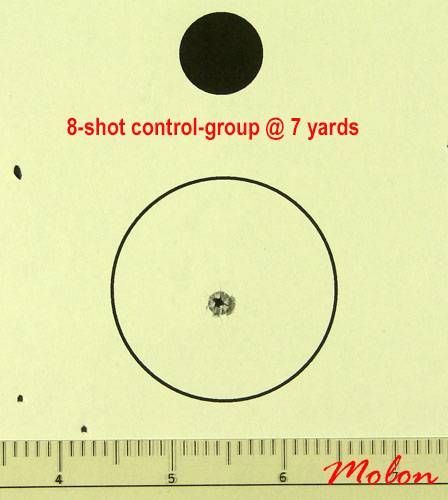 The 8-shot parallax test-group at 7 yards . . . 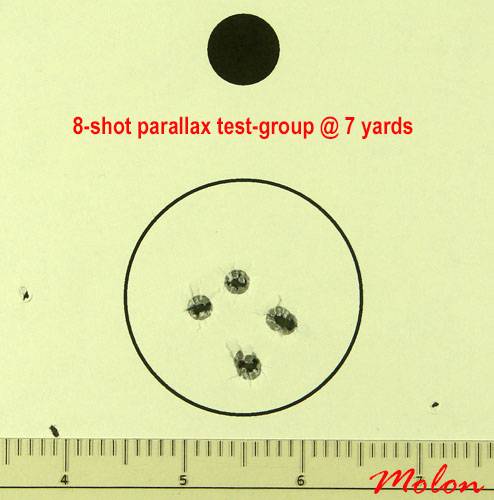 Aimpoint Comp M5 Results The 8-shot control group fired at 7 yards had an extreme spread of 0.039”, which at 7 yards is 0.53 MOA. The extreme spreads of the parallax test-groups are shown in the table below. 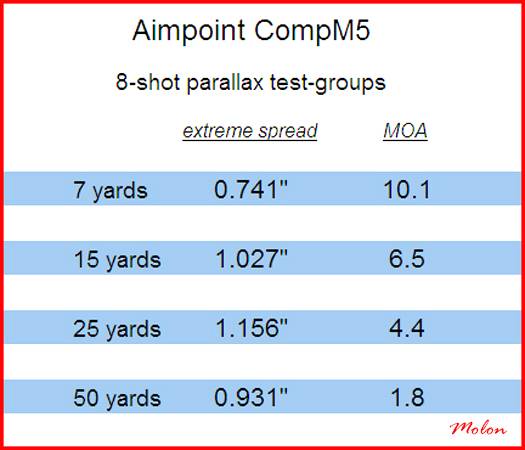 Trijicon MRO Results 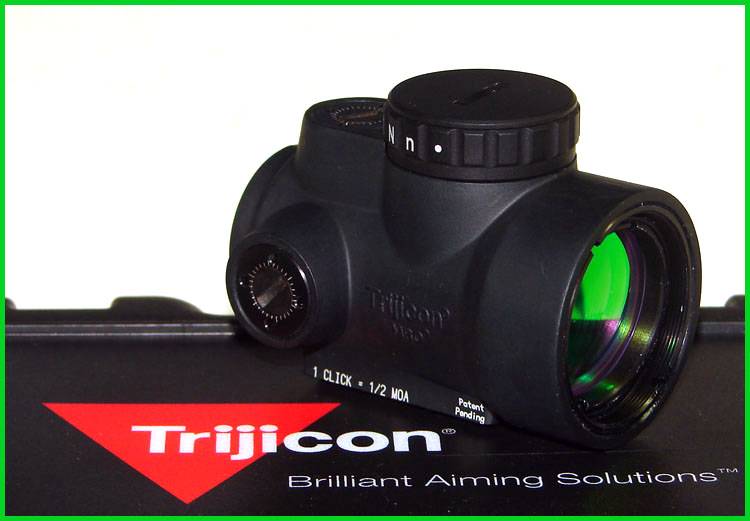 I repeated the ballistic exercise described above using a 2nd-generation Trijicon MRO with a 2 MOA red-dot. The results are shown in the table below. 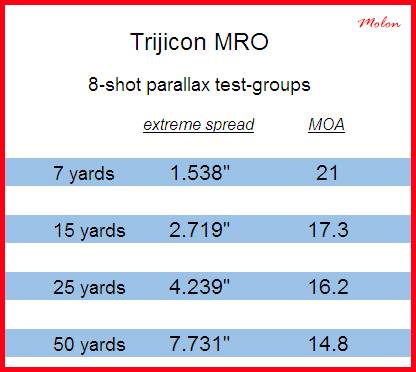 I also conducted the 50 yard portion of the parallax test using an additional 2nd-generation Trijicon MRO with a 2 MOA red-dot. The results were nearly identical to that of the first MRO. The extreme spread of the 8-shot parallax test-group was 7.46”, which at 50 yards is 14.3 MOA. Comparisons The tables and graphs below show the results from both the Aimpoint Comp M5 and the Trijicon MRO, side-by-side, for comparison. Results in inches . . . 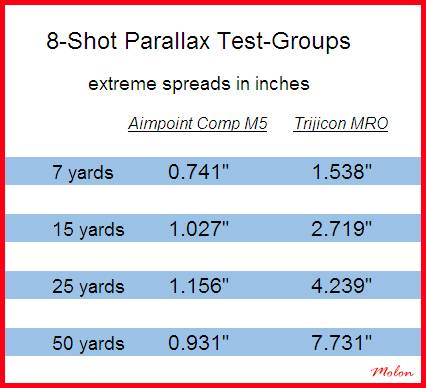 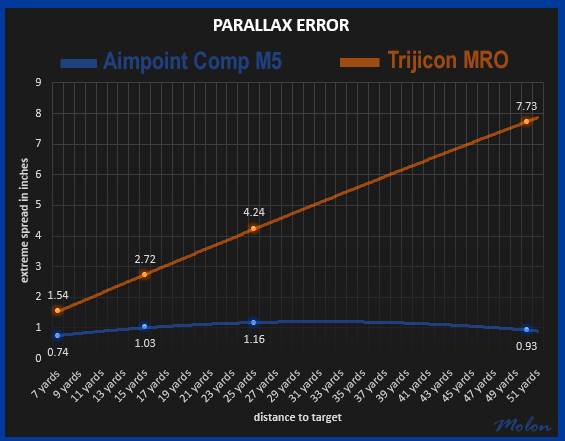 Results in minutes of angle . . . 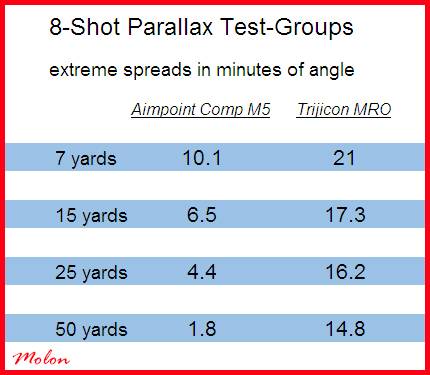 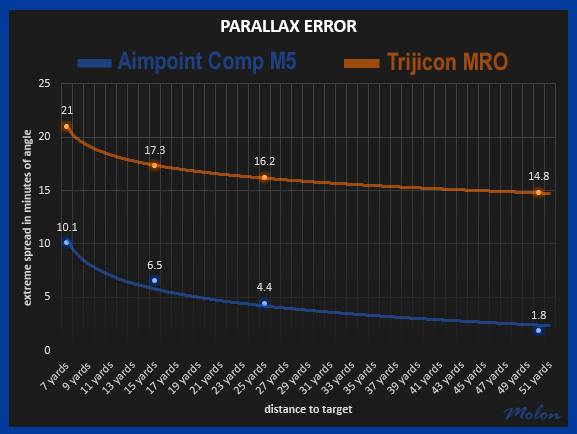 ... Aimpoint T2 Parallax Error At 50 Yards 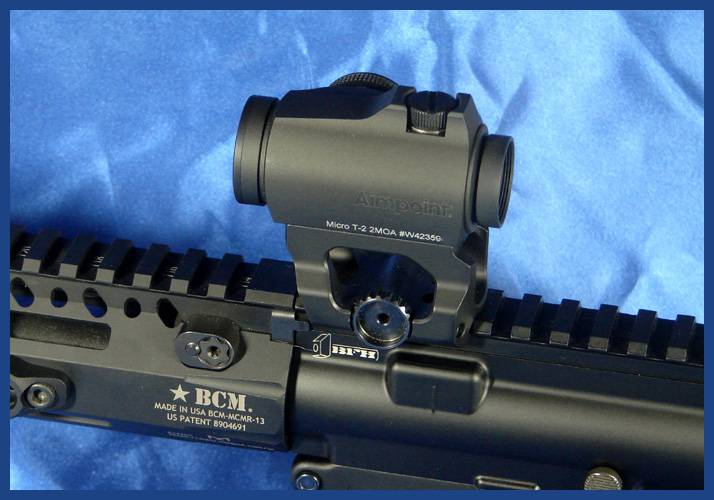 An 8-shot parallax test-group fired from 50 yards using an Aimpoint T2 had an extreme spread of 0.907", which at 50 yards equates to 1.7 MOA. ... The target shown below is the actual 50 yard parallax-test target for one of the Gen-2 Trjicon MROs that I tested. The parallax error is 7.7 inches. The target also clearly demonstrates the asymmetric parallax pattern of the MRO. I’d like to see someone do the trigonometry for those "hold-offs", on the fly, in the urban prone position. 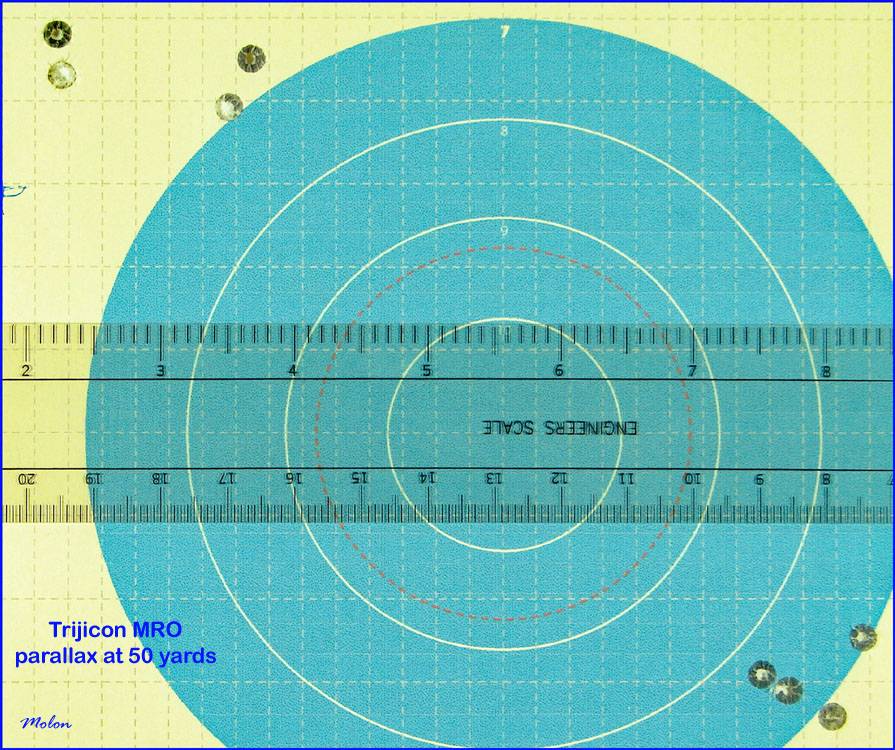 Now, let’s superimpose the above parallax-test target on a realistic training target at 50 yards, for both a head-shot and an upper thorax shot. Only three shots out of eight shots hit the head of the target when using the MRO. Only two shots out of eight shots hit the upper thorax of the target when using the MRO. 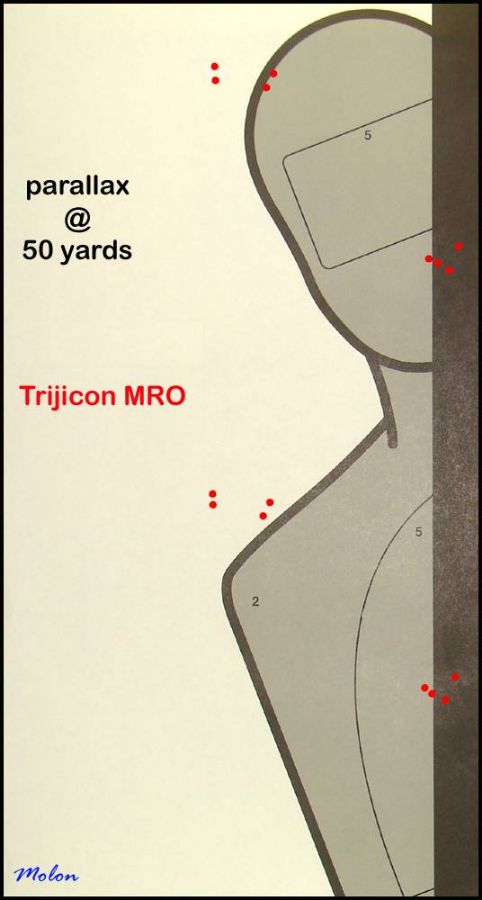 That’s a whole lot of missed shots, and those shots were taken with a precision AR-15, using match-grade hand-loads, shooting from a bench-rest set-up. Now substitute a chrome-lined, NATO chambered barrel using factory ammunition and shooting from over/around/under a hard-cover position and the amount of missed shots drastically increases. Here's the 50 yard parallax-test target for an Aimpoint T2 superimposed on the realistic training target along with the MRO. Every single shot fired using the Aimpoint T2 hit the head of the target and the upper thorax of the target. 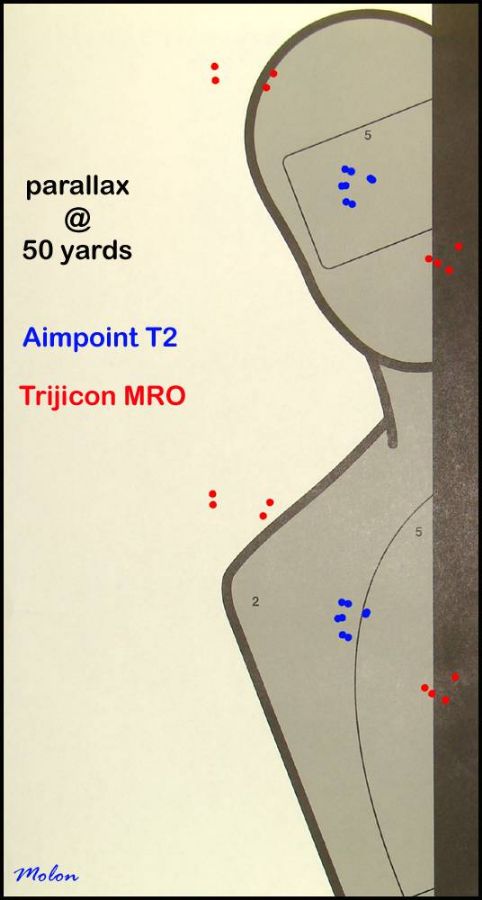  |
|
Welcome back. Thank you for objectively validating both Greeneye Tactical testing and casual observational concerns about parallax with the MRO. One can mount it on a vice-clamped Picatinny rail and look at a black dot on a wall at 7 yards and 15 yards and see the red dot wander with lateral and vertical head movement while looking through the MRO, especially at the edges of the FOV. The deviation is significant. Now, we know how much. I was surprised to see how much MRO parallax error there was even as far out as at 50 yards. |
|
It's hard to put into words how much more valuable a post like this is than all the anecdotal stuff we'd see in most "what optic should I choose?" threads. Thanks for taking the time, and also for validating my until-now completely unfounded Aimpoint > MRO position 
|
|
Quoted: It's hard to put into words how much more valuable a post like this is than all the anecdotal stuff we'd see in most "what optic should I choose?" threads. Thanks for taking the time, and also for validating my until-now completely unfounded Aimpoint > MRO position To be fair, the Aimpoint T1 had similar parallax. It’s the update lenses of the T2 and M5 that you get these results. |
|
Quoted: Well, dang. My position is still the same, but guess I'm back to unfounded Quoted: Quoted: To be fair, the Aimpoint T1 had similar parallax. It's the update lenses of the T2 and M5 that you get these results. EoTech turned out to be the best. At other known trade offs of course. The MRO and T1 testing had similar results. I’d suspect the T1 would be better in real use as the smaller window would necessitate a more consistent cheek weld driving a better sight picture and POA POI consistency. |
| I remember the parallax-error with the original MRO being pretty significant. We were using them in conjunction with helmets / face shields, so centering the dot was often difficult. I thought it was just me, at first, until other people complained of the same issue. Not that I'd be using an MRO for precision shooting, but it would nice to see them tighten that up a bit more. |
|
Quoted: It's hard to put into words how much more valuable a post like this is than all the anecdotal stuff we'd see in most "what optic should I choose?" threads. The scientific process and raw data does tend to be a bit more substantive than "i LiKe MiNe! [insert pic of product in question]" and "iT wOrKs FoR mE!" Molon, your work is much appreciated. I would really love to see data from a Sig Romeo8T. Reason being that it is a "large window" LED-based red dot, and InRange demonstrated that it may not have terrible parallax issues. For a while it seemed that parallax error was inevitable with larger LED optics, perhaps inherent in the technology. But, if it can be shown that an optic like the Romeo8T doesn't have a POA/POI issue meaningfully different than the holographic versions, then we know the best feature of a traditional LED (battery life) and traditional holographic can be successfully integrated. |
|
Quoted: EoTech turned out to be the best. At other known trade offs of course. The MRO and T1 testing had similar results. I'd suspect the T1 would be better in real use as the smaller window would necessitate a more consistent cheek weld driving a better sight picture and POA POI consistency. Quoted: Quoted: Quoted: To be fair, the Aimpoint T1 had similar parallax. It's the update lenses of the T2 and M5 that you get these results. EoTech turned out to be the best. At other known trade offs of course. The MRO and T1 testing had similar results. I'd suspect the T1 would be better in real use as the smaller window would necessitate a more consistent cheek weld driving a better sight picture and POA POI consistency. |
| In regards to the MRO, I still think the huge parallax we see with it is due to size difference between the ocular and objective lens. The larger objective lens allows the dot to move further off the center of the ocular lens then if they were both the same size. I bet there would be less parallax if the lens were the same size. |
|
Quoted: In regards to the MRO, I still think the huge parallax we see with it is due to size difference between the ocular and objective lens. The larger objective lens allows the dot to move further off the center of the ocular lens then if they were both the same size. I bet there would be less parallax if the lens were the same size. DING! I was going to post something similar but use Field of View as the basis. The results could be (should be?) normalized to the field of view through each sight. |
|
Quoted: DING! I was going to post something similar but use Field of View as the basis. The results could be (should be?) normalized to the field of view through each sight. Quoted: Quoted: In regards to the MRO, I still think the huge parallax we see with it is due to size difference between the ocular and objective lens. The larger objective lens allows the dot to move further off the center of the ocular lens then if they were both the same size. I bet there would be less parallax if the lens were the same size. DING! I was going to post something similar but use Field of View as the basis. The results could be (should be?) normalized to the field of view through each sight. Not necessarily. From what I've seen it has three main variables: 1. Lens cant. The tilt of the lens has bearing on parallax 2. Lens coating. This too has an effect 3. Len size. Your point above, but it's not the whole story. Again, the T2 and the T1 have the same lens size at 18mm. Aimpoint changed the coating and cant of the T2. It makes it more clear and display a rounder dot as well as much much better from a parallax perspective. |
|
Quoted: Looks like the MRO is now written off the official uber tactical list now  I wouldn't say that. The Aimpoint T1 is almost as bad as the MRO, and it's still one of the most prolific hard-use red dot sights. Just get the dot roughly centered in the tube for precision shots. |
|
Looks like the cost difference yields a tangible difference/benefit. Great experiment and write-up. I’d have liked to have seen a centered group, and a “half-way-to-edge” group for sensitivity analysis for both optics. I’d be more likely to rush a shot slightly off center than all the way to the edge of the field of view. But given cost of ammo and time this test certainly bounds worst case performance. Always enjoy your methodical and quantitative approach. |
|
Quoted: Not necessarily. From what I've seen it has three main variables: 1. Lens cant. The tilt of the lens has bearing on parallax 2. Lens coating. This too has an effect 3. Len size. Your point above, but it's not the whole story. Again, the T2 and the T1 have the same lens size at 18mm. Aimpoint changed the coating and cant of the T2. It makes it more clear and display a rounder dot as well as much much better from a parallax perspective. The tilt angle, material (index of refraction) and thickness (optical path length) of the window inside also affects the sighting error. Coatings are too thin to affect parallax. They are to reduce reflections and increase contrast. |
|
That about lines up with my much less measured anecdotes regarding my MROs. If the dot is centered-ish it’s a non-issue, but if I want to string shots putting the dot at either end of the viewing window will definitely do it. Mine was a good 4-5 inches @ 25 from extreme opposite ends of the viewing window which is about what I see here. ETA excellent data as always, thank you for your continued contributions. I always read them when I see them. |
|
Quoted: Increased what? View? Open your other eye.... Quoted: Quoted: The benefit of the increased view seems to be negated by the parallax. Increased what? View? Open your other eye.... What I meant by, “increased view,” is that there is less of the effect of looking through a tube. Even with both eyes open. |
|
Quoted: In regards to the MRO, I still think the huge parallax we see with it is due to size difference between the ocular and objective lens. The larger objective lens allows the dot to move further off the center of the ocular lens then if they were both the same size. I bet there would be less parallax if the lens were the same size. |
|
Quoted: In regards to the MRO, I still think the huge parallax we see with it is due to size difference between the ocular and objective lens. The larger objective lens allows the dot to move further off the center of the ocular lens then if they were both the same size. I bet there would be less parallax if the lens were the same size. I’ve said this before and I still think there’s some truth to it. I don’t think they’d test even, but I think the MRO would fare considerably better with the normalized objective lens. This is super anecdotal, but it seems like most of the warpiness occurs around the rim, kinda like bouncing a laser off a soup bowl. I don’t know if that’s actually founded though. Either way I think the Aimpoint is the more refined design. Trijicon has made huge progress in the RDS field, and they make an excellent RDS, it’s just that Aimpoint is the Glock of the optic world. They make one product and have refined that one product to the point that it’s simply unparalleled in the market. |
|
Quoted: Increased what? View? Open your other eye.... Quoted: Quoted: The benefit of the increased view seems to be negated by the parallax. Increased what? View? Open your other eye.... The larger window still allows one to better find the dot. This doesn’t matter on a sandbag @ 100, but it does when one starts shooting faster, while moving, or in janky positions. |
|
Quoted: The larger window still allows one to better find the dot. This doesn’t matter on a sandbag @ 100, but it does when one starts shooting faster, while moving, or in janky positions. Quoted: Quoted: Quoted: The benefit of the increased view seems to be negated by the parallax. Increased what? View? Open your other eye.... The larger window still allows one to better find the dot. This doesn’t matter on a sandbag @ 100, but it does when one starts shooting faster, while moving, or in janky positions. In those same scenarios you then get the "amazing" benefit of the MRO parallax. Full circle. |
|
Quoted: In those same scenarios you then get the "amazing" benefit of the MRO parallax. Full circle. Quoted: Quoted: Quoted: Quoted: The benefit of the increased view seems to be negated by the parallax. Increased what? View? Open your other eye.... The larger window still allows one to better find the dot. This doesn’t matter on a sandbag @ 100, but it does when one starts shooting faster, while moving, or in janky positions. In those same scenarios you then get the "amazing" benefit of the MRO parallax. Full circle. Yeah I see the irony of that. I’d rather a dot that’s offset to a dot that’s not there, but to each their own. |
|
Quoted: Interesting, and I like some aspects of the EoTechs a lot. But aside from the anecdotal hardware issues, it's the battery life that keeps me from them. But still good to know in terms of this parallax error question, thank you. Definitely not anecdotal. Companies don’t pay out millions if the stuff they put out wasn’t junk. |
|
Quoted: Aimpoint T2 Parallax Error At 50 Yards https://www.ar15.com/media/mediaFiles/28568/aimpoint_t2_002-1459940.jpg An 8-shot parallax test-group fired from 50 yards using an Aimpoint T2 had an extreme spread of 0.907", which at 50 yards equates to 1.7 MOA. ... |
|
Quoted: I also wonder if a 4 MOA Comp M2 would shoot within a better parallax error than the MRO. I didn't do any actual parallax testing with my 4 MOA Aimpoints, but I did some precision testing with my ML2 with a 4 MOA dot. Precision Shooting With an Aimpoint First and foremost, the Aimpoint red dot sight is a combat sight. Its primary purpose is for use in situations that require “reflexive shooting” at multiple targets, at close ranges. The Aimpoint excels in this type of shooting because it easily allows you to shoot with both eyes open and to focus on the target while shooting. All of my self-defense AR-15s have Aimpoints mounted on them. However, should the need arise (for example, making a head-shot on an aggressor at 100 yards who has most of his body behind hard cover) the Aimpoint sight is certainly up to the task of making precision shots. There are those on this website who claim that when using an Aimpoint sight with a four minute of angle dot, that it is not possible to shoot groups that are smaller than four minutes of angle in extreme spread. One such person has gone so far as to claim that groups shot from 100 yards using an Aimpoint with a 4 MOA dot will be “greater than 4 inches. Usually much greater.” As we shall soon see, such statements are completely false. To determine the level of precision obtainable when using an Aimpoint sight with a 4 MOA dot, I mounted an Aimpoint ML2 with a 4 MOA dot on one of my Krieger barreled AR-15s. This AR-15 is easily capable of producing consistent sub-MOA 10-shot groups at 100 yards when using a high magnification scope. Shooting with the Aimpoint sight was done from a bench-rest at a distance of 100 yards using NRA 200 yard High Power type targets that I scaled-down for 100 yards. (The aiming black is approximately the same width as a human head.) Sighting was done using the whole dot centered on the bullseye. Three 10-shot groups were fired in a row for evaluation. 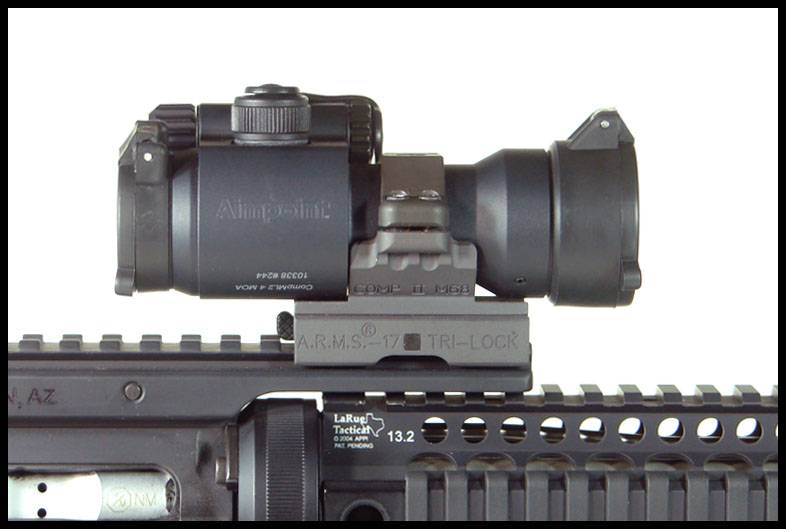 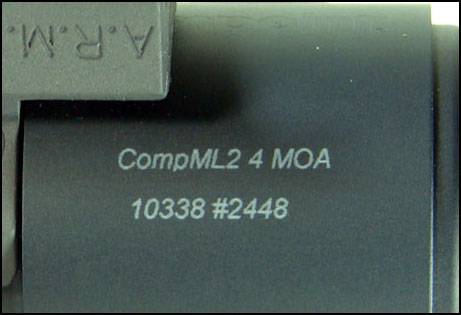 Zeroing the Aimpoint sight at 100 yards was conducted during a down-pour with 20-25 mph winds. The first two 10-shot groups were also fired under these conditions. The first 10-shot group had an extreme spread of 1.41”. 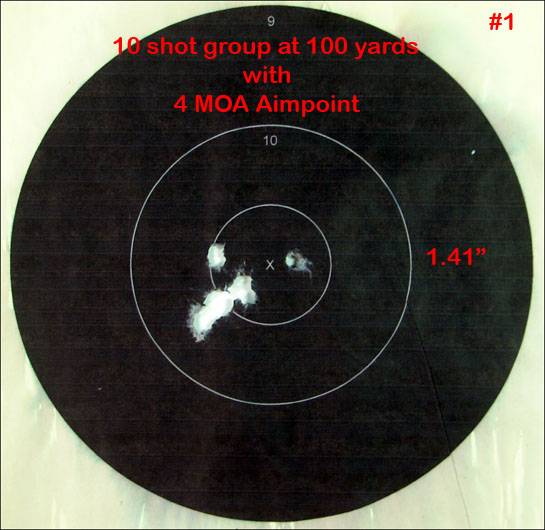 With another couple clicks of windage and elevation adjustment, the second 10-shot group had all shots going into the X-ring. The extreme spread for this group was 1.19”. 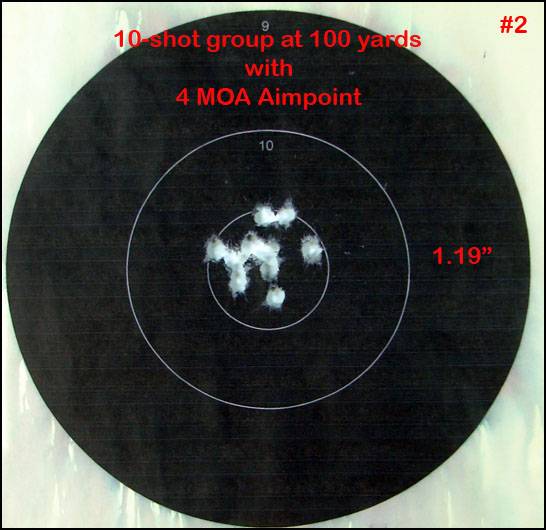 Just as quickly as the down-pour had started, the rain stopped, the winds died down and the sun began shining again. I posted a new and dry target on the 100 yard backer and continued shooting. The third 10-shot group had an extreme spread of 1.14”. The average extreme spread for all three of the 10-shot groups was 1.25”. 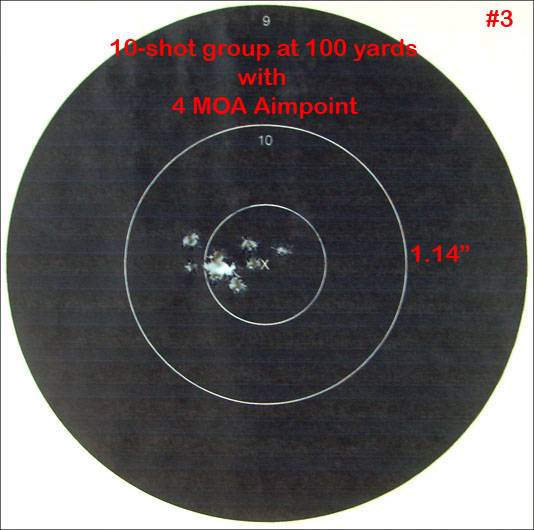 ... |

|
Very nicely conducted experiment. A few comments on the original experiment and on some of the responses: -parallax error of a reflex sight is affected by the shape of the lens (most are spherical surfaces, but better aspherical designs have less parallax. -parallax error is affected by the tilt angle, although aspherics mitigate that to some degree -parallax error is affected by the F/# of the optic (approximately the ratio of the length to the width). -parallax error is not effected by how thick the lens is. If it makes a difference, they fubar'ed something. -parallax error is not effected by the coatings For most practical uses, parallax issue in red dot sights is overblown and if optics companies didn't keep on claiming that their products were parallax free, it would really be a non-issue. Virtually all good quality red dot sights have a sweet spot in the center of the FOV where parallax is well controlled. If you need to make an accurate shot or you are at a longer distance, stay away from the edges. Holographics generally have less of a parallax issue at the edges. ILya |
|
Quoted: I didn't do any actual parallax testing with my 4 MOA Aimpoints, but I did some precision testing with my ML2 with a 4 MOA dot. Precision Shooting With an Aimpoint First and foremost, the Aimpoint red dot sight is a combat sight. Its primary purpose is for use in situations that require “reflexive shooting” at multiple targets, at close ranges. The Aimpoint excels in this type of shooting because it easily allows you to shoot with both eyes open and to focus on the target while shooting. All of my self-defense AR-15s have Aimpoints mounted on them. However, should the need arise (for example, making a head-shot on an aggressor at 100 yards who has most of his body behind hard cover) the Aimpoint sight is certainly up to the task of making precision shots. There are those on this website who claim that when using an Aimpoint sight with a four minute of angle dot, that it is not possible to shoot groups that are smaller than four minutes of angle in extreme spread. One such person has gone so far as to claim that groups shot from 100 yards using an Aimpoint with a 4 MOA dot will be “greater than 4 inches. Usually much greater.” As we shall soon see, such statements are completely false. To determine the level of precision obtainable when using an Aimpoint sight with a 4 MOA dot, I mounted an Aimpoint ML2 with a 4 MOA dot on one of my Krieger barreled AR-15s. This AR-15 is easily capable of producing consistent sub-MOA 10-shot groups at 100 yards when using a high magnification scope. Shooting with the Aimpoint sight was done from a bench-rest at a distance of 100 yards using NRA 200 yard High Power type targets that I scaled-down for 100 yards. (The aiming black is approximately the same width as a human head.) Sighting was done using the whole dot centered on the bullseye. Three 10-shot groups were fired in a row for evaluation. https://www.ar15.com/media/mediaFiles/28568/aimpoint_comp_on_rifle_01-1681264.jpg https://www.ar15.com/media/mediaFiles/28568/aimpoint_comp_ml2_4_moa_01-1681263.jpg Zeroing the Aimpoint sight at 100 yards was conducted during a down-pour with 20-25 mph winds. The first two 10-shot groups were also fired under these conditions. The first 10-shot group had an extreme spread of 1.41”. https://www.ar15.com/media/mediaFiles/28568/aimpoint_10_shot_group_at_100_yards_001_-1681260.jpg With another couple clicks of windage and elevation adjustment, the second 10-shot group had all shots going into the X-ring. The extreme spread for this group was 1.19”. https://www.ar15.com/media/mediaFiles/28568/aimpoint_10_shot_group_at_100_yards_02b_-1681261.jpg Just as quickly as the down-pour had started, the rain stopped, the winds died down and the sun began shining again. I posted a new and dry target on the 100 yard backer and continued shooting. The third 10-shot group had an extreme spread of 1.14”. The average extreme spread for all three of the 10-shot groups was 1.25”. https://www.ar15.com/media/mediaFiles/28568/aimpoint_10_shot_group_at_100_yards_03_l-1681262.jpg ... Someting I knew a while ago. When Aimpoint came out with the 2 MOA T-1....everybody bumrushed to trade in there 4 MOA T-1's... I was like.."Why"...You can turn it down and still get precision... plus you can turn it up and get bigger.  While no where as sciency...as our esteemed Molon...My informal on my belly test with min of man steel case...I'll take that every day. |
[ARCHIVED THREAD] - Observations On The Effect Of Parallax Error When Shooting With an Aimpoint Comp M5 and Trijicon MRO (Page 1 of 2)
AR Sponsor