


AR Sponsor

[ARCHIVED THREAD] - Controlliong Gas At The Port Is Best? Feel Free To Talk Me Out Of It. (Page 1 of 2)
Posted: 11/25/2025 2:55:36 PM EDT
|
I've seen all the various methods being employed to regulate gas pressure from the barrel to the BCG. Adjustable blocks, different ID tubes, adjustable keys etc. Of course when it comes to the overall operating system, we have different system lengths, different mass carriers, various buffer springs, buffer weights etc. I'm thinking mainly of controlling the gas. I can't get it outta my head that doing this at the port where it first leaves the bore is the best way. Simply sending whatever excess gas there may be out the muzzle before it even reaches any other part of the rifle just strikes me as the way to go. Why would I want to have to deal with it any further into the cycle than that if I don't have to? I suppose this is an indirect argument for adjustable gas blocks. Although reducing the ID of the tube accomplishes pretty much the same thing without the adjustability. This is not a declaration of dogma. I'm willing to be talked out of it if presented with convincing arguments to the contrary. I thought it might be an interesting discussion. EDIT: I should have specified this when I posted it, but my premise assumes that the existing gas rate is already not ideal. SOMEthing needs to change. |
| Yup if you are the least bit handy with a tap or electric drill, it is pretty easy to fit a vented set screw inside your gasblock gas port. Then you can tune your gas to run with any buffer or suppressor. I keep my buffer standard weight and spring, then open up the gas till it locks back. When suppressed all the time, the .050" standard hole in the setscrew is mostly what I use. Works with carbine and midlength gas lengths. Haven't messed with rifle length much to know if it will need to be opened up. |


|
Quoted: Yup if you are the least bit handy with a tap or electric drill, it is pretty easy to fit a vented set screw inside your gasblock gas port. Then you can tune your gas to run with any buffer or suppressor. I keep my buffer standard weight and spring, then open up the gas till it locks back. When suppressed all the time, the .050" standard hole in the setscrew is mostly what I use. Works with carbine and midlength gas lengths. Haven't messed with rifle length much to know if it will need to be opened up. |
|
However, as some of you may know I am the inventor of the MicroMOA Govnah adjustable gas block which Griffin Armament bought the patents for: https://www.ar15.com/forums/Armory/Griffin-Armament-Adjustable-gas-block/20-559222/ Like my old Govnah, the Griffin is port based so you know exactly how large the port size is. I don't make a penny off their sales but that is what I would get today if I wanted adjustable. Here is a link to my site regarding tuning 556: https://c3junkie.com/?page_id=1403 When it comes to suppressed, I personally think reducing the port size should be combined with a large volume gas tube. This increases the dwell time so that the cyclic rate is so slow that allows more time for the gas to go out the can vs in the action or your face. 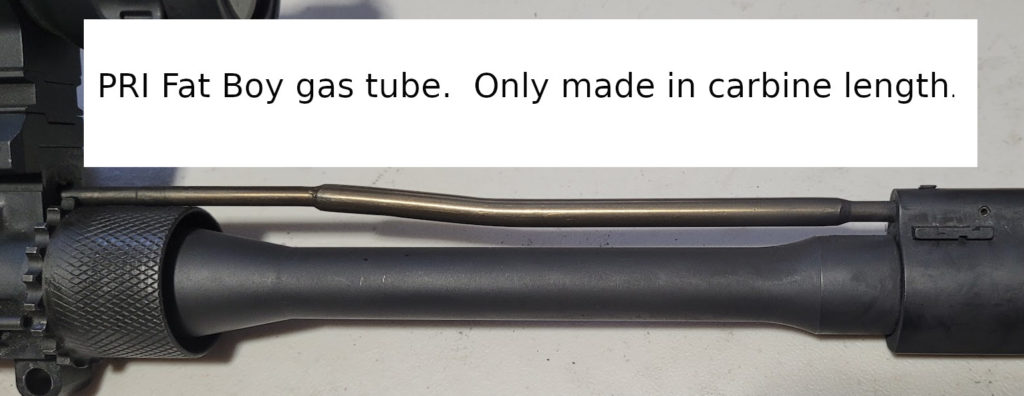  M16 Ultimax |

|
Quoted: Yup if you are the least bit handy with a tap or electric drill, it is pretty easy to fit a vented set screw inside your gasblock gas port. Then you can tune your gas to run with any buffer or suppressor. I keep my buffer standard weight and spring, then open up the gas till it locks back. When suppressed all the time, the .050" standard hole in the setscrew is mostly what I use. Works with carbine and midlength gas lengths. Haven't messed with rifle length much to know if it will need to be opened up. |
|
Your hypothesis seems spot on. I tried various methods of restricting gas to reduce recoil on a couple of A1 barrels. The idea was that I wanted to make them as pleasant to shoot as possible for my young daughters. The adjustable blocks were finicky and seem to be much more ammunition sensitive than was reasonable. Next, I tried BRT‘s restricted gas tube. The recoil seemed excessive. I mean, it wasn’t violent or painful, it just seemed like the BCG was moving much faster than it should. More about it below. Then I tried one of the gas tubes with a set screw adjustment. Can’t remember the name but seemed to recall they made a second generation that worked better. The one I had was wildly inconsistent, even with an Allen key inserted and taped to the hand guard, or the crown around the set screw crimped ensuring it didn’t move. Finally, I plugged and re-drilled a hole in the FSB smaller than recommended on any of the tables I found online. .061 iirc. I didn’t write it down and cannot remember 100%. With the full ID tube it would barely but 100% reliably activate the bolt catch when single rounds were fired. I haven’t tried any steel case ammo but with many different brass cased loads it works great. All of this was done with the JP lightweight bolt carrier. It has been clean, well lubricated and broken in. I haven’t fired many high end ARs but the smoothness of that JP bolt and efficiency of the gas rings as well above any other I’ve tried. It’s super smooth with almost no friction. I finally settled on one configuration and it is by far my favorite AR. Just an old Frankengun but it shoots like a loud pellet rifle. Sadly, with that JP bolt there is no M-16 cut available and I don’t think it would have the energy to operate any of the FRT’s on the market. It’s always been run with the stiffest spring on the JP silent capture system. |
|
Quoted: What tap are you all using? I tried tapping one of mine for a vented set screw and the tap doesn't go far enough in to be able to thread the hole. I ground down the tip so it will thread deeper into the gastube tunnel. Once the threads go through, you can secure a 1/8" setscrew in the gap and not have to file anything sticking out into the barrel channel. Mine actually lock the gas tube in so the small roll pin is unnecessary at that point. Once less point of gas leaking by. You also have to grind off some of the rear threads on the tap so that the tap clears the bottom threads for the barrel securring setscrew. |
|
I agree. People argue about different components and gadgets to reduce gas, but why not just do it at the very first step which is the port itself? There are some nicely tuned GP barrels that run well with suppressors. Issues can be that if you do not have a can, or use really bad ammo, or if it gets -20 degrees, the rifle won't work well. I talked to Sprinco's CEO a while back about his methods. They have built a business down the operating line to use stringer springs to optimize the AR. I also called LMT. They want light springs, light buffers, large gas ports, carbon gas systems (generally) to make their rifles work in the widest array of circumstances possible. Me? I prefer a nicely tuned AR starting with proper gas port sizes for how I intend to use the rifle. |
|
Quoted: What tap are you all using? I tried tapping one of mine for a vented set screw and the tap doesn't go far enough in to be able to thread the hole. https://www.mcmaster.com/2662A46/ |
Not sure but I need figure it out, and a bit off topic.  On a whim I picked up a KAK 11.5 mid length suppressor only barrel, put the Polonium on it (which is gassy in it's own) but it is gassier then I thought it would be compared to the 13.7 I had it on. Shoots great though I will say. The 13.7 had an adjustable block on it and it still was gassy but not bad. Thing with the KAK supposedly you should not change the block or tube, not sure why other then that is the way they built it. Or may try the bootleg BCG or the low gas charging handle. I know KAK I believe has a down vent type BCG as well. Any thoughts out there? |
|
Quoted: However, as some of you may know I am the inventor of the MicroMOA Govnah adjustable gas block which Griffin Armament bought the patents for: https://www.ar15.com/forums/Armory/Griffin-Armament-Adjustable-gas-block/20-559222/ Like my old Govnah, the Griffin is port based so you know exactly how large the port size is. I don't make a penny off their sales but that is what I would get today if I wanted adjustable. Here is a link to my site regarding tuning 556: https://c3junkie.com/?page_id=1403 When it comes to suppressed, I personally think reducing the port size should be combined with a large volume gas tube. This increases the dwell time so that the cyclic rate is so slow that allows more time for the gas to go out the can vs in the action or your face. https://c3junkie.com/wp-content/uploads/2023/06/PRI-FatBoy-1024x396.jpg  https://www.youtube.com/watch?v=Y5pMVJX4FZw https://www.youtube.com/watch?v=n-J8QOXua2M https://www.youtube.com/watch?v=Y5pMVJX4FZw https://www.youtube.com/watch?v=n-J8QOXua2MDid you change your user name? I remember someone used to post & I knew he was the Govnah guy, I didn't know that was you. |
|
Quoted: Quoted: What tap are you all using? I tried tapping one of mine for a vented set screw and the tap doesn't go far enough in to be able to thread the hole. https://www.mcmaster.com/2662A46/ |
|
Quoted: Yeah, the one I linked to works great. I just use a drop of cutting oil and screw in, screw out, and repeat until it's deep enough then blow it out with compressed air. |
|
Quoted: Not sure but I need figure it out, and a bit off topic. On a whim I picked up a KAK 11.5 mid length suppressor only barrel, put the Polonium on it (which is gassy in it's own) but it is gassier then I thought it would be compared to the 13.7 I had it on. Shoots great though I will say. Quoted: Not sure but I need figure it out, and a bit off topic. On a whim I picked up a KAK 11.5 mid length suppressor only barrel, put the Polonium on it (which is gassy in it's own) but it is gassier then I thought it would be compared to the 13.7 I had it on. Shoots great though I will say. It started to be extremely time consuming to try to determine optimal port sizes for customers. Almost like you had to do a questionnaire. What can? What ammo? What buffer? What spring? With more low back pressure options today, the variables are even greater. If I were KAK, I'd get the lowest back pressure can and determine what port works with that and port all the barrels for that so I don't have to deal with returns. Thing with the KAK supposedly you should not change the block or tube, not sure why other then that is the way they built it. Or may try the bootleg BCG or the low gas charging handle. I know KAK I believe has a down vent type BCG as well. Any thoughts out there? I'm not sure what you mean by that. If you want to go dedicated with that 11.5 Mid KAK barrel, I would probably get a YHM suppressor gas block which as I posted above, the 'current' ones are ported at .063 the last time I checked. On my 11.5" Mid pictured below, I'm using an old MicroMOA FJ Federson hybrid polygonal barrel that but I'm also using a custom large volume gas tube which will require a larger port that I'm sure you don't have. I also don't know anything about the buffer, spring or ammo you are using. Do you know what the port size is in your barrel now?  |
|
Quoted: Sweet. Now to decide what to open my set screw to for my 12.5 carbine with Turbo K. Thinking .052 or .055 If it helps any, I ordered a suppressed only tube from BRT for a 10.5 carbine gas with aem5 suppressor (Allegheny Tapered block and extended brake) and they speccd a .052. Runs amazing. You have a little more dwell time but a lower back pressure can. |
|
Quoted: If it helps any, I ordered a suppressed only tube from BRT for a 10.5 carbine gas with aem5 suppressor (Allegheny Tapered block and extended brake) and they speccd a .052. Runs amazing. You have a little more dwell time but a lower back pressure can. |
|
Quoted: However, as some of you may know I am the inventor of the MicroMOA Govnah adjustable gas block which Griffin Armament bought the patents for: https://www.ar15.com/forums/Armory/Griffin-Armament-Adjustable-gas-block/20-559222/ Like my old Govnah, the Griffin is port based so you know exactly how large the port size is. I don't make a penny off their sales but that is what I would get today if I wanted adjustable. Here is a link to my site regarding tuning 556: https://c3junkie.com/?page_id=1403 When it comes to suppressed, I personally think reducing the port size should be combined with a large volume gas tube. This increases the dwell time so that the cyclic rate is so slow that allows more time for the gas to go out the can vs in the action or your face. https://c3junkie.com/wp-content/uploads/2023/06/PRI-FatBoy-1024x396.jpg https://www.youtube.com/watch?v=Y5pMVJX4FZw https://www.youtube.com/watch?v=n-J8QOXua2MI have the complete MicroMOA suppressor ready 12.5 mid upper with the Govnah. Works great. I also have Adam Arms 11.5 uppers with a 3 position dial, normal, suppressed, no gas. Also works great. |
|
Quoted: I've seen all the various methods being employed to regulate gas pressure from the barrel to the BCG. Adjustable blocks, different ID tubes, adjustable keys etc. Of course when it comes to the overall operating system, we have different system lengths, different mass carriers, various buffer springs, buffer weights etc. I'm thinking mainly of controlling the gas. I can't get it outta my head that doing this at the port where it first leaves the bore is the best way. Simply sending whatever excess gas there may be out the muzzle before it even reaches any other part of the rifle just strikes me as the way to go. Why would I want to have to deal with it any further into the cycle than that if I don't have to? I suppose this is an indirect argument for adjustable gas blocks. Although reducing the ID of the tube accomplishes pretty much the same thing without the adjustability. This is not a declaration of dogma. I'm willing to be talked out of it if presented with convincing arguments to the contrary. I thought it might be an interesting discussion. EDIT: I should have specified this when I posted it, but my premise assumes that the existing gas rate is already not ideal. SOMEthing needs to change. It really depends. There are three major variables at the piston that must have the correct values in order for it to work: the right pressure, the right temperature, and the correct mass flow. At the gas port you can reduce the port diameter, and by throttling the flow reduce pressure, but this will also reduce the mass flow, as well as cool the gas. With the gas tube, if you increase passage diameter, you increase the system volume. This will reduce the temperature, reduce the pressure, and not interfere with the flow. By having a heavier reciprocating mass, you have reserve energy, in case of dirt, or other fouling. Saying you only should tune an AR is with the gas port, is like saying the only way to New York is driving up Interstate-95. Yes, it is a direct route, but it is by no means the only way, and you may want some of the possible differences another route might bring. |
|
Quoted: What is the ideal gas port for a dedicated 16 inch mid length suppressed? I’ve been looking at Griffin’s adjustable gas disc chart as a reference point (it’s on their product page for the gas block). It gives two port options and includes LBP and conventional measurements. |
|
Quoted: I've been looking at Griffin's adjustable gas disc chart as a reference point (it's on their product page for the gas block). It gives two port options and includes LBP and conventional measurements. Attached File |
| When building AR's I used to think adjustable gas blocks were a good idea. Then I realized that once set up, I have never adjusted any of them or changed them regardless of which ammo I use. So the last couple just got regular gas blocks, and from the performance of the different rifles, I can't tell the difference. Changing the weight of the recoil buffers DOES make a difference though, so I just bought a number of the heavy buffer weights and a stamping set so I can put as many heavy weights as I want into a recoil buffer than I stamp H, H-1, H-2 or H-3 on the face of the recoil buffer. |
|
Quoted: It really depends. There are three major variables at the piston that must have the correct values in order for it to work: the right pressure, the right temperature, and the correct mass flow. At the gas port you can reduce the port diameter, and by throttling the flow reduce pressure, but this will also reduce the mass flow, as well as cool the gas. With the gas tube, if you increase passage diameter, you increase the system volume. This will reduce the temperature, reduce the pressure, and not interfere with the flow. By having a heavier reciprocating mass, you have reserve energy, in case of dirt, or other fouling. Saying you only should tune an AR is with the gas port, is like saying the only way to New York is driving up Interstate-95. Yes, it is a direct route, but it is by no means the only way, and you may want some of the possible differences another route might bring. Some stuff to think about in here that I hadn't considered. A couple quick points for now. I wasn't suggesting that controlling the gas at the port was the only legit way, to be clear. It was more of an Occam's razor-ish train of thought. Why complicate things any further than that if it already works? Like I say, you brought up a couple points I hadn't thought of. |
|
I agree. My home defense 12.5" has a Centurion barrel with an undersized gas port. It's shot suppressed and has been 100% reliable and not over gassed. I love my Superlative adjustable gas block on my 12.5" Grendel for hunting, but prefer KISS for anything intended for "social" use instead of fun. |
|
This has been one of the only worthwhile discussion topics presented in quite a while. One would hope the forums would regain the amount of traffic they once had and the tech knowledge would return. I couldn't agree more with the OP as an individual especially since I know exactly the type of ammo I handload and can estimate pressure levels of loaded ammo. Those looking for a wider operating envelope may have a different opinion |
|
I have used nothing, BRT gas tubes, and own or have helped install/use several adjustable gas block. Taming gas down - even on unsuppressed guns - makes a noticeable difference and is worth doing, especially when manufactures are hogging out gas ports. The BRT gas tubes work well and are great if you don't need any adjustment and don't feel like installing a new gas block. The YHM suppressor gas block is also clever but it is a .0625 port now for what it's worth. I really like the Aero AGB. The design keeps everything within the same footprint of the OEM and after years of using 3 of them suppressed and non-suppressed - no issues carbon locking etc. I don't tend to adjust them but I like having the option if needed. I keep an extra Allen key in all my pistol grips with batteries, etc. I helped a friend install a RifleSpeed and we shot it over a long weekend and I wasn't super impressed. It adds ~ 3 oz over standard block, costs a lot more, and adjustments felt a bit gritty - but toolless adjustment is nice. |
|
Quoted: The answer is, and always will be, the proper sized gas port is the only thing that isn't a band aid. With all due respect sir, that's an assertion. Not an argument. Honestly, I don't understand some folks aversion to adjustable gas blocks. In at least some circumstances they make all the sense in the world to me and in no common circumstance that I can think of are they actually a detriment to anything. All the potential problems I hear as arguments against them seem to be much more hypothetical than real. With an occasional, but easily avoidable case of carbon lock being the rare exception. Aside from being a bit more expensive, there is no actual downside. Worst case scenario is that somebody finds their sweet spot and never changes it after that. However even then, that sweet spot might only be readily available because of the easy adjustablity of the gas block in the first place. Just my 2 cents. |
|
Quoted: I really like the Aero AGB. The only one I have is an Aero. It's several years old and is on it's third barrel. No complaints whatsoever. I had the foresight to put a little Lucas Red n Tacky on the adjustment needle when I got it and it's never locked on me at all. Every once in a while if I think of it, I take it apart, clean it out and refresh the little dab of Lucas Red N Tacky. That does mute the "clickiness" a bit, but the adjustments are still easily discernible. It probably doesn't even need the cleaning, but I just do it... because... why not? I have a spare adjustment needle, ball bearing detent and spring for it just n case. Nothing earth shattering. It just does what it's supposed to do. It allows me to increase or decrease the gas at the port using an allen key, with 15 (I think it's 15) clickable adjustments. No need to remove the handguard. What's not to like? 
|
|
Quoted: @Nobody69s thanks! Got it ordered. I remember looking at that after discovering my issues and wondering if it would get deep enough. Quoted: Quoted: Quoted: What tap are you all using? I tried tapping one of mine for a vented set screw and the tap doesn't go far enough in to be able to thread the hole. https://www.mcmaster.com/2662A46/  
|
| Gotta use lots of lube on the tap and go slow. I use an electric drill with the gasblock in a vice. I only use phosphate gas blocks. That one looks like nitrate. You would probably have to hit the inside of the hole with a grinding dremel bit to take the surface hardening off. Then run the tap through. Either way that sucks. |
|
Theres nothing wrong with adjustable gas. I tune all of rifles and they run 100%. Superlative is my go to usually. Some have cans on them 24/7. Only gun i dont have an agb on is my 300 blackout, it has a bootleg carrier, which is easier to switch when swapping sub and supers. Itll run both wide open but there is about a 25k psi pressure difference between the two. Which obviously beats the gun up a little bit with supers. I just tune that out. |
| I’ve had good luck with the Bootleg BCG as well as the old Gemtech BCG. Both do an adequate job of controlling the gas. Once upon a time there was an adjustable gas block called the Govnah. It worked alright, and had a sliding plate with different gas port sizes to manage the gas. It was a pain in the ass to adjust under the rail so I abandoned it. I also had a Noveske Switchblock at one point in time. It was alright, but was a total bitch to switch back and forth between settings. I abandoned that as well. This probably won’t sway you one way or the other, just my experiences. |
 Failed To Load Title Here’s the Griffin in action. Extremely simple and foolproof design, but you obviously give up some of the adjustability of other options, though those are typically more prone to seizing. Not really anything to go wrong here! |
|
Quoted: https://www.youtube.com/watch?v=4BY80fKKXpEHere's the Griffin in action. Extremely simple and foolproof design, but you obviously give up some of the adjustability of other options, though those are typically more prone to seizing. Not really anything to go wrong here! . I should have bought a third Griffin during the sale.
|
| A guy joined snipershide just to vent his gripes about the griffin quick adjust gasblock. Seemed like the detent that keeps the disc from turning was allowing the disc to turn during shooting. Gas leaks were an issue and the pin that holds the disc in should have been threaded so that when you pull the small setscrew, the pin would be attached. In order to change the discs now, it is much harder to get the pin out that holds the disc. |
|
Quoted: A guy joined snipershide just to vent his gripes about the griffin quick adjust gasblock. Seemed like the detent that keeps the disc from turning was allowing the disc to turn during shooting. Gas leaks were an issue and the pin that holds the disc in should have been threaded so that when you pull the small setscrew, the pin would be attached. In order to change the discs now, it is much harder to get the pin out that holds the disc. |
|
Quoted: A guy joined snipershide just to vent his gripes about the griffin quick adjust gasblock. Seemed like the detent that keeps the disc from turning was allowing the disc to turn during shooting. Gas leaks were an issue and the pin that holds the disc in should have been threaded so that when you pull the small setscrew, the pin would be attached. In order to change the discs now, it is much harder to get the pin out that holds the disc. |
|
Had issues at a run and gun durring the cold weather. I was using a 12.5 midlength gas with YHM Turbo3. It was under 30* for the morning and had several failure to pick up the next round malfunctions. I currently use a vented set screw gasblock with a .055" sized vent. The buffer was 2 steel 1 aluminum weights and durring testing and zeroing check, only had one fail to feed. Thought it was just a fluke. Have since opened up the setscrew to .061" to see if it locks back in colder weather and standard weight carbine buffer. As the day warmed up it shot fine so above 30* all worked fine with no gas to face. Something to think about when running so lean. |
|
Quoted: With all due respect sir, that's an assertion. Not an argument. Honestly, I don't understand some folks aversion to adjustable gas blocks. In at least some circumstances they make all the sense in the world to me and in no common circumstance that I can think of are they actually a detriment to anything. All the potential problems I hear as arguments against them seem to be much more hypothetical than real. With an occasional, but easily avoidable case of carbon lock being the rare exception. Aside from being a bit more expensive, there is no actual downside. Worst case scenario is that somebody finds their sweet spot and never changes it after that. However even then, that sweet spot might only be readily available because of the easy adjustablity of the gas block in the first place. Just my 2 cents. I do agree, partially. The are some use cases for adjustable gas blocks. I currently have guns with adjustable gas blocks that are ten plus years old and have north of 10,000 rounds on them. I probably have more experience that I should have with adjustable gas blocks. Most of them good, but some of them bad. At one point in time I was 100% set on the SLR Adjustable gas blocks. Literally to the point where I spent thousands of dollars converting all my guns to SLR Adjustable gas blocks. My theory was make sure the gas port was big enough to run any ammunition I wanted to, then choke it down with the adjustable block. In a perfect world, that is what everyone should do to ensure the gun will run anything you throw at it and any weather condition. All was fine and dandy until I started to have failures across multiple rifles. The issue was SLR had an problem with the metallurgy of the stamped flat spring that vented the gas. Basically, after only a few rounds, the part would deform and basically act like it was open, so the gun would become under gassed. Not really an ideal situation to have when you drove a full day to compete in a match and BOTH of your guns go down. God forbid you get into a gun fight and you've got a single shot rifle. After that, I switch to Superlative Arms on all my fun guns. I have had really good success with them when maintained properly. Adjustable gas blocks require more maintenance and there are more parts in the system that can fail. The more amount of single point failures a system has, the less reliable it becomes. People always forget that a rifle is a sum of all parts. There aren't many parts in the gas system that can fail and the rifle will keep running as designed. So why add another point of failure? Notice how I said funs guns above. I use the word funs guns because they are guns meant to mess around with at the range. They put a smile on your face when you shoot them. Ideally they make it easy to blast off supers then switch to subs or lessen the recoil while you're taking your girlfriend to the range. Adjustable gas blocks DO have a place, but they are not for guns that could cost you time, money, or your even your life. A gas port should be drilled around the specific ammunition you want to shoot, your elements, and what suppressor you're using. After you've got that all figured out, build another one if you want to do something different. |
|
Quoted: I suppose the real question is what sort of problems you’re experiencing? Sometimes problems that appear to be over gassing is actually under gassed. To be clear, I wasn't having any problems. The original post was just something that's been rumbling around my noggin for a long time and I thought I'd throw it open for discussion. |
[ARCHIVED THREAD] - Controlliong Gas At The Port Is Best? Feel Free To Talk Me Out Of It. (Page 1 of 2)
AR Sponsor
Join the Community
Your next conversation starts here.
Create your free account to join discussions, share your experience, save topics, and connect with the AR15.COM community.
- Join discussions
- Follow topics and replies
- Connect with fellow enthusiasts
Already a member? Sign in
Stay informed by subscribing to our Newsletter